
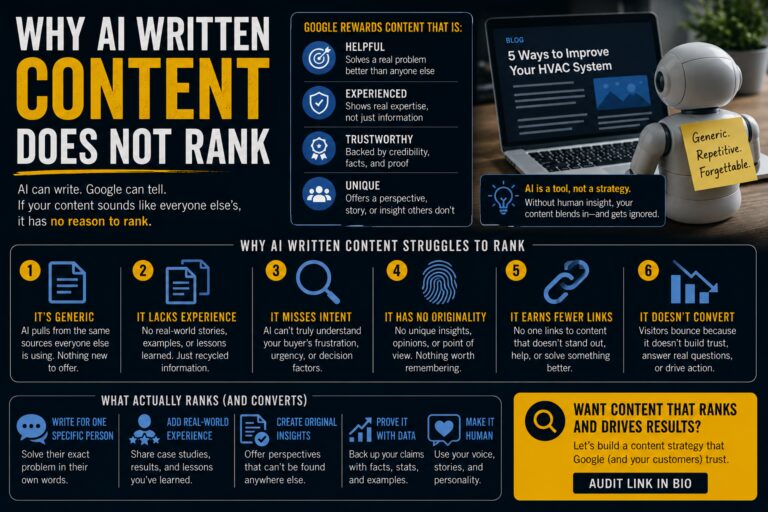
Is Google penalizing AI content?
Not for being AI generated. Google has been explicit that it evaluates content quality rather than production method.
That statement gets misread constantly in both directions. It does not mean AI content is fine. It means the penalty is not aimed at authorship, it is aimed at the characteristics that mass produced content tends to have.
Thin, unoriginal, unhelpful content has always underperformed. AI made it dramatically cheaper to produce at volume, which is why the problem became visible all at once.
There is also a measurable performance gap worth knowing about. Analysis of content performance has found human written content pulling substantially more traffic than AI generated content, on the order of several times more. That gap is not a penalty. It is what happens when content has nothing distinctive in it.
So the honest framing is this. Nobody is punishing you for using AI. The market is just not rewarding output that says nothing.
Reason 1: Nobody picked a keyword first
This is the most common failure and it has nothing to do with AI. AI just made it happen forty times a month instead of twice.
A prompt like write a blog post about HVAC maintenance produces a post about HVAC maintenance generally. It targets nothing specific. Ask for ten such posts and you get ten pages competing against each other for overlapping terms, which is a problem called cannibalization.
Google now has to choose which of your ten pages is the best answer for the same query. It picks one, usually not the one you would have picked, and the other nine dilute your site rather than strengthening it.
The fix is upstream of the writing. One keyword per post, decided before a word is written, mapped against every other post so no two overlap. This is thirty minutes of planning that determines whether the next thirty hours of production is worth anything.
Everything downstream is easier once this is done, including the AI prompting, because you can tell the model exactly what question the page answers.
Reason 2: There is no point of view
A language model generates the statistically likely continuation of text on a topic. That is the average of what has been published.
The average is not wrong. It is just not distinctive, and distinctive is the entire currency here.
When an engine has fifty pages saying regular HVAC maintenance extends system life and one page saying most maintenance plans are sold wrong and here is what to check before you buy one, it has a reason to select the second.
Having a point of view means being willing to say something a competitor would not put in writing. That is uncomfortable, which is exactly why it is defensible.
AI cannot generate this for you because it does not have one. It can articulate yours if you supply it, which is a genuinely useful thing and a completely different workflow than asking it what to think.
Reason 3: There is no first hand experience in it
Google weights demonstrated experience heavily, and so do the answer engines when selecting sources.
AI cannot fabricate a job you did. It can describe a generic furnace repair. It cannot describe the one in Simpsonville where the previous contractor had wired the thermostat backwards and the homeowner had been paying for it for two winters.
That specificity does three things at once. It signals real expertise. It is unquotable by competitors. And it makes the page useful in a way a summary of the topic is not.
This is the reason our posts carry named numbers from real accounts, anonymized by industry. A compliance focused MSP that cut cost per lead by 45 percent while raising qualified leads 120 to 150 percent in ninety days. An HVAC company whose organic traffic climbed 53.7 percent in a month. A deck builder at position one with 32 direction requests in month one.
No model can produce those sentences without access to the underlying accounts. That is the point.
Reason 4: There is no structure
Raw AI output tends toward a recognizable shape. A general introduction, several evenly weighted sections, a summarizing conclusion that restates everything.
That shape is close to the opposite of what performs.
What is missing: an answer block in the opening hundred words, headings written as real buyer questions, sections short enough to survive extraction, FAQ blocks with schema, and internal links to the rest of the site.
The conclusion in particular is dead weight. Nobody reads it, no engine lifts it, and it exists because the format expects it.
Structure is where AI drafts are most easily rescued, because restructuring is mechanical work. The keyword and the experience have to come from you. The structure can be imposed afterward in twenty minutes.
How should you actually use AI for content?
As a drafting tool inside a process that has a strategist at both ends.
Before the draft, you decide the keyword, the specific question the page answers, the point of view, and which real result or experience anchors it. This is the part that determines whether the post is worth publishing and it cannot be delegated to the model.
During the draft, AI is legitimately useful. It produces structure quickly, generates variations, and gets you past the empty page. Give it the keyword, the question, your point of view, and your real example, and it will produce a serviceable draft in a fraction of the time.
After the draft, you rewrite the opening into a real answer block, insert the specifics only you have, cut the conclusion, fix the headings into questions, add the FAQ block and schema, and add internal links.
That workflow produces good content faster than writing from scratch. What it does not do is remove the person who knows what they are doing, which is the promise being sold and the reason those forty post packages fail.
What does a good AI prompt for content actually contain?
If you are going to use AI, the prompt is where the strategy lives. A weak prompt guarantees a weak draft no matter how capable the model is.
Five things belong in it. The exact keyword the page targets. The specific question the page answers, written as a buyer would ask it. Who the reader is, in concrete terms rather than a persona label. The point of view the piece argues for. And at least one real example or number from your own work.
Then constraints. Answer first in the opening hundred words, headings written as questions, short sections, no concluding summary.
Compare that to write a blog post about HVAC maintenance and it becomes obvious why the output differs so much. The model is not the variable. The input is.
Even with a strong prompt, the real example still has to come from you and the final structure still needs a pass. There is no version of this where nobody who understands search touches the page.
What does forty posts a quarter actually cost you?
More than the invoice.
You get keyword cannibalization across your own site. You get a domain increasingly composed of pages that produce nothing, which affects how the whole site is evaluated. You get an internal narrative that content marketing does not work, which is expensive because it makes the next attempt harder to fund.
And you get an opportunity cost that is hard to see. Eight genuinely good posts, each targeting a real keyword with a real result in it, would have outperformed the forty by a wide margin and taken less total time to produce.
Volume was never the constraint in content marketing. Having something worth saying was.
There is one more cost that shows up later. Once a site is full of undifferentiated content, cleaning it up is harder than never publishing it. You have to decide which pages to keep, which to merge, and which to remove and redirect, and every one of those decisions carries risk to whatever rankings do exist.
Publishing less is reversible. Publishing forty thin posts a quarter creates a cleanup project that someone will be paid to untangle.
Frequently asked questions
Will Google penalize my site for using AI to write posts?
Not for using AI itself. Google evaluates whether content is helpful, original, and demonstrates experience. AI drafts that are edited to include real expertise and specifics perform fine. Unedited output at volume performs badly because it lacks those qualities.
How much editing does an AI draft actually need?
Expect to rewrite the opening entirely, insert your real examples and numbers, convert headings into buyer questions, cut the conclusion, and add an FAQ block with schema. Roughly a third of the words change and all of the strategy comes from you.