What changed about search?
A large share of queries now get answered before anyone clicks anything.
AI Overviews sit above the organic results. ChatGPT Search, Perplexity, and Gemini answer conversationally and cite a handful of sources. The ten blue links did not disappear, but for a growing set of queries they moved down the page or stopped being where the decision happens.
Business owners hear this and conclude SEO is dead. It is the opposite of dead. The target moved.
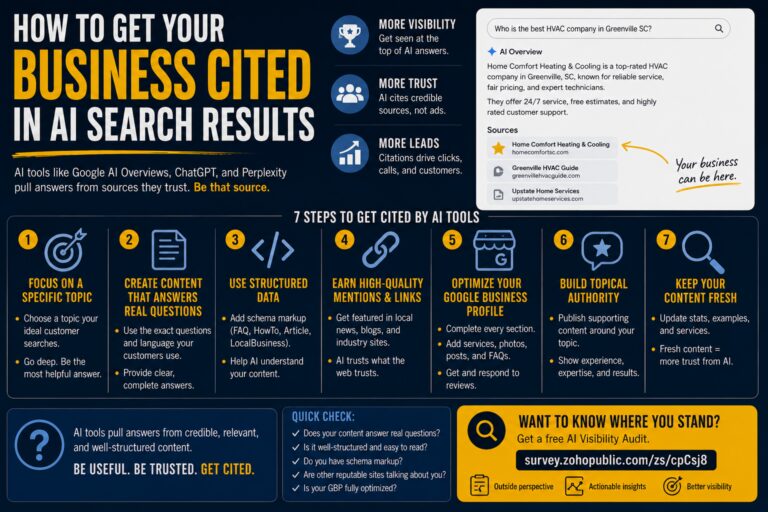
You are no longer only competing to rank. You are competing to be the source the answer gets built from. And a citation in an AI answer arrives with something a normal search result does not have, which is the implicit endorsement of having been selected by the engine.
The mechanics underneath are worth understanding because they explain every recommendation that follows. These systems retrieve chunks of content, not whole pages. They assemble an answer from pieces. So the unit of optimization is no longer the page. It is the extractable section.
What does not change?
More than the panic suggests.
You still have to be indexed. AI engines are not inventing answers from nothing. They pull from pages that exist, are crawlable, and have earned some measure of authority.
You still have to be credible. Sites with first hand experience, real results, and consistent entity signals get selected more often than thin content, for the same reasons they always ranked better.
And local intent still resolves the same way. When someone asks an AI assistant for a good HVAC company in Greenville, the answer draws heavily on the same signals that drive the map pack. Your Google Business Profile did not stop mattering. If anything it matters more, because it is a structured, machine readable statement of who you are and where you work.
The businesses getting cited by AI are overwhelmingly the ones who were already doing the fundamentals well. That is the uncomfortable part for anyone hoping this is a fresh start.
Rule 1: Put the answer in the first hundred words
This is the single highest impact change and most sites fail it immediately.
A page about furnace repair costs should answer what furnace repair costs in the opening block. Directly, in plain language, self contained enough that the paragraph makes sense if someone reads only that paragraph.
What kills it is the warmup. When the temperature drops, homeowners across the Upstate start thinking about their heating systems. That sentence answers nothing, and an engine assembling a response has no reason to lift it.
Set the answer block off visually so it reads as a distinct element. This helps human skimmers and it helps the extraction.
The discipline is harder than it sounds because it requires you to know exactly what question the page answers before you write it. Most pages fail this test not because of formatting but because nobody decided what the page was for.
Rule 2: Write headings as the questions people ask
Answer engines match content to questions. Give them the match.
How much does furnace repair cost in Greenville. How do I know if my furnace needs replacing. Do you charge for estimates. These are headings. Our Services and Why Choose Us are not.
Then answer the question directly in the first sentence under the heading. Do not build up to it. The heading and the sentence beneath it should function as a complete question and answer pair if lifted out of the page entirely, because that is exactly what happens to them.
This also improves the page for humans, which is the recurring theme of everything in this post. Nothing here is a trick played on machines. It is clarity, enforced.
Rule 3: Keep chunks short enough to stand alone
Retrieval systems pull sections. If your section only makes sense in the context of the three sections before it, it does not survive extraction.
Practically this means short paragraphs, tight lists, and self contained sections. It means avoiding pronouns that reach backward across headings, because as noted above stops making sense the moment the chunk is separated from what it referred to.
It also means repeating key entities naturally rather than substituting vague references. If the section is about furnace repair in Greenville, say furnace repair in Greenville rather than this service in the area. Not stuffed. Just consistently named.
There is a real tension here with elegant writing. Good prose flows and references backward. Extractable content is more modular than that. This is a case where the format wins.
Rule 4: Ship structured data on every page
Schema tells machines what your page is instead of making them infer it. Inference is where you lose.
The set that matters for a local service business:
- Organization and LocalBusiness, with areaServed defined. This is your identity statement.
- Service, on every service page, naming the service explicitly.
- FAQPage on every page with an FAQ block. This is the highest leverage schema for AI citations because it hands the engine pre-formed question and answer pairs.
- BreadcrumbList on metro and location pages, which reinforces site hierarchy.
- Article on blog posts, with a real author and real dates.
On WordPress, Rank Math handles most of this without touching code. FAQPage in particular should be on every post that has an FAQ block, which in our standard is every post.
Schema is not a ranking hack. It is a translation layer. You are removing ambiguity for a reader that cannot ask clarifying questions.
Rule 5: Use concrete specifics instead of adjectives
Adjectives get skipped. Numbers and named places get quoted.
Compare two sentences. We deliver results driven marketing for home service businesses. Versus, a Greenville HVAC company saw inbound calls rise 242 percent after a Google Business Profile rebuild with no additional ad spend.
The first is unquotable because it says nothing verifiable. The second is a complete, citable fact with a subject, a number, a mechanism, and a constraint.
This is also the strongest defense against being replaced by AI generated competitors, because a language model can produce infinite variations of the first sentence and cannot produce the second one without access to your actual client data.
Every claim you can make specific, make specific. Name the city. Use the real number. Say what was and was not part of the result.
Rule 6: Include experience nobody else has
First hand experience is weighted heavily by Google and it is the differentiator that survives everything else.
This means the job that went sideways and what you learned from it. The thing customers always get wrong. The specific number from a specific project. The opinion you hold that your competitors would not put in writing.
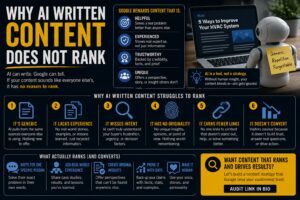
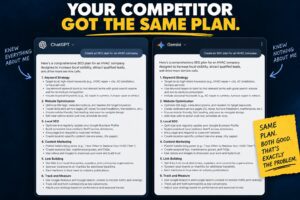
AI systems produce the average of what has already been published on a topic. The average, by definition, is not distinctive, and distinctive is what gets selected when an engine has ten sources saying the same thing and one saying something specific.
This is also the part of your content that cannot be commoditized. Structure can be copied. Schema can be copied. A decade of doing the work in a specific market cannot be.
Should you add an llms.txt file?
It is low effort and worth doing once your key pages are solid, but treat it as marginal rather than foundational.
An llms.txt file at your site root points AI crawlers toward your most important pages, similar in spirit to a sitemap. Adoption across engines is still uneven and it is not a substitute for anything above.
Add it after the six rules are actually implemented. A perfectly formatted pointer to badly structured pages does not help.
One practical note on measurement. Traffic from AI answers frequently does not attribute cleanly in analytics, and referral data from these engines is inconsistent. That means the standard reporting will understate the effect, and you may see brand searches and direct traffic rise without an obvious source.
Watch for that pattern. A climb in branded search volume alongside flat non branded traffic often means people are finding you in an AI answer and then looking you up by name.
Frequently asked questions
Does optimizing for AI search hurt traditional Google rankings?
No. Every recommendation here also improves traditional rankings: clear answers, question based headings, structured data, and first hand experience are all long standing ranking factors. You are executing the same fundamentals for a second audience, not choosing between them.
How do I know if AI engines are citing my business?
Ask them directly. Query ChatGPT, Perplexity, and Google AI Overviews with the questions your buyers ask, using your city, and see which sources get named. Repeat monthly. There is no mature tracking tool for this yet, so manual checking is the reliable method.