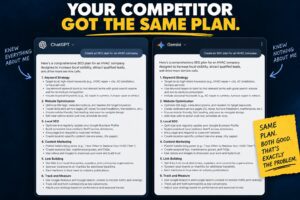
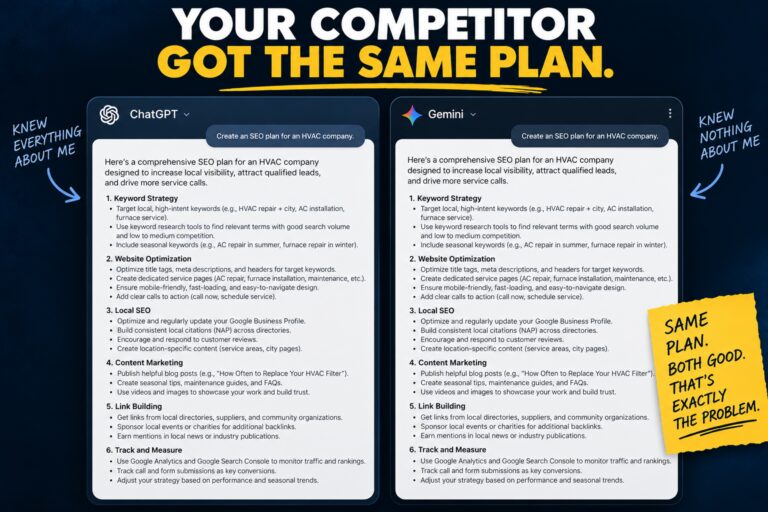
I asked two different AI tools for an SEO plan for an HVAC company. One account had months of context about me and my work. The other was cold. No history, different model, nothing.
The plans came back nearly identical. Same service pages. Same four cities. Same article titles. Same warning about thin location pages. Same 90-day sequence. Same closing advice about measuring revenue instead of traffic.
Both plans were good. That’s the part worth sitting with. A correct strategy that anyone in your market can get free in nine seconds isn’t a strategy. It’s a starting line.
Were the AI plans actually any good?
Yes. Genuinely.
I went in expecting to catch them being wrong: keyword density targets, word count minimums, the usual myths. That’s not what came back.
Both plans led with high-intent keywords instead of chasing search volume. Both built dedicated pages per service instead of one catch-all “HVAC Services” page. Both treated Google Business Profile as its own channel with its own work. Both laid out a review request process tied to job completion. Both said to prioritize real local relationships over buying batches of backlinks. Both told me to measure booked jobs and revenue, not rankings.
One of them said, word for word: “Do not make 30 nearly identical pages with the city name swapped.”
The other said: “Don’t create dozens of thin location pages just to target city names.”
That’s the mistake I spend the most time undoing for clients. Both flagged it unprompted.
So let’s settle this before going further: the accuracy isn’t the problem. If you were waiting for the part where I catch AI being stupid, it isn’t coming. The plans were better than a lot of paid proposals I’ve read.
So what’s actually wrong?
They’re the same plan.
Not similar. The same. Here’s what both produced independently:
- The same service page list: AC repair, AC installation, AC maintenance, furnace repair, furnace installation, heat pump, indoor air quality, commercial
- The same four Upstate cities for location pages
- The same warning against thin city pages
- The same GBP checklist: categories, services, service areas, photos, hours, review responses
- The same review request flow, triggered at job completion
- The same article titles: Why is my AC blowing warm air. Repair or replace. How much does replacement cost. How long does a system last. What size do I need.
- The same conversion list: tap to call, request service, financing, licensing, trust signals
- The same authority plan: chambers, sponsorships, manufacturer listings, local contractors
- The same technical list: indexing, speed, sitemap, canonicals, schema, internal links
- The same metrics: GBP calls, form fills, booked jobs, revenue from organic
- The same phased rollout across 90 days
One of those plans came from an account that has been talking about local SEO for months. The other came from nothing.
Your competitor typed nine words and got your strategy.
That’s not a hypothetical. Two of you can run that prompt tonight and compare notes tomorrow.
Why do the plans come out identical?
Because they learned from the same place.
AI didn’t invent this advice. It absorbed the public documentation on how search works, a large share of it Google’s own SEO Starter Guide, which is free, has been sitting at developers.google.com for years, and which almost no business owner has read.
The convergence isn’t a bug. It’s the mechanism. Ask a hundred models a hundred times and you’ll get the same document, because there’s one body of public guidance underneath all of it.
Which means the “strategy” you were sold, whether by AI or by an agency charging four figures for a deck, is largely the public manual, reformatted.
That’s worth knowing before you pay for it again.
What can’t be in any AI plan?
Three things. None of them optional.
Your actual site
Neither plan looked at a single URL.
Neither knows whether your existing pages are indexed, what you already rank for, whether your GBP is verified or duplicated, or who currently holds the map pack in your city. Every step is conditional on findings nobody gathered.
The cold-account version was honest about it. It closed by asking for the company name, city, website and service areas, because without those it was prescribing from “HVAC company” in the abstract.
That’s the gap. Not accuracy. Applicability.
Execution
Between the two plans there are somewhere north of fifty discrete tasks. “Fix technical SEO” is a heading with fourteen items under it. “Complete technical audit” is a month of work for someone who knows what they’re doing and a wall for someone who doesn’t.
Hand that to an owner with trucks to dispatch and here’s what happens: they do the three easy ones and the rest sits there. Not laziness. The constraint was never information.
Proof only you have
Both plans said to add local photos, real project details and genuine reviews. Neither can produce a single one.
AI can generate the page. It cannot generate the evidence: the job you finished in Simpsonville last Tuesday, the photo of the unit, the review that names the tech and the neighborhood. That’s the one input that’s structurally unavailable to your competitor’s plan, because it isn’t a plan input at all. It’s your business.
So what separates you now?
Not the strategy. Everyone has it.
Who executes it, who knows what’s already true of their site, and who has real proof to put on the page.
That’s a harder sell than “we’ll build you a strategy.” It’s also the only one left that means anything.
How do you check where you stand?
Three things, twenty minutes.
1. Run the prompt. Ask AI for an SEO plan for your business. Then compare it to whatever your agency or freelancer last sent you. If they match, you know what you’re paying for.
2. Check what Google actually has. Search site:yourdomain.com. That’s a rough count of your indexed pages. Rough, because Google has said the operator is an estimate, so open Search Console → Page Indexing for the real number. If you’ve published thirty pages and see nine, every “build more pages” step in that plan is premature.
3. Count your own proof. How many photos on your website did you take? How many reviews name a specific service and a specific town? That number is your actual advantage, and no plan can raise it for you.
Frequently asked questions
Is AI good at SEO now?
At describing strategy, yes. Noticeably better than two years ago, and largely accurate against Google’s current documentation. At applying it to a specific business it has never seen, no. Those are different jobs.
If AI gives good plans, why hire anyone?
Because the plan was never the hard part. Execution, and knowing which four of fifty tasks matter for your site this quarter, is what actually moves calls. That requires looking at the site.
Does that mean SEO advice is worthless now?
Generic advice is. It was always closer to free than people realized. Google publishes most of it. What holds value is diagnosis and delivery.
How do I make my plan different from my competitor’s?
You don’t make the plan different. You make the execution and the proof different. Real photos, real jobs, real reviews, real local detail, and actually finishing the work.
Where did the AI learn all this?
Public documentation, and a lot of it Google’s own SEO Starter Guide. It’s free. This series goes through it page by page, and shows what the AI version leaves out.
Everyone in your market has the same plan. Almost nobody knows what’s true of their own site.
The free SEO audit looks at what yours is actually doing: what’s indexed, what’s ranking, what your Google Business Profile is producing, and comes back with the three things that matter first.
Google guidance quoted from the SEO Starter Guide, developers.google.com, under CC BY 4.0.