Why is more traffic the wrong answer?
Because traffic multiplies whatever your conversion rate already is, including zero.
The pattern we see constantly: an owner notices leads are flat, concludes they need more visibility, and buys ads. Traffic doubles. Leads stay flat. Now they are spending money to prove the same problem twice.
Run the arithmetic on your own numbers. A site getting a thousand monthly visitors at a one percent conversion rate produces ten leads. Doubling traffic gets you to twenty leads and doubles your acquisition cost. Doubling conversion to two percent gets you to the same twenty leads and costs nothing recurring.
The second one also improves every future traffic dollar you spend, because ads pointed at a page that converts perform better than the same ads pointed at a page that does not.
This is why we fix conversion before scaling traffic. Not because traffic does not matter, but because the order changes the economics permanently.
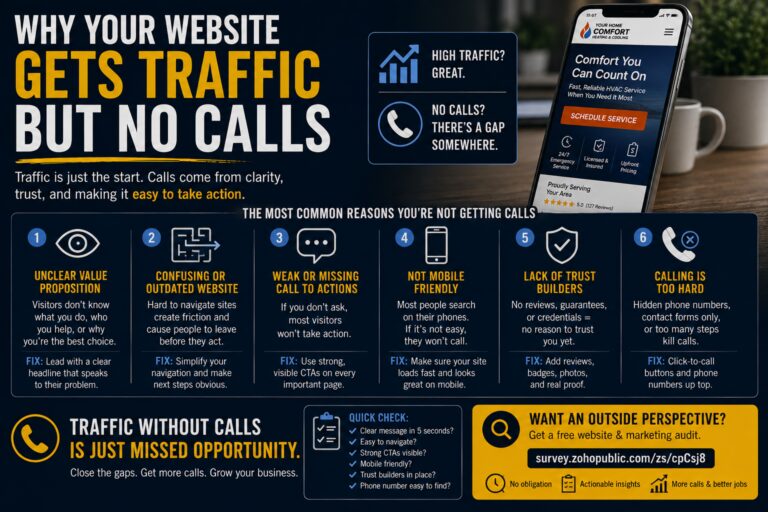
Problem 1: How fast does your site load on a phone?
Turn off wifi and load your site on cellular data. Count the seconds.
Past three seconds you are losing a meaningful share of visitors before anything renders. Most of your traffic arrives on a phone, frequently on an imperfect connection, often standing in a house with an active problem and low patience.
Speed is invisible to owners because you load your own site on office wifi on a desktop where everything is cached. It feels instant. It is not instant for the person who matters.
The usual causes are straightforward. Images uploaded at full camera resolution and never compressed. A page builder loading scripts and stylesheets for features the page does not use. Cheap shared hosting that slows down under load. A stack of plugins nobody has audited in three years.
All three are fixable without a rebuild, and this is typically the cheapest meaningful improvement available on any site we audit.
Problem 2: What does the top of your page say?
Open your busiest service page. Read only the first paragraph.
If it opens with your founding year, your commitment to quality, or your dedication to the community, you are losing people in the first four seconds.
The visitor arrived with a specific problem. They typed it into Google. They landed on your page. The first hundred words have exactly one job, which is to confirm they are in the right place and tell them what happens next.
What belongs there: what you do, where you do it, how pricing works or what a call costs, and how quickly you can be there. Plain language, no warmup.
This matters twice in 2026. A skimming buyer decides in seconds. And AI Overviews, ChatGPT Search, Perplexity, and Gemini lift clean, self contained answers from near the top of pages when they assemble responses. An answer buried in paragraph six does not get quoted by either audience.
The company history is not worthless. It just belongs further down, after the visitor has decided to keep reading.
Problem 3: How much are you asking for?
Count the fields on your contact form.
If a service quote request has twelve fields, that form is a filter, and it is filtering out the people who were ready to act. Every additional field costs you submissions, and the cost is steepest on mobile where typing is genuinely annoying.
Name, phone, and a short description of the problem. That is enough to have a conversation. Everything else can be asked on the call, by a person, which is a better experience anyway.
The objection is always the same: we need the details to qualify. You do not need them at the form. You need them before you dispatch a truck, and those are different moments separated by a phone call you now get to have.
Check the phone number too. On mobile it should be a tap to call link, visible without scrolling, in the header. A number that has to be copied and pasted is a number that does not get dialed.
Problem 4: Is there any proof before the scroll?
People decide fast and they decide on signals.
Somebody landing on your page has never heard of you and is thirty seconds from calling a competitor instead. What tells them you are real and competent, without requiring them to read anything?
- Review count and rating, pulled live or displayed honestly. A hundred and eighty reviews at 4.9 does more work than three paragraphs of copy.
- A specific result or number. Not we deliver quality service. Something concrete a competitor could not copy without lying.
- The towns you serve, named. This confirms you are local, which is the thing they are actually checking.
- Licensing, insurance, and relevant certifications. Table stakes, but their absence is noticed.
- A real photo of real work. Stock imagery signals the opposite of what you want it to.
This costs nothing to add and it is the difference between a page that reads as a business and a page that reads as a template.
How do you know which problem you actually have?
Measure before you guess, because the fix is different depending on where people leave.
Three things to look at. Bounce rate on mobile specifically, separated from desktop, because a high mobile bounce rate with normal desktop numbers points straight at speed. Time on page, because visitors leaving in under fifteen seconds did not read anything, which points at the opening. And form starts versus form completions, because people who begin filling out a form and abandon it are telling you the form is too long.
If your analytics cannot answer those three questions, that is the actual first fix. Every optimization decision after this one depends on being able to see what changed.
Also call your own business from an unknown number sometime this week and see what happens. A meaningful share of the conversion problems we find are not on the website at all. The site produced the call and nobody answered it.
What about the pages people actually land on?
One thing worth checking that owners almost never do: find out which page most of your traffic lands on first.
Owners assume it is the homepage. Frequently it is not. It is a service page, or a location page, or an old blog post that happens to rank for something. Whichever page it is, that page is doing your first impression work and it was probably never designed to.
Every page on your site should be able to function as a landing page, because search decides where people enter, not you. That means every service page needs the phone number, the proof, the service area, and a clear next step. Not just the homepage.
The version of this that costs the most money is a well ranked blog post with no call to action on it at all. Traffic arrives, reads, learns something, and leaves, because nobody put a next step on the page.
What does fixing this actually produce?
It makes every visitor you already have worth more, permanently, and it improves the return on all future traffic spend.
A deck builder in Greenville hit position one for their target keyword in month one and logged 32 direction requests from their Google Business Profile in the same window. Direction requests are the metric worth watching, because nobody pulls up driving directions to a company they are casually researching. That is buying behavior.
That result came from one keyword chosen before anything was written, a service page built to answer the exact question the buyer types, and a profile rebuilt around the same term. Visibility and conversion built together, in the right order, with no ad spend that month.
Visibility that does not convert is a vanity metric. Traffic is only worth what it produces.
The order to fix these in is worth stating, because doing them all at once means you learn nothing about which one mattered. Speed first, since it affects every other measurement. Then the opening of your top three pages. Then the form. Then proof elements. Change one thing, give it two weeks, look at the numbers.
Frequently asked questions
What is a good conversion rate for a service business website?
For local home services, two to five percent of total visitors taking a contact action is a reasonable range, higher on high intent service pages. Below one percent almost always indicates a structural problem rather than a traffic quality problem.
Should I fix conversion or SEO first?
Conversion first, because it produces results immediately and improves the return on every SEO and ad dollar that follows. Fixing conversion on existing traffic is also cheaper than acquiring new traffic to a page that does not work.