Q4 does one of two things to a business. It buries you, or it goes quiet.
Buried means no time. Quiet means no money. Different reasons, same outcome: the work gets pushed to January.
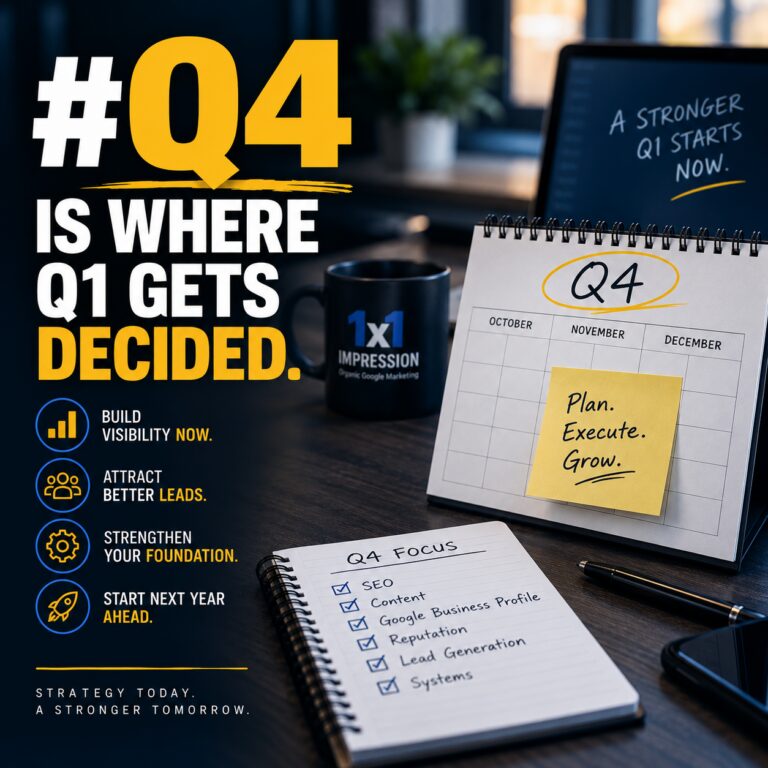
But search doesn’t pay out when you do the work. It pays out months later. Which means Q1 2027 is being decided right now, in October and November and the businesses that own it in January are the ones putting in the work during the exact quarter everyone else uses as an excuse.
Which one is Q4 for you?
If you’re in home services heading into heating season, retail, anything holiday-driven, Q4 buries you. Phones ringing, trucks out, no room to think about a website.
If you’re in B2B, construction, anything discretionary or elective, Q4 goes quiet. Budgets are spent. Decisions slide to next year. Nobody’s signing anything in December.
Two completely different quarters. One identical outcome: nothing gets done.
The busy ones say I’ll deal with it in January. The slow ones say I’ll deal with it when cash comes back.
January arrives. Neither one deals with it.
Why January is already too late
Here’s the part almost nobody accounts for.
Google’s own documentation says it plainly:
“Some changes might take effect in a few hours, others could take several months.”
Read that in October and it’s a scheduling fact. Read it in January and it’s bad news.
You cannot plant in January and harvest in January. Work you start on New Year’s Day starts showing up in March, April, sometimes later. Meanwhile the company that started in October is already ranking when your best month arrives.
Q1 is when the phone is supposed to ring. New budgets. New-year urgency. Tax refunds in home services. Planning season in B2B. Deferred maintenance people finally stop deferring.
That’s harvest season. Harvest season is not planting season.
Everybody’s plan already said this
Here’s what makes it worse.
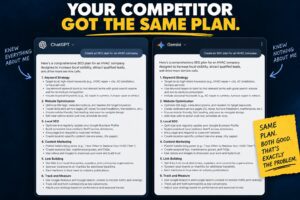
I ran an experiment recently. I asked two different AI tools for an SEO plan for an HVAC company. Both plans had a section on seasonal work. Both said the same thing: build the content before the demand shows up. September and October for heating. March and April for cooling.
The plans knew. They’ve been telling people this all year, free, on demand.
Almost nobody executed it.
That’s the whole story of small business SEO, and it’s the thing I’m going to spend the next few months on.
What I’m doing about it
Starting next week I’m running a series called What AI Didn’t Tell You.
I’m going through Google’s own SEO Starter Guide: the actual documentation, free and public, one page at a time. What Google says. What your AI plan said. What neither one can tell you about your specific site.
It kicks off with something that surprised me: I asked two AI tools for the same SEO plan, one that knew everything about me and one that knew nothing. They gave me the same plan. Both plans were good.
That’s not a compliment or a complaint. It’s the situation. Everybody in your market has the strategy now. What’s left is execution, knowing what’s actually true of your own site, and proof nobody else can generate.
Every post in the series ends with one thing you can check on your own site in five minutes. Fourteen of them by the end. Run them all and you’ll know more about your own visibility than most of the people selling you services.
The honest part
Most of you won’t do this.
You didn’t in Q1. You didn’t in Q2. You didn’t in Q3. The plan has been sitting in a doc since February.
I’m not saying that to be harsh. I’m saying it because it’s the actual opportunity. The field in January is going to be very thin, and whoever spent Q4 doing unglamorous work is going to walk into it alone.
Pick one thing. Do it before Thanksgiving.
Start here, today
Search site:yourdomain.com in Google.
That’s a rough count of how many of your pages Google has actually indexed. For the real number, open Search Console and look at the Page Indexing report.
If you’ve published thirty pages and you’re seeing nine, that’s your Q4. Not more content. Getting Google to find what you already built.
Want to know what your Q4 should be?
The free SEO audit looks at what your site is actually doing right now: what’s indexed, what’s ranking, what your Google Business Profile is producing, and comes back with the three things that matter before January.
Google guidance quoted from the SEO Starter Guide, developers.google.com, under CC BY 4.0.