
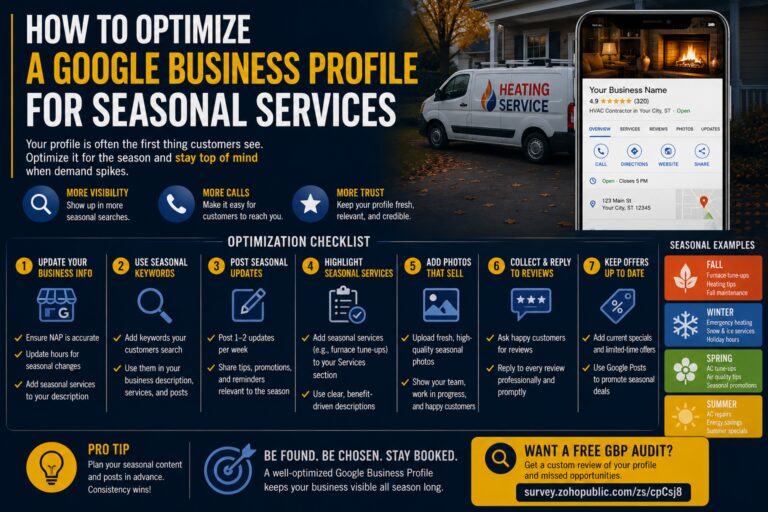
Why does the Google Business Profile matter more than the website?
Because it is what the customer sees first, and often the only thing they see.
A homeowner searching for heating repair on a phone gets a map pack with three listings before any website appears. They see your name, your rating, your review count, your hours, and a call button. A large share of them will tap call from that screen and never visit your site at all.
Which means for a meaningful slice of your customers, your profile is your entire marketing presence.
It is also the fastest thing to fix. Website changes take weeks to be evaluated. Profile changes can shift map pack placement within days. When we audit a local business, the profile is where we look first, because it is where the largest gap between current state and potential state usually sits.
One HVAC company we worked with saw inbound calls climb 242 percent after a profile rebuild. Website clicks from the profile went up 80.8 percent and profile interactions rose 44.3 percent. No additional ad spend, no new website. The demand was already in the market. The profile was blocking it.
How does Google decide who appears in the map pack?
Three factors. Understanding them tells you where to spend effort.
Proximity
How close the searcher is to your business address. You cannot change your address, and this is the factor people obsess over because it feels unfair.
What you can change is what you do with your service areas, which is a separate setting and where most businesses hurt themselves. More on that below.
Relevance
How well your profile matches what was searched. This is almost entirely in your control and it is where most profiles fail.
Categories, service entries, and your business description are what Google reads to decide whether you match furnace repair or just HVAC generally. A vague profile loses to a specific one every time.
Prominence
How established and active you appear. Review count, review velocity, photo activity, post frequency, and mentions of your business elsewhere on the web.
This is why a profile that went silent in April underperforms an identical business that posts weekly. Activity signals that you are operating.
Is your primary category correct?
This is the single highest impact field on the profile and the one most often set wrong.
The mistake is choosing a category that describes how the owner thinks about the business rather than how customers search for it. A company that does furnace repair, AC service, and duct cleaning might set their primary category to Contractor, which is technically true and commercially useless.
Your primary category should match the highest intent, highest value search term for your business. HVAC Contractor. Plumber. Pest Control Service. Deck Builder.
Then add secondary categories for your other real service lines. Do not add categories for services you do not actually perform. Google is reasonably good at catching this and it undermines relevance across everything.
If you have never reviewed this field, go look at it right now. We find it wrong more often than we find it right.
Are your seasonal services listed individually?
This is the seasonal specific fix and it is the one that matters most this month.
Open the services section of your profile. You should see individual entries with individual descriptions. Heating tune up. Furnace repair. Heat pump service. Emergency heating repair. Fall pest treatment. Rodent exclusion.
What most businesses have instead is a business description paragraph that mentions everything and a services section with two generic entries.
Google uses the service list to understand what you offer. A service that is not listed is a service you are not matching searches for. It is that direct.
Each entry gets a short description of a few sentences. Write it the way a customer would describe the problem, not the way a technician would describe the work. Someone searches furnace not turning on, not intermittent ignition failure.
Add your seasonal services now, before demand arrives. Leave them listed year round unless you genuinely stop offering them.
Are your service areas set honestly?
This is where ambition actively hurts you.
The instinct is to claim a wide radius so you show up everywhere. It does the opposite. Claiming a hundred mile radius dilutes your relevance in every one of those places, including your home city where you actually have a chance.
Set service areas to where you actually and regularly work. For an Upstate South Carolina company that might be Greenville, Simpsonville, Mauldin, Greer, Fountain Inn, and Taylors. Not the entire state.
A tight, honest service area with strong signals beats a wide one with diluted signals. You will rank better in fewer places, and those places are where your trucks already go, which is the whole point.
If you want coverage in a city that is genuinely a growth market for you, the answer is a real service page for that city on your website, with real local specifics. Not a service area claim.
How often should you post photos and updates?
Photos: weekly if you can, monthly at minimum. Posts: weekly.
Photos are the easiest signal to produce and the most consistently neglected. Real job site photos taken on a phone. A truck at a house. A technician working. A completed install. They do not need to be polished. They need to be real and recent.
If the most recent photo on your profile is from spring, your listing reads as inactive to both the algorithm and the person deciding who to call.
Profile posts are short and local. Service plus location plus intent plus a clear call to action. Fall tune up season, Greenville and Simpsonville, book before the first cold snap, call button. That is the whole format.
Assign this to whoever is already in the field with a phone. Five photos a week is enough. It does not need a marketing person.
What should you do about reviews?
Build a process, then respond to every single one with intent.
The process part is unglamorous. Asking has to be a step in the job rather than a favor someone remembers. The window is the moment work is finished and the customer is satisfied. A text with the direct review link, sent before leaving the property.
Review velocity matters separately from total count. Forty reviews earned over six years reads differently than forty earned in the last twelve months. One says you existed. The other says you are busy right now.
The response side is where free ranking signal gets wasted daily. Thanks for the review adds nothing. A response that names the service and the city adds a relevance signal and shows the next reader you are paying attention.
Something like: glad we got the furnace running the same day, and thank you for trusting us with the Simpsonville house. That sentence works on three audiences at once.
What about the Q and A section?
Most businesses have never looked at it. It is an open answer surface sitting on your listing.
Anyone can post a question on your profile, and anyone can answer it, including competitors and people with wrong information. An empty Q and A section is an unclaimed asset.
Populate it yourself. Post the five questions customers actually ask, and answer them. Do you offer emergency service. What areas do you cover. Do you charge for estimates. How fast can you get here. Do you service this brand.
These answers show on your listing, they get read by people deciding whether to call, and they are exactly the kind of clean, self contained question and answer pairs that answer engines pick up.
What order should you do all of this in?
Categories first, because everything else is evaluated against them. Then the service list, then service areas, then photos and reviews as ongoing habits rather than projects.
The whole first pass takes under an hour for most businesses. The ongoing part takes about ten minutes a week and it is the part that decides whether any of it holds.
A profile that gets rebuilt once and then abandoned drifts back toward invisible within a couple of quarters, because prominence is measured on recent activity. Consistency beats intensity here by a wide margin.
Frequently asked questions
How fast do Google Business Profile changes take effect?
Category and service changes are often reflected within days, sometimes hours. Map pack position can shift in the same window. This makes profile work the fastest lever in local search, well ahead of website changes, which take weeks to be evaluated.
Should I remove seasonal services in the off season?
No. Leave them listed year round unless you genuinely stop offering them. Removing and re-adding services resets any accumulated relevance and creates a gap where you match nothing. Keep the entries and adjust your profile posts seasonally instead.