
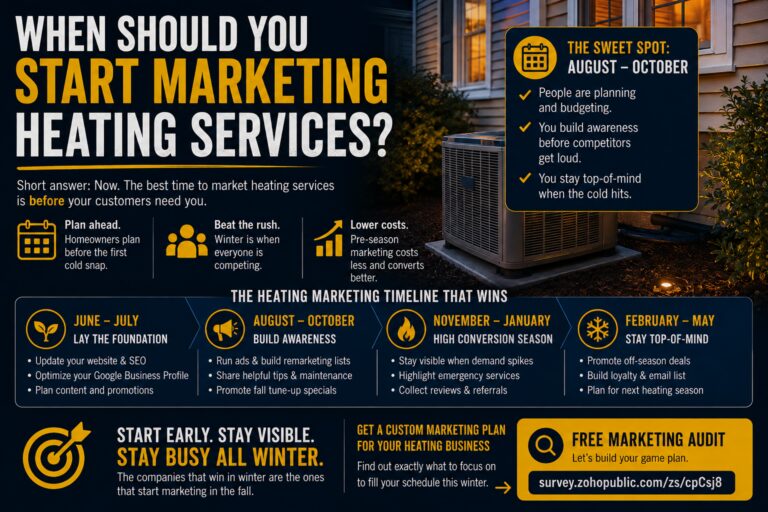
How does seasonal search demand actually behave?
It does not switch on. It curves, and the curve starts earlier than owners expect.
Maintenance and tune up searches climb first, in late September and early October, driven by homeowners being responsible before the weather turns. These are your best margin calls, because they are planned rather than urgent and they convert into service agreements.
Repair and emergency searches spike sharply with the first hard freeze, usually somewhere between late October and early December depending on your market. This is the volume peak. It is also the moment the customer does not comparison shop. They call whoever appears first and looks open.
Replacement searches follow the repair spike by a few weeks, as the people whose systems failed decide they are not doing this again next winter. These are your highest ticket jobs and they are won by whoever handled the repair call or whoever ranks for replacement terms.
Three distinct demand waves. The position you hold in each one was earned before any of them started.
Why is November the most expensive month to start?
Because every company in your market notices demand at the same moment, for the same reason.
Their phone gets busy or it does not. Either way, in November, every competitor in your service area is looking at the same seasonal reality and making the same decision to spend more. Paid search costs climb because everyone is bidding simultaneously on the same limited inventory of high intent clicks.
Meanwhile organic positions are already set. The pages ranking for heating repair in your city in November were published and settled months earlier. You cannot buy your way into that list in three weeks.
So the company that did the work in September gets the same traffic in November at no additional cost, while their competitor pays peak season prices for the leftovers.
This is the entire argument for working in the quiet months, and it is the argument owners most consistently reject, because September feels like the wrong time to spend money on marketing when the phone is not ringing.
You are not spending on September demand. You are buying position for the month that pays.
What should you build, and when?
| Timing | What to build | Why then |
|---|---|---|
| 8 to 12 weeks out (late Aug to Sep) | Seasonal service pages. Heating repair, furnace tune up, heat pump service, each with its own page and keyword | Pages need time to be crawled, evaluated, and settled into a stable position |
| 8 weeks out (September) | Google Business Profile service entries for every seasonal offering | Profile changes can move map pack placement within days, but you want them stable before the spike |
| 6 weeks out (early October) | Supporting blog content answering seasonal questions. When to service a furnace, what a tune up includes, signs of failure | Captures research intent ahead of the emergency wave and feeds AI Overview citations |
| 4 weeks out (mid October) | Review push targeting recent maintenance customers | Review velocity in the ninety days before peak season is what registers as prominence |
| 2 weeks out (late October) | Ads pointed at pages that are already converting | Ads amplify a working foundation. They do not substitute for one |
| During the season | Photos, GBP posts, review responses. Maintenance only | No time for building. Keep signals active and let the foundation work |
How should a seasonal service page be structured?
One page, one service, one city, one keyword. Decided before you write, not discovered afterward.
The most common failure we see is a single page covering heating, cooling, and maintenance together. That page competes for everything and wins nothing, because Google cannot tell what it is about and neither can a buyer.
The structure, top to bottom:
- H1 naming the service and the city the way people search it. Not a clever headline. Furnace Repair in Greenville, SC beats Keeping Your Family Warm All Winter.
- Answer block in the first hundred words. Direct and self contained. What the service is, what it costs or how pricing works, how fast you can be there. This is what AI engines lift and what a skimming buyer reads.
- Proof immediately after. Review count, a specific result, the towns you cover. People decide on signals within seconds.
- H2s written as the questions buyers actually type. How much does furnace repair cost. How do I know if my furnace is failing. Do you offer emergency service. Answer each one directly underneath the heading.
- One primary CTA repeated down the page. Not five competing buttons.
- Internal links up to your main HVAC service page and out to one related seasonal page.
- FAQ block with two questions, answers at 40 to 50 words, marked up with FAQPage schema.
Should you publish a new page every year?
No. Update the same page.
This is where a lot of seasonal content strategy goes wrong. Companies publish a fresh Winter 2025 Heating Guide, then a fresh Winter 2026 version, and end up with two pages competing against each other while neither accumulates any history.
A page with two or three years of accumulated authority, updated with current pricing context and current dates, outranks a brand new page every time. Google can see that the URL has been serving this query reliably for years.
So keep the URL. Refresh the content in August. Update the dates, adjust anything that changed about pricing or service offerings, add any new questions customers started asking last season, and republish.
Ten minutes of updating beats two hours of writing something new that starts from zero.
How do you win the emergency wave specifically?
The repair spike behaves differently than the maintenance wave and it rewards different preparation.
Somebody whose heat failed at 8 PM in December is not comparison shopping. They are not reading your about page. They are looking at a map pack on a phone and calling the first listing that looks open and reachable.
Which means four things decide whether you get that call, and none of them are content quality.
- Emergency service listed as its own service entry on your Google Business Profile, in those words, because that is what gets typed.
- Accurate hours, including holiday hours. A listing showing closed does not get called even if you would have answered.
- A tap to call phone number visible without scrolling on mobile, on both your profile and your website.
- Somebody actually answering. The most expensive failure in this entire category is the call that came through and went to voicemail.
Set your holiday hours in October, not in December. It takes two minutes and it is the highest return two minutes available to a seasonal business.
What does this look like as a content plan?
Three tiers, each doing a different job.
Service pages are the foundation. One per service, per primary city, built to convert buyer intent. These are the pages that need the eight to twelve week runway and they are the ones ads should point at.
Supporting blog content captures research intent ahead of the buying wave. When should I service my furnace. What does a tune up actually include. Signs your heat pump is failing. These posts rarely convert directly and they do two valuable things: they build topical authority that lifts the service pages, and they are the natural material for AI Overview citations, because they are literally question and answer content.
Google Business Profile posts run weekly during the season and carry the local intent signal. Short, specific, service plus city plus a call to action. These do not need to be clever. They need to exist consistently.
One good service page plus three supporting posts per seasonal service is a realistic target. That is achievable in September. It is not achievable in November.
Does this apply to pest control and plumbing too?
Yes, and the fall pest window is even tighter than the heating window.
Rodents, spiders, and stink bugs move indoors as temperatures drop, which means the search spike for rodent exclusion and fall treatment starts in September, not October. If fall treatment is not listed as its own service on your Google Business Profile right now, you are already missing those searches.
Plumbing has two seasonal spikes worth planning for. The holiday hosting spike, driven by garbage disposals and drain clogs around Thanksgiving and Christmas. And the freeze spike, when burst pipes create the highest urgency calls of the year.
One pest control company we worked with went from one million to three and a half million in revenue over twelve months. The first thing we did was cut twenty thousand a month in ad waste, then rebuild the organic foundation underneath so leads did not have to be purchased at full price every month forever. The company sold successfully after that.
Same principle across all three trades. The season is decided four to twelve weeks before it starts.
The plumbing version has one wrinkle worth planning for. Both plumbing spikes are almost entirely emergency driven, which means the profile work matters more than the content work. A burst pipe customer is not reading anything. Get the emergency service entry, the hours, and the tap to call link right, and let the content do its work on the planned jobs instead.
Across all three trades the underlying rule holds. Demand is predictable, the curve starts earlier than it feels like it should, and the position you hold when it peaks was decided weeks before anyone noticed the weather.
Frequently asked questions
Is it too late to start if the season already began?
Not for Google Business Profile work, which can move map pack placement within days. It is late for new service pages, which need weeks to settle. Fix the profile now, publish the pages anyway, and they will be positioned for next season.
How many seasonal pages should an HVAC company have?
One per service, per primary city. For most companies that means four to six real pages, not thirty templated ones. Google flags duplicated city pages as doorway pages, and that penalty affects your entire domain, not just those pages.