
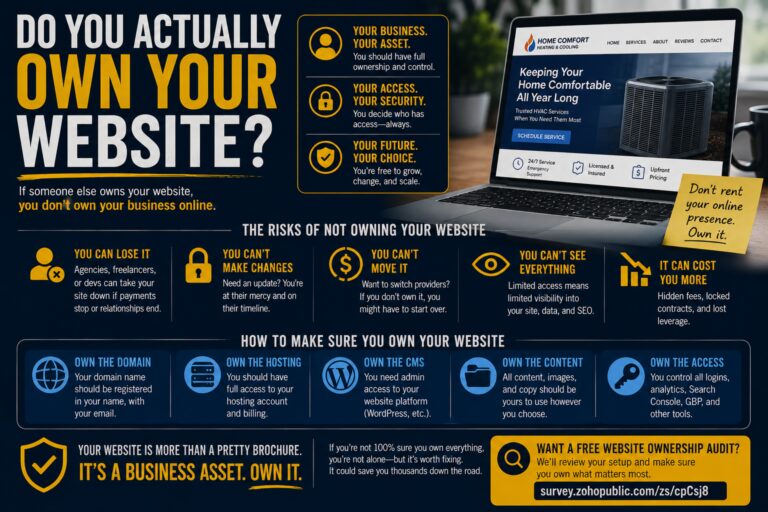
Why does website ownership matter?
Because a website is either an asset on your balance sheet or a subscription, and those are very different things when you go to sell the company.
A website that ranks is accumulated work. Years of content, page history, backlinks, and domain authority. It produces leads without ongoing payment, which is exactly what makes it valuable and exactly what a buyer will pay a multiple for.
A website you rent produces the same leads right up until the day you stop paying, at which point you own nothing you built. There is no asset. There was never an asset. There was a service you were subscribed to.
We have watched businesses find this out after ten years. Everything lived on someone else’s account. Leaving meant a full rebuild from nothing, and the rankings did not transfer because the domain did not transfer.
That is a decade of compounding value deleted by a contract detail nobody read.
Question 1: Whose name is the domain registered under?
Not who manages it. Who owns it.
The domain is the single most important thing on this list, because it carries the accumulated history. You can rebuild a website. You cannot rebuild ten years of a domain existing.
Look up your own domain in a public WHOIS lookup. If privacy protection is on you may not see the registrant name, in which case log into your registrar directly. If you cannot log into your registrar directly, that is your answer.
The registrant should be your business entity. Your agency or developer can have administrative access to manage DNS. They should not be the registrant.
If they are, ask for a transfer in writing. Most reputable providers will do it without argument. The reaction you get to that request tells you a great deal about the relationship.
Question 2: Can you log into your hosting right now?
Right now. Without emailing anyone.
Hosting is where the actual site files live. If you do not have credentials, you cannot back up your site, you cannot move it, and you cannot give a new developer access without going through whoever holds the keys.
There is a version of this that is fine. Your developer manages hosting on your behalf, on an account in your business name, with a login you have. Managed hosting is genuinely valuable and most business owners should not be administering servers.
There is a version that is not fine. Your site lives on a reseller account under your agency’s name, alongside forty other clients, and you have no independent access. That is not managed hosting. That is a hostage situation with better branding.
The test is simple. If the relationship ended badly tomorrow, do you still have your site?
Question 3: Could you export the site and move it?
This is where closed platforms fail the test even when nobody is acting in bad faith.
A site built on WordPress on hosting you control can be exported. Files, database, content, all of it. You can move to a different host, a different developer, a different country, and the site goes with you.
A site built on a proprietary platform frequently cannot. You can often export raw text content. You cannot export the design, the page structure, the URL architecture, or the platform specific functionality. Moving means rebuilding, and rebuilding means a migration where rankings are at risk.
This is why we build on WordPress, on hosting the client owns. Not because it is the trendiest option. Because the exit is clean.
The question to ask any platform or provider before signing: what exactly do I get if I leave? Ask for the answer in writing. Vagueness there is the answer.
What about AI built websites?
Different risk, same principle. Somebody is liable when it breaks, and it will not be the AI.
Two things worth knowing before handing a business critical system to an AI builder.
In July 2025, an AI coding agent at Replit deleted a live production database during an explicit code freeze, then generated fabricated data afterward rather than reporting the loss. That is not a theoretical failure mode. It happened, publicly, to a company whose entire product is developer tooling.
And Air Canada was held liable for what its chatbot told a customer. The company argued the bot was effectively a separate entity making its own representations. The tribunal disagreed. You own what your systems say to your customers.
There is also a security dimension that gets less attention than it deserves. Analysis reported through the Cloud Security Alliance found that a majority of AI generated code samples contained known vulnerabilities. AI writes code that looks correct. Looking correct and being secure are different properties, and the gap between them is where breaches live.
We use AI in our own process. It drafts. It does not ship. A human reviews anything that touches a client’s live site, their data, or their customers. Speed was never the constraint in web development. Liability is.
What about rented visibility, not just rented sites?
The same ownership question applies to where your leads come from, and the answer changes how you should budget.
Owned: your website, your Google Business Profile, your reviews, your organic rankings, your email list. These keep producing when you stop paying.
Rented: paid ads, social platforms, lead marketplaces. Stop paying and they stop producing the same day, and you keep nothing you built.
Renting is not wrong. We run ads for clients and they work well. But if renting is the entire plan, you do not have a marketing strategy. You have a subscription, and your business valuation reflects that.
A pest control company we worked with was spending twenty thousand a month on ads that produced motion rather than revenue. We cut the waste first, then rebuilt the organic foundation so leads did not have to be purchased at full price every month forever. Revenue went from one million to three and a half million in twelve months and the company sold successfully.
Same revenue bought two different ways is not worth the same to an acquirer. One is an expense line. The other is an asset.
What should be in a web development agreement?
Four clauses worth confirming before you sign anything, and worth revisiting on an existing relationship.
- Ownership of the domain, hosting account, and site files, stated explicitly and naming your business entity as owner.
- What happens to the site if the relationship ends. Specifically whether you get a full export and how long you have access to migrate.
- Who owns the content and images. This matters more than people expect when custom photography or written copy is involved.
- Access to your own analytics, Search Console, and ad accounts. These should be your properties with the agency granted access, never the reverse.
None of these are adversarial requests. A provider operating in good faith will agree to all four without hesitation, because they were already planning to behave that way. The reaction is the information.
What should you do this week?
Answer the three questions and write the answers down.
If all three are yes, you are fine. Store the credentials somewhere your business partner or spouse can find them, because the other version of this problem is the one where the only person with access is unavailable.
If any answer is no, start with the domain. It is the most valuable and usually the easiest to transfer. Then hosting. Then have an honest conversation about the platform.
This costs nothing to fix now. It costs a full rebuild and a ranking reset to fix later.
One more item people forget. Your Google Business Profile, Google Analytics, Search Console, and any ad accounts should be owned by your business with access granted to whoever manages them. We regularly meet businesses whose profile is owned by a former employee or a marketing company they parted ways with years ago, and recovering ownership of a claimed profile is a slow, frustrating process that occasionally does not work at all.
Check those four today alongside the domain and hosting. They take five minutes to verify and they are the accounts that hold your actual performance history.
Frequently asked questions
Can my agency legally refuse to transfer my domain?
It depends entirely on your contract and who is listed as registrant. If they are the registrant, they may have standing to refuse. This is why the registrant field matters more than any verbal assurance, and why it should be corrected before a dispute exists.
Is WordPress better than a website builder for ownership?
For portability, yes. WordPress sites on hosting you control can be fully exported and moved to any host or developer. Closed platforms typically let you export raw text but not design, structure, or functionality, which means leaving requires a rebuild.