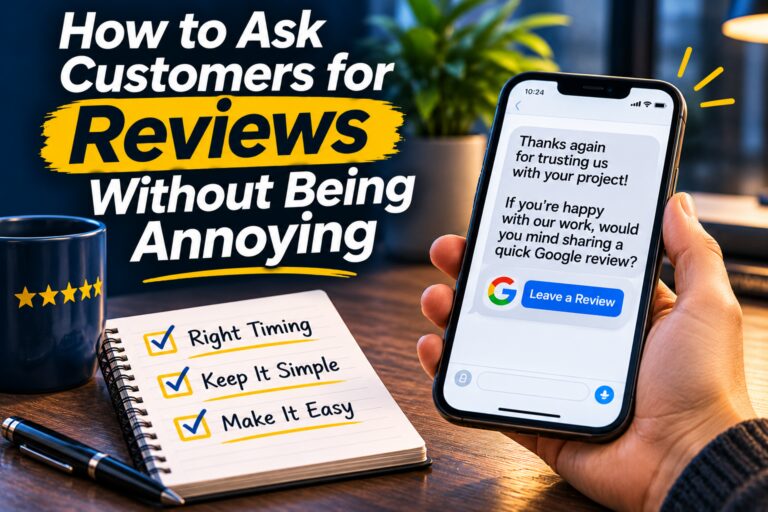
Ask on site, while the work is still visible and the customer is happy, then follow with one text the same day and one reminder three days later. Ask them to mention the service they got and the town they live in. Never offer anything in exchange and never write it for them. A process attached to the job beats a campaign you run when you remember, which is the real reason most businesses have four reviews.
Why do most service businesses have so few reviews?
Not because customers are unwilling. Because nobody asked at the moment they would have said yes.
Here is the pattern I see constantly. A company completes forty jobs in a quarter. Thirty-five go well. They have four reviews.
The gap is not quality. It is timing. The asking happens, when it happens at all, two weeks later in a batch email to people who have already moved on.
A customer is most willing to write a review in the ten minutes after the problem is solved. The AC is blowing cold again. The water is draining. They are relieved and they are standing in front of the person who fixed it.
That window closes fast and it does not reopen.
When exactly should you ask?
Three touches, and the first one matters more than the other two combined.
On site, by the tech. Out loud, before leaving. This is the one that converts, and it is the one most companies skip because it feels awkward.
Same day, by text. Within a few hours, with the direct link. Not a portal, not a login. One tap to the review form.
Three days later, once. One reminder. If they do not respond to that, stop. Two nudges is helpful. Four is why people think review requests are annoying.
That is the whole system. The reason it works is that it is attached to job completion rather than to someone’s memory, which means it runs whether or not anybody is thinking about marketing that week.
What should the tech actually say?
Short, specific, and no pressure. Something close to this:
“If we did right by you today, a quick Google review helps us more than anything else. I’ll text you the link before I pull out of the driveway. No worries either way.”
Three things are doing work in there. It is conditional, so there is no pressure if they were unhappy. It names the platform. And it sets up the text so the message that arrives is expected rather than random.
For the text itself:
“Thanks again for having us out today. If you have a minute, a quick review really helps folks in [town] find us. If you can mention what we did for you, even better. [link]”
That is it. No paragraph of explanation. No apology for asking.
What makes a review actually useful?
Two things, and only one of them is the star rating.
Specificity. A review that says “they replaced our unit in Simpsonville and had it running the same day” does work that “great company” cannot. It tells a stranger what you do, where you do it, and how it went. It also tells Google the same three things.
That is why the ask includes the nudge to mention the service and the town. You are not writing it for them. You are pointing.
Recency. A steady trickle beats a pile. Four reviews this quarter reads as a busy, operating business. Forty reviews with nothing since 2024 reads as a question mark, no matter how good the rating is.
Consistency is the whole game here. Two reviews a month, every month, puts you ahead of a competitor who got twenty in one push and then stopped.
What should you never do?
Two hard lines, and they are not stylistic preferences.
Never offer anything in exchange. No discounts, no gift cards, no entry into a drawing. Google’s policies prohibit incentivized reviews, and the risk is not a slap on the wrist. It is your profile.
Never filter who you ask. Asking only the customers you are confident will say something nice is review gating, and it is also against policy. Ask everyone whose job went normally.
And a softer one: never write the review for them. A customer who copies and pastes your sentence produces something that reads exactly like what it is, and a page of them reads worse.
What do you do about a bad review?
Answer it, fast, in public, without getting defensive.
This is counterintuitive but a calm, specific reply to a complaint converts more skeptical prospects than another five-star review will. It shows how you behave when something goes wrong, which is the thing a stranger is actually trying to work out.
Acknowledge the specific issue. Say what you did or are doing. Offer to take it offline with a real contact. Do not argue the facts in public even when you are right.
What you cannot do is leave it sitting there. An unanswered complaint at the top of your profile does more damage than the complaint itself.
How does this connect to getting found?
Reviews are the bridge between the reputation you already have and the people who have never heard of you.
Your referral network knows you are good. Nobody else does. A stranger searching for an electrician at eight at night is making a decision from a map result, a star rating, and whatever the most recent three reviews say.
That is also why the town matters. Reviews mentioning specific places reinforce where you work, which is the thing local search is trying to figure out.
And it compounds. A profile with steady recent reviews gets chosen more, which produces more jobs, which produces more reviews. The hard part is the first ninety days of actually doing it.
Frequently asked questions
How do I ask customers for reviews without being pushy?
Ask once on site while the work is fresh, send the link by text the same day, and send one reminder three days later. Keep it conditional and brief. Two touches after the verbal ask is helpful. More is annoying.
Can I offer a discount for a Google review?
No. Google’s policies prohibit incentivized reviews, and so is asking only customers you expect to be positive. Both can put your profile at risk. Ask everyone whose job went normally and offer nothing in return.