Why Q4 Is the Smartest Time to Invest in Marketing (While Everyone Else Slows Down)

Most Businesses Coast Through Q4, That’s Why You Shouldn’t

Every year around October, something predictable happens.
Businesses start to slow down.

Marketing budgets tighten. Content calendars fade. Everyone’s attention shifts to holidays, parties, and “we’ll start fresh in January.”

But while the majority coast, the smart ones double down.

Q4 is the most strategic time to invest in marketing. The moves you make now decide how fast you grow in Q1.

The Momentum You Build Now Powers Your Next Year

SEO, advertising, and brand awareness don’t flip on like a light switch. They build momentum over time.

When you invest in marketing during Q4, you’re planting the seeds that sprout when everyone else is just waking up.

Here’s what happens when you keep your foot on the gas:

  • Your rankings improve while competitors are silent.
  • Your ads cost less due to lower seasonal competition.
  • Your pipeline fills before January instead of scrambling to rebuild it.

Search engines reward consistency.
So while others “pause,” you keep building visibility, trust, and engagement, and that compounds into real growth when Q1 hits.

Marketing Now = Faster Q1 Results

Think of marketing like fitness.
You don’t stop training in December and expect to be in shape by February.

The same goes for your business.
Every post, ad, and optimized page you publish now sets the stage for faster growth in the new year.

Q4 campaigns can help you:

  • Capture holiday traffic and turn it into repeat customers.
  • Rank for high-value keywords before your industry’s busy season.
  • Launch new offers while competitors are inactive.

When January rolls around, you won’t be starting from zero. You’ll already be in motion.

Hiring Experts Now Has Real Financial Perks

Here’s something most business owners overlook, hiring marketing experts in Q4 can count as a year-end business expense.

That means the investment you make now can directly lower your taxable income for the year.
You’re not just spending money, you’re investing it strategically while writing it off.

Plus, partnering with an agency means you don’t have to juggle planning, posting, and reporting during the busiest personal season of the year.

We handle the strategy, execution, and optimization so you can stay focused on:
Your customers
Your family
And a well-earned holiday break

A Seamless Process for a Strong Finish

At 1×1 Impression, we make end-of-year marketing easy.
We know Q4 is chaotic, which is why our onboarding is simple, our strategies are clear, and our systems run in the background while you enjoy your holidays.

Here’s how we make it work:

  1. Quick discovery call – We get to know your goals and timeline.
  2. 90-day marketing map – SEO, content, and social all aligned.
  3. We execute — you approve – No extra meetings, no overwhelm.
  4. Monthly reports – Know exactly what’s working.

You finish the year strong while we prep your brand to hit January at full speed.

Q4 FAQs

1. Is Q4 really a good time to market if sales are slower?
Yes. Lower competition means better visibility and cheaper ad costs. It’s also the perfect time to prepare your content and rankings for Q1 demand.

2. How long before I see results from Q4 marketing?
SEO and organic strategies take 60–90 days to build traction, which makes Q4 the ideal time to start if you want momentum in January and February.

3. What if I don’t have time for marketing right now?
That’s exactly why you hire experts. We handle your campaigns, content, and reporting so you can focus on your business and enjoy the holidays stress-free.

4. Can marketing expenses really help with taxes?
Yes. Most marketing investments qualify as deductible business expenses. Always confirm with your accountant, but Q4 is the best window to leverage this.

5. What services make the biggest Q4 impact?
SEO, Google Business optimization, and ad campaigns targeting your top local or seasonal keywords all drive the fastest results going into Q1.

Most business owners slow down in Q4. The smart ones use it as a launchpad.

If you want 2026 to start strong, the time to prepare isn’t January — it’s right now.

Investing in your marketing today gives you the visibility, leads, and tax benefits that carry you into the new year with momentum.

While others hit pause, you’ll be the one already moving forward.

If you’re ready to finish the year strong and start Q1 ahead of your competition, we’ll make it effortless.
Our team will build and run your end-of-year marketing strategy so you can focus on family, clients, and the holidays — while your business keeps growing.
Schedule Your Q4 Marketing Strategy Call with 1×1 Impression


7 Ways to Use ChatGPT for SEO (That Actually Move the Needle)

AI Isn’t the Strategy, It’s the Assistant

AI tools like ChatGPT have completely changed how fast we can research, plan, and create. But let’s be clear: AI is only as smart as the person using it.

A tool can suggest topics, generate outlines, and even draft paragraphs, but it doesn’t understand your goals, your brand, or your customer base.
That’s where expertise matters.

In 2025, the best SEO results come from marketers who use AI to scale strategy, not skip it.
Here are seven ways you can use ChatGPT to support real SEO growth,and why a professional strategy still makes the difference.

1. Topic Research at Record Speed

ChatGPT can help identify trending ideas, common pain points, and question-based topics faster than manual research ever could.

Try prompting:

“What are 10 blog topics a local service business could publish about to attract new customers in 2025?”

You’ll get a solid starting list. But here’s the catch, ChatGPT doesn’t know your competition or local market data.
An SEO expert does.

We take AI’s raw ideas and validate them through data tools like Google Trends or Google Search Console before deciding which ones will actually rank.

2. Creating Content Outlines That Match Intent

ChatGPT can build smart outlines when given the right direction.
For example:

“Create an outline for a blog about how AI is changing local SEO, targeting small business owners in South Carolina.”

You’ll get a clean structure that’s easy to expand.
But without SEO experience, you won’t know which subtopics need keyword targeting or how to format for AI Overviews.

That’s why strategy always comes first. The tool speeds up execution, not thinking.

3. Drafting Meta Titles and Descriptions

ChatGPT can generate dozens of meta tag options quickly, which is great for testing CTR (click-through rate) performance.

Prompt example:

“Write five SEO meta titles and descriptions for a blog about keyword research in the age of AI.”

It’s efficient, but human review is still essential.
Only a strategist understands brand tone, conversion triggers, and emotional appeal that make users click.

AI can suggest, but it doesn’t sell.

4. Writing Schema Markup and FAQs

Schema helps your content qualify for AI overviews and featured snippets.
You can use ChatGPT to generate basic schema or FAQ templates, saving time for the technical setup.

Example:

“Write FAQ schema for a blog about AI and SEO.”

But knowing which schema to apply and how to structure it for local visibility takes expertise.
The value isn’t in the code, it’s in the strategy behind it.

5. Repurposing Long-Form Content into Social Posts

ChatGPT is great for turning blogs into shorter posts for platforms like LinkedIn or Facebook.
You can prompt it to summarize, extract quotes, or write captions that link back to your site.

Example:

“Summarize this blog into three engaging LinkedIn posts.”

This is a powerful way to stay visible and keep your content alive across channels.
But again, knowing what resonates with your specific audience comes from experience, not automation.

6. Keyword Expansion and Topic Clusters

You can use ChatGPT to brainstorm keyword variations or subtopics around your core theme.
For example:

“Give me 15 related search topics to ‘local SEO for contractors.’”

Then, an expert filters those results, identifies search intent, and builds internal linking maps that actually improve rankings.

AI can surface ideas,but only a strategist can turn them into a cohesive content architecture that Google trusts.

7. Writing Smarter, Not Harder

ChatGPT helps you overcome writer’s block and speed up the drafting process.
It can even create content in your brand tone if you feed it examples.

But the most common mistake businesses make is publishing AI-generated content without optimization or strategy.

Google’s new algorithms and AI Overviews can spot generic text instantly.
That’s why every piece still needs human review, editing, and optimization.

AI should make your process faster, not cheaper.
The shortcut mindset is what kills results.

AI Doesn’t Replace Experts, It Amplifies Them

The real opportunity isn’t about replacing SEO professionals with AI.
It’s about working smarter by combining expertise with technology.

AI can’t analyze competitors, interpret analytics, or build trust signals, but it can take your insights and scale them.
That’s the difference between using a tool and leading with strategy.

If you want to use ChatGPT effectively for SEO, work with someone who knows how to ask the right questions, interpret the data, and turn insights into growth.

Because at the end of the day, AI is only as smart as the user behind it.

FAQs

1. Can ChatGPT handle SEO on its own?
No. ChatGPT can help with research, structure, and writing, but it can’t manage full SEO strategy. You still need expertise to guide direction, analysis, and optimization.

2. Is using AI content against Google’s guidelines?
No, as long as it provides value, originality, and experience-based insight. Google rewards quality, not just authorship.

3. What’s the best way to use ChatGPT for SEO safely?
Use it for brainstorming, drafting outlines, and identifying ideas — then refine everything manually for tone, accuracy, and intent.

4. Can AI improve local SEO?
Yes. ChatGPT can help create Google Business post ideas, FAQs, and local keyword lists, but ranking locally still requires proper optimization and consistent posting.

5. How can businesses use ChatGPT without losing authenticity?
Use AI as a tool for efficiency, not replacement. Always personalize, fact-check, and inject your brand’s unique voice into the final result.

AI is a powerful tool that we have access to, but only when it’s guided by strategy.
AI can create, assist, and analyze, but it can’t lead. That’s where expertise matters.

The brands winning in 2025-2026 are the ones who blend smart technology with human strategy and creativity.

If you’re ready to use AI to scale your SEO — not sabotage it — let’s build your strategy together.
We’ll create a data-backed plan that uses tools like ChatGPT to grow your visibility, authority, and client base.
Work with 1×1 Impression SEO

Keyword Research in the Age of AI: What Still Works in 2025

Keyword Research Has Changed Forever

There was a time when keyword research was simple. You’d plug a few phrases into a tool, look at volume and competition, and start writing. That formula worked for years. But with AI now driving search results, the way we find and target keywords has completely evolved.

Google’s Search Generative Experience (SGE) and tools like ChatGPT have changed how people search, how they phrase questions, and how search engines understand context.

The good news? Keyword research still matters — it just looks different. If you adapt now, you’ll get ahead of most businesses that are still chasing outdated metrics.

Let’s walk through how to approach keyword research in 2025 and the strategies that still deliver real rankings.

1. Search Volume Isn’t the Goal Anymore

For years, marketers obsessed over keywords with high volume. The logic was simple: more searches meant more traffic. But AI has changed the game.

Search intent and topical depth now matter more than raw numbers.

A keyword with 150 monthly searches but clear purchase intent can outperform a keyword with 15,000 vague searches.
Your goal isn’t to chase traffic anymore — it’s to attract qualified intent.

How to find intent-driven keywords:

  • Look for phrases that signal questions or problems. (Example: “how to optimize for AI overviews” instead of just “AI SEO”)
  • Study People Also Ask boxes and Reddit threads for the way real people ask questions.
  • Use AI tools like Perplexity, ChatGPT, or Gemini to simulate how people search in natural language.

These tools help you uncover intent-rich, conversational queries that are fueling the next wave of search results.

2. Topic Clusters Beat Keyword Lists

Google doesn’t rank isolated pages anymore — it ranks topic authority.
That means your keyword research should focus on clusters, not just terms.

Start by mapping your core pillar topic. For example, if your pillar is “AI SEO,” your supporting cluster might include:

  • Keyword research in the age of AI
  • How to optimize content for Search Generative Experience
  • Using AI tools for content audits
  • The future of search intent and ranking factors

Each supporting piece builds credibility for your main topic.

The goal is to show Google and AI models that your site doesn’t just touch on a subject — it owns it.

3. Use AI to Find the Missing Gaps

Traditional tools like SEMrush and Ahrefs are still powerful, but AI tools can help uncover new opportunities faster.

Try this workflow:

  1. Open ChatGPT or Perplexity and ask:
    “What are people searching for about [your topic] that isn’t well answered online?”
  2. Then run those suggestions through your keyword tool to validate search data.
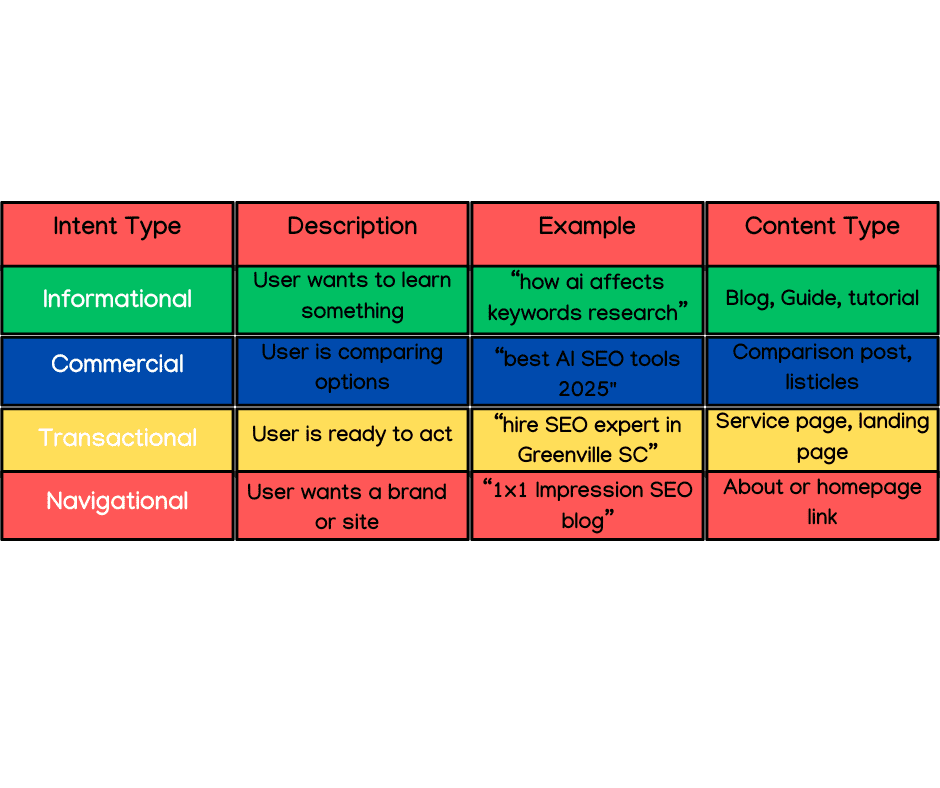
  3. Group them into subtopics by search intent (informational, comparison, transactional).

This blend of AI brainstorming and data validation gives you a list of keywords that aren’t oversaturated yet but are growing in demand.

4. Focus on Search Intent Above Everything

Every keyword you target should match the intent behind the search. AI is getting smarter about this every month.
Here’s how to simplify it:

Heading 15

5. Keywords Are Conversations Now

AI has made search language more natural. People type or speak in complete thoughts, not short phrases.

That means your keyword research should include long-tail conversational phrases that reflect how people actually talk.

For example:

  • Old style: “SEO tips”
  • New style: “what are the best SEO tips for small businesses in 2025”

Use these conversational queries in headers and FAQs to help AI models connect your content to modern search behavior.

6. Don’t Forget Entity Keywords

Entity SEO is one of the biggest ranking factors in 2025.
Entities are specific people, places, products, or concepts that Google recognizes as “things.”

For example, instead of writing “SEO tools,” mention “Surfer SEO,” “Clearscope,” or “Frase.”
Instead of “AI models,” mention “Gemini,” “ChatGPT,” or “Claude.”

The more entity-rich your content, the easier it is for AI to associate your site with real-world authority.

7. Build With Long-Term Data, Not One-Off Trends

Trendy keywords spike fast and fade even faster.
The goal is to build content around consistent themes that evolve with time.

Use your analytics to identify which content topics consistently attract users.
Then expand those with updated examples and refreshed insights every quarter.

Google favors sites that keep content alive instead of publishing and abandoning it.

8. Use AI Tools Wisely

AI can save hours of manual keyword sorting if you use it strategically.

Here’s how:

  • Use ChatGPT to group keywords by intent or theme.
  • Use SEMrush or Rank Tracker to analyze difficulty and opportunity.
  • Use Google Trends to spot seasonal changes and emerging search behavior.

The goal is not to let AI do the thinking — it’s to use it as a research partner that expands what you can see.

FAQs

1. Is keyword research still necessary with AI?
Yes. AI changes how keywords work but doesn’t remove them. Keyword research now focuses on context, search intent, and topical authority.

2. What tools are best for keyword research in 2025?
Use a mix of traditional tools like SEMrush and newer AI-driven tools like Perplexity, ChatGPT, or Rank Tracker for broader insight.

3. How many keywords should I target per post?
Focus on one main keyword, a few secondary variations, and supporting entity keywords. It’s about coverage, not quantity.

4. What’s the biggest mistake people make in keyword research now?
Relying only on volume or difficulty. In 2025, search intent and topical fit are far more important for long-term rankings.

5. Can AI help write SEO-optimized content?
AI can help outline and structure your content, but human expertise, examples, and perspective make it rank and convert.

Keyword research hasn’t died. It’s evolved.
The winners in 2025 are the ones who stop chasing search volume and start building authority.

Your keywords should map to a larger strategy, one that connects topics, intent, and real experience.

Stay consistent, refresh often, and let AI help you spot what others miss.

If you’re ready to stop guessing and start ranking, let’s map out your AI-optimized SEO plan.
We’ll identify the right topics, clusters, and keywords to position your business as the authority in your space.
Schedule your SEO Strategy Call with 1×1 Impression

How AI Is Reshaping SEO

And What to Do About It

The SEO Playbook Has Been Rewritten…AGAIN

For years, SEO revolved around keywords, backlinks, and content volume. Those things still matter, but they’re no longer the foundation.
Artificial intelligence has completely changed how search engines read, rank, and recommend content.

Google, Bing, and even ChatGPT-style search experiences now prioritize intent, authority, and topic relevance over everything else. You can no longer trick your way to the top with keyword stuffing or link swaps.
You have to earn visibility through relevance, accuracy, and expertise.

If you’ve noticed your organic traffic dip or rankings shift, it’s not a penalty. It’s the new normal. AI is running the show now, and the sites that understand how it works are pulling ahead.

Let’s break down exactly what’s changed and how to adjust your strategy.

1. AI Search Results Are Changing How People Click

AI-driven search, or what Google calls Search Generative Experience (SGE), is now reshaping the results page. Instead of showing a list of ten blue links, Google’s AI summarizes information into a direct answer at the top of the screen.

That means your content might be used to form part of that AI answer, but the user may never click through to your website. Traditional SEO metrics like impressions and clicks mean less when the answer lives above the fold.

So how do you win in this new environment?

  • Focus on clear, factual, well-structured content that AI can easily reference.
  • Answer the core question of your topic in the first paragraph.
  • Use headers, lists, and subtopics that make your post scannable.
  • Include data, quotes, and experience-based insights that signal credibility.

AI models pull from high-trust content. The more proof of experience and authority your site shows, the more likely it is to be cited.

2. Keywords Still Matter, But Topics Matter More

The days of chasing one keyword at a time are over. AI evaluates the full context of a page, not just its target phrase.

Instead of focusing on a list of keywords, shift to topics and clusters.
Pick one core subject, then create multiple posts that explore related angles.

For example, if your pillar post is “How AI is Reshaping SEO,” your supporting content could include:

  • Keyword research in the age of AI
  • How AI tools impact content creation
  • The truth about AI-written blogs and ranking
  • How to optimize for Search Generative Experience

Interlink them. Each blog supports the others, helping Google understand that your site owns the topic.

When your site builds topical authority, you’ll start ranking for hundreds of variations around that theme.

3. E-E-A-T Is Non-Negotiable

E-E-A-T stands for Experience, Expertise, Authority, and Trust.
Google has made it clear that content must be written by real people with real knowledge. AI can assist, but your human perspective and proof of experience matter more than ever.

To improve your site’s E-E-A-T signals:

  • Add an author bio that highlights your experience.
  • Link to real data sources and references.
  • Use original examples, stories, or screenshots.
  • Keep your site updated and your information current.

When AI evaluates which sites to trust, these signals set you apart from generic content mills or fully AI-generated blogs.

4. Human Creativity Is the Competitive Edge

AI can create content, but it can’t create trust.
Readers and search engines are both drawn to authenticity. Your insights, experience, and point of view will always stand out.

Use AI to handle the busy work, not the voice of your brand.

  • Let AI help outline, summarize, or analyze.
  • Write the insights and examples yourself.
  • Edit everything for tone, accuracy, and brand alignment.

SEO in 2025 is about using AI to scale without losing personality. The blend of automation and authenticity is where your authority grows.

5. SEO Is Now a Continuous Conversation

You can’t publish once and move on anymore. Search engines and AI models constantly learn from new content, engagement, and context.

Treat your blog like an ongoing conversation with your audience.

  • Update high-performing posts every 60–90 days.
  • Add new data or examples when trends change.
  • Repurpose key sections into LinkedIn posts, short videos, or podcast segments.

This activity keeps your site fresh, signals relevance, and helps your content show up in evolving AI search results.

6. AI Tools Are Your Advantage, Not the Enemy

AI doesn’t replace SEO. It makes SEO faster and smarter.

Use it to research, outline, and refine, not to replace your expertise. Some examples:

  • Use ChatGPT, Gemini, or Perplexity for topic discovery.
  • Use Surfer, Clearscope, or Frase to identify semantic terms.
  • Use RankMath, Yoast, or WebSite Auditor to improve technical SEO.

The key is balance. Let AI guide your workflow, but don’t let it replace your insight.

7. The Future Belongs to Those Who Adapt

AI isn’t killing SEO. It’s forcing it to evolve.
Search engines will always need trusted, high-quality content to reference. Your job is to make sure your site is the one they trust.

If you’re consistent, strategic, and authentic, you’ll outrank the noise.

This next phase of SEO isn’t about chasing algorithms. It’s about becoming the reliable source that both humans and AI look to for answers.

AI FAQs

1. Is SEO still relevant in the age of AI?
Yes. AI has changed how SEO works, but it hasn’t replaced it. SEO now focuses more on authority, trust, and topic coverage than just keywords.

2. How do I optimize for AI Overviews?
Create detailed, trustworthy content with structured formatting. Use clear subheadings, answer-based paragraphs, and include expert insights to help AI models cite your work.

3. Should I use AI to write my content?
You can use AI tools for research and structure, but your insights and experience should lead. AI-generated content alone won’t build trust or rank consistently.

4. What metrics should I watch now that clicks are down?
Focus on engagement time, scroll depth, and conversion actions rather than only clicks. These show how valuable your content is, even if AI answers reduce page visits.

5. What’s the most important SEO skill in 2025?
Adaptability. The ability to combine human creativity with AI-driven insights will define who stays visible long-term.


AI has rewritten the SEO rulebook, but the fundamentals are the same — quality content wins. Focus on depth, trust, and expertise, and your site will continue to rank even as search evolves.

Search has changed, most businesses haven’t.

If you’re ready to stop guessing and start ranking, let’s build your AI-proof SEO plan today.

Work with 1×1 Impression

How Can SEO Help My Business

Why is it Imperative for a Business to Have a Strategic SEO Plan?

In the world of business, achieving a favorable rank in search engine results is not just beneficial but necessary. SEO, or Search Engine Optimization, employs the strategic use of targeted keywords and phrases to augment your online visibility, helping you stand out in a saturated market.

Understanding the fundamentals of SEO reveals it’s not merely about escalating visibility. It adopts a strategic avenue involving on-page optimization, technical SEO, and link-building, effectively fueling business growth through various avenues. Below, we delve into the crucial ways an SEO strategy can be a game-changer for your business:

1. Amplifying Website Traffic

SEO drives targeted traffic to your site, directing potential customers to your offerings. This strategy is grounded in cultivating a network of backlinks from other websites and social platforms, thereby enhancing your ranking on search engines and increasing the likelihood of attracting qualified leads, ultimately elevating profitability.

SEO can significantly aid in amplifying website traffic by optimizing various elements on and off your website to improve its visibility in search engine results for targeted keywords and phrases. Here is how it helps and the top three strategies to amplify traffic:

How SEO Amplifies Website Traffic
1. Keyword Optimization
Utilizing relevant keywords strategically in your website content, including in the meta description, headers, and titles, helps search engines understand the context of your pages. This understanding facilitates the display of your website in the search results for queries related to those keywords, thereby increasing the likelihood of attracting users interested in your content or services.

2. Quality Content Creation
Creating high-quality content that provides value to your readers is essential. Informative, engaging, and original content attracts more visitors and encourages them to spend more time on your website, which can potentially improve your site’s search engine rankings. Moreover, quality content is more likely to be shared, further increasing your site’s visibility and traffic.

3. Backlink Building
Backlinks, or inbound links from other reputable websites to yours, are a vital SEO strategy. These links signal to search engines that your site is trustworthy and relevant, potentially improving your site’s rank in search results. To build a healthy backlink profile, focus on creating valuable content that others want to link to and forming partnerships with other credible websites in your industry.

Top Three Strategies to Amplify Traffic1. On-Page SEO Optimization
Focusing on on-page SEO, which involves optimizing individual web pages, ensures that your site ranks high in search results and attracts more qualified traffic. Techniques include optimizing title tags, URLs, and images, and creating high-quality, keyword-rich content.

2. Technical SEO
This involves optimizing the backend structure of your website to help search engines crawl and index your site more effectively, enhancing its visibility in search results. Strategies include improving site speed, ensuring mobile-friendliness, and creating an XML sitemap.

3. Content Marketing
Develop a content marketing strategy that involves creating and distributing valuable, relevant content to attract a clearly defined audience. Consistently publishing blog posts, videos, infographics, and more can help draw traffic to your website over time.

2. Foster Trust and Build Authority

A continuous SEO strategy aids in establishing a formidable online presence, creating a basis for a trustworthy and reputable business image. It involves gathering positive reviews and generating relevant content that promotes your brand as reliable and quality-driven.

E-E-A-T stands for Experience, Expertise, Authoritativeness, and Trustworthiness. Following the best practices regarding E-E-A-T can significantly improve the quality of your website according to Google’s guidelines. Here are some of the best practices:


1. Experience:
1.1 This relates to the overall user experience on a website. It involves factors like website design, ease of navigation, page loading speed, and mobile-friendliness. A positive user experience is essential for SEO

2. Expertise
2.1 Expert Content Creators
Ensure that your content is created by individuals with expertise in the relevant field. Demonstrating the qualifications and experience of your content creators can be a plus.

2.2 Comprehensive Content
Create content that covers topics comprehensively, showcasing deep knowledge in the particular field.

3. Authoritativeness
3.1 Backlinking
Build a strong backlink profile with links from other authoritative websites to your content.

3.2 Citations
Use citations and references to authoritative sources to back up the claims or data mentioned in your content.

4. Trustworthiness
4.1 Secure and Accessible Website
Ensure that your website is secure and accessible, providing a safe browsing experience for users.

4.2 Transparency
Maintain transparency by including privacy policies, and terms of service on your website to build trust with your users.

5. Additional Practices
5.1 User Experience
Focus on improving user experience through a well-structured website, faster loading time, and mobile optimization.

5.2 Positive Reviews
Encourage users to leave positive reviews and testimonials, and showcase them on your website to build trust and show authority.

6. Continuous Learning
6.1 Stay Updated
Stay updated with the latest industry trends and updates to maintain expertise and authority.

6.2 Training and Certifications
Encourage team members to undergo training and acquire certifications to continuously enhance their expertise.

Following E-E-A-T best practices involves showcasing expertise, building authoritativeness, and establishing trustworthiness through various strategies such as creating comprehensive content, securing your website, and building a strong backlink profile. It’s a continual process that plays a crucial role in enhancing your website’s SEO performance, as it aligns well with Google’s guidelines for evaluating content quality. Remember to always operate ethically and prioritize the user’s experience to build a site that genuinely meets E-A-T standards.

3. Enhancing Conversion Rates

SEO not only augments the likelihood of attracting potential customers through quality content creation but also offers savings through reduced ad spending. This dual benefit facilitates a prosperous business outlook through heightened visibility in organic search results.

To enhance conversion rates, focus on creating high-quality content, optimizing your landing pages, developing a strategic keyword plan, and prioritizing technical SEO aspects. Remember to continuously monitor and adjust your strategies based on analytics to foster a website that not only attracts visitors but effectively converts them into customers. It is a dynamic process that requires a balanced approach to SEO and CRO practices to achieve optimal results.

4. Delivering Long-Term Results

SEO is a long-haul strategy that brings sustainable competitive advantages. Through persistent efforts, it promises results that endure for years, continually adapting to the ever-evolving digital landscape and securing sustained visibility on platforms like Google and Bing.

5. Facilitating Effective Lead Generation

Strategically optimizing web pages to rank higher in search results enhances the possibility of garnering targeted leads. The judicious incorporation of appropriate keywords positions you precisely where potential clients are looking, hence optimizing the lead generation process.

6. Improving User Experience

Beyond pleasing search engines, SEO is about offering value to your visitors, creating a user-friendly website environment that reduces bounce rates and fosters positive user experiences, thereby driving more traffic to your site or blog.

7. Offering Cost-Effectiveness

SEO stands tall as a cost-efficient route to escalate your online ranking, offering a sustainable and affordable pathway to augment sales volumes through increased traffic flow.

8. Uncovering New Opportunities

An adept SEO strategy can unlock new avenues for brand visibility and recognition, nurturing deeper engagements with your audience and fostering opportunities in diverse spheres, including digital and social media domains, enhancing sales and customer service strategies in the process.

An ongoing SEO strategy is more than a digital marketing tool; it is a comprehensive approach to ensure sustainable business growth. While it demands dedication and a strategic approach, the long-term benefits it brings are substantial. Reach out to our expert SEO team today, and let us guide your business to unprecedented heights with a customized SEO strategy.


Ethical SEO Services

The Essential Guide to Ethical SEO Services: Avoiding the Black Hat Traps

Why Steering Clear of Black Hat SEO is Crucial

In the competitive digital landscape, falling prey to the allure of rapid results promised by Black Hat SEO tactics is a looming danger. Unethical practices such as keyword stuffing, hidden texts, and cloaking not only lead to severe penalties from search engines but can irreversibly tarnish your online reputation. Hence, the urgency to embrace ethical SEO services cannot be overstated.

Why Do You Need Ethical SEO Services?

In a world where everyone claims to adhere to high moral standards, how can one discern an ethical SEO company from one merely boasting empty promises of stellar search engine rankings? It is non-negotiable to engage in honest, transparent SEO services that guide your business to long-lasting success.

Why Ethical SEO is Not Just a Choice, but a Necessity.
The digital marketplace is rife with tempting shortcuts and dubious SEO strategies, commonly known as Black Hat SEO. These unethical tactics — ranging from deceptive cloaking to spammy link building — might promise instant success, but the ramifications can be severe and long-lasting. It’s crucial to understand why ethical SEO services are not just preferable, but absolutely essential in sustaining a healthy online presence.

Understanding the Real Stakes
Falling into the trap of Black Hat SEO can lead to:

  1. Google Penalties: Search engines have stringent measures in place to penalize websites engaging in unethical practices, including delisting them from search results entirely.

2. Reputation Damage: Once lost, trust is incredibly hard to rebuild. Unethical SEO can erode your brand’s credibility, pushing away potential customers.

3. Financial Setbacks: The resources spent recovering from penalties and rebuilding your online presence can be monumental, straining your finances severely.

Diving Deep into SEO

Contrary to popular belief, search engine optimization (SEO) goes beyond peppering content with keywords. It entails fostering a fruitful user experience by developing useful content and enhancing your online reputation. In a digital landscape where algorithms are continually evolving, keeping abreast of the latest trends and adapting to them is pivotal. Here, ethics intersect with SEO, establishing a foundation of trust and transparency that anticipates not just the probable but also the improbable.

The Marriage of Ethics and SEO

Adopting ethical SEO practices is not just the right thing to do; it ensures sustainability. While manipulating the SEO system might offer fleeting success, it inevitably leads to a decline, perhaps even an irrecoverable one. In contrast, ethical SEO lays the groundwork for enduring benefits, sculpting a reputable space for your website in the online domain.

Finding Your Ethical SEO Haven

Yes, ethical SEO service providers do exist, guaranteeing not just short-term wins but consistent, long-term results. While on your quest to find the ideal partner, consider the following:

Google Rankings: Fact or Fiction?

Ethical SEO agencies don’t promise overnight success. They commit to enhancing your chances of success by abiding by Google’s rules, offering transparency and genuine efforts, devoid of deceit.

Transparent Reporting

Insist on a detailed account of the strategies implemented. A genuine SEO partner embraces transparency, showcasing every step undertaken to elevate your site, nurturing a relationship built on trust.

Beyond the White-Hat Technique

Look for a company that not only adheres to “White Hat” techniques but goes a step further to ensure ethical delivery of services, maintaining a flexible SEO plan devoid of unrealistic promises.

Embarking on an Ethical SEO Journey with 1×1 Impression

Our seasoned professionals are adept at crafting strategies aligned with ethical SEO norms, steering your campaign towards sustainable success. Leveraging proven methodologies, we aspire to facilitate your journey to achieving high rankings, imbued with integrity and transparency. Speak with a strategist and kickstart your ethical SEO voyage with us today! Learn More

How to Increase CTR in SEO

5 Simple Ways On How To Increase CTR In SEO

The organic click-through rate, or CTR, is how many clicks an organic search result receives out of how many times it was clicked on. Search engines are constantly evolving and new features are being added that make it more difficult for marketers to rank at the top organically. This has led to a decline in the CTR over time.

In this post, we will discuss 5 simple ways on how to increase your CTR in SEO!

  1. Identify Low Performing Pages in Google Search Console
  2. Attractive Title
  3. Informative Description
  4. Structured Data
  5. Optimize Your URLs


Things To Note Before You Start Optimizing CTR:

Before you proceed to improve your SEO click-through rate it is necessary to make a backup of previous and current CTR graphs and values.

Login in your Google search console account > Coverage > Select a 6/12 month timeline > Export to Google Sheets

Then, edit the sheet as per the below-mentioned criteria:

The first step is to create a spreadsheet with the following columns: Domain, Title, Description, URL/Permalink, CTR (%), Position. The next column would be for notes where you will note how much your click-through rate has improved or worsened. You should also include how long it took you to improve this metric and any other pertinent information.

A spreadsheet can be as simple as a table in Google Sheets, or you could use an external service such as Microsoft Excel. Make sure that your file is secure and protected from prying eyes!

It’s also important to note how much traffic each page receives so that you know how well the CTR improvement has affected it.

After you have made a backup, it’s time to get down and dirty!

Identify Low Performing Pages in Google Search Console

The first step is to identify low-performing pages. This involves going into Google Search Console and looking at a couple of different metrics:

Coverage – This report shows you your top landing pages from organic search by impressions, clicks, clickthrough rate (CTR), average position, etc. Find the pages with the lowest CTR and investigate how they can be improved.

In GSC go to:

  • Open Performance
  • Select the Pages tab
  • Check on Average CTR

It is suggested to sort according to the impressions you will get to know which page has a low performing CTR.

Once you collect the data and know which URL needs to improve. Let’s move on to other factors.

***

Attractive Meta Title

Your meta title tags are the first impression you make on visitors scrolling through search results. They need to be eye-catching, informative, and helpful in directing users toward actionable pages.

Remember that searchers rarely read past your headline when deciding how they want to proceed with their task or goal! And since the average person only reads 25% of any page (and skips right over large blocks of text), it’s important to get straight to the point in order for people to actually click into your content. A study by Conductor shows how different websites have organized their most visited landing pages according to how much of the page users actually read. The majority (80%) of pages studied had a headline and sub-headline, followed by an image or graphic – but over half (58%) didn’t display content below this section!

When writing your meta title:

– Make it short and sweet: Ensure that you are staying within the character limits (50-60 characters) Use Moz Title Testing Tool (https://moz.com/learn/seo/title-tag)

– Use keywords, including how users might search for your topic: For example, “how to increase CTR in SEO” is more likely to rank than just “improve ctr SEO”

Power Words for Meta Title

People cannot resist being influenced by powerful words, they are so persuasive! If you were to type “dog training” into Google, how many results would pop up? Probably a lot. Now, how about something more specific like “how to train your dog not to bark” – which search result do you think is more likely going to catch your attention from the get-go?

Many marketers have been using powerful words to improve their conversions and CTR. Check out this article to get a list of power words (https://optinmonster.com/700-power-words-that-will-boost-your-conversions/)

Informative Meta Description

A meta description is a place where you can explain your product/service or unique selling point to catch the maximum attention of your target audience. It is a short description of how you can help them and why they should check out your website.

The meta description is one of the most important elements on how we can increase CTR in SEO and it’s a great opportunity how we can make more clicks from organic searches. It should be clear, concise, and compelling enough to engage users which can potentially convert them into leads or sales.

If you cannot explain what your website or product is all about in a few words how can you expect people to click and visit your website?

While writing the meta descriptions keep them under 155 characters so that it fits within Google’s search results which display around 156-160 characters of the description depending on the device it’s viewed from. If you go over this, then users may see a truncated or ellipses version of your meta description.

Tips to write an attractive meta description

  • Check out Ad copy for your target keyword: An ad copy will give you tons of ideas on how you can write your meta description
  • Power Words: Find power words that will make your product or service more appealing to the audience.
  • Keep it simple: Don’t try too hard on explaining your service, Talk about benefits for the user
  • Add Call-To-Action: Include a CTA, i.e. “Learn more here.”

Make sure you do not spam keywords in the meta description.

Structured Data

There is an increasing amount of competition when it comes to getting ranking and traffic from search engines, particularly with the rise of paid advertisements which can be placed prominently at the top or side of a page.

The knowledge graph has also taken over some SERP real estate, while featured snippets have started showing up for many queries too – all taking away valuable screen space that may otherwise go towards providing searchers with more information about how they can accomplish their tasks by clicking through onto sites.

Structured data (or rich snippets) has become one of the most useful tools for increasing how high a site can rank for any given search query. Using structured data markup helps to improve how the SERP displays your content, and this often provides searchers with more information about how exactly they can complete their searches by clicking through onto sites.

Moreover, because of how much attention-rich snippets have been receiving as of late from Google as well as how beneficial they can be for increasing CTR, there is no reason not to get started implementing them right away.

Image markup is another way in which you can use structured data to improve how well your site ranks within search engine results in pages (SERPs). Using image markup allows you to make it clear exactly what the images are that are being displayed on your pages, and how they can be used to help with a particular task.

For example, if you have an eCommerce site selling clothes then it may make sense for each product image to feature a ‘buy now button in order to allow users interested in that item the opportunity to easily add it to their basket without having to navigate away from the SERP.

Adding product markup to each image will help you achieve this, and also improve how high your site ranks on a given search query as well as how many clicks it gets through to its destination page (which is of course what every SEO wants!).

Using tools like this schema generator(https://technicalseo.com/tools/schema-markup-generator/), SEOs can now integrate a variety of schema types by clicking a few buttons. Deploying structured data has become much more accessible than ever before.

Optimize Your URLs

URLs are how search engines categorize your site’s content. Make it easy for them to do their job by using unique, descriptive URLs that include relevant keywords and make sense to users (not an overwhelming string of numbers or random characters).

For example, this URL: domain/professional-seo-services-company

Is much easier to read and understand than: domain.com/professional-seo-services-company?location=simpsonville&state=sc (and ranks higher in search results).

Using keywords throughout your URL structure is also helpful, like how we use the term “SEO” multiple times on our New York SEO Company URL.

URLs are how search engines categorize your site’s content. Make it easy for them to do their job by using unique, descriptive URLs that include relevant keywords and make sense to users (not an overwhelming string of numbers or random characters).

To Conclude

When it comes to rankings and conversions, organic Google CTR has been crucial for clients.

Indeed, conversions don’t happen quickly without rankings (which most people are focused on), but orders mean little without traffic that leads to conversions (which many people neglect). See how we can optimize your website’s CTR through our website SEO services. 

How to Write a Good Meta Description


How To Write A Good Meta Description & Get More Clicks On Your Website

The meta description is an essential part of your website because it’s what people see when searching for something on Google and other search engines. It is also one of the first things visitors will notice about your site.

Meta descriptions are a great way to increase traffic to your website. They can help you rank better in search results and get more clicks from potential customers.

But how do you write a practical meta description?

In this article, I will show you some tips and tricks on how to write a good meta description that gets clicks on your website.

What is Meta Description?

A meta description is a piece of HTML that gives a summary of a web page. A meta description tag is a part of the search snippet on a search engine results page (SERP). It is meant to give the user an idea of what is on the page and its relation to their search query.

Those words that match the search term are bolded in the text. The goal is to get the searcher to click through to your site.

The meta description is usually displayed below the title tag of a web page. The meta description is used by search engine robots like Google and Bing to display snippets of text describing the content found on a particular webpage.

They let Google know what your web page will be about, which is why they are essential. If Google can read and understand your meta description, they will have a better chance of putting your page at the top of search results.

What Is The Best Length For Meta Descriptions?

You can’t find the right length of text. It depends on what you want to say. To get the point across, you should use enough space and keep it short and quick. However, if you look at the search results in Google, you’ll mostly see snippets that are 120 to 156 characters long, like in the example shown above.

Because we can’t always change Google’s results, we can’t do everything we want. Sometimes it shows the meta description, and other times it just takes a few sentences from your text and adds them to the page. The best thing to do is to keep it short. It’s so that if Google does show the meta description you’ve written, it won’t be cut short.

Meta description length also depends upon the pixel density of the user screen. We recommend to user Potent’s SERP Snippet Preview, which will assist you in writing a meta description with an optimal length. 

Is Meta Description A Ranking Signal?

No, because it is not an SEO ranking factor.

Google says that meta descriptions should NOT be used as ranking signals. It is also crucial to remember that the quality of the meta description will also impact the click-through rates, so it is vital to use this element wisely.

Things To Know Before Writing A Perfect Meta Description

Before we start writing our meta description, let’s go over some basic rules for meta descriptions:

1) Use keywords to describe your product or service. This helps both users and search engines.

2) Keep it under 160 characters. You don’t need to worry about the character limit. But make sure you include your keyword(s) within those 160 characters.

3) Try to avoid using too many exclamation marks. They may appear natural when talking about your products or services, but they increase the chances of being filtered out by Google.

4) Make sure that your meta description contains only relevant information. Don’t write something generic. Instead, try to focus on one specific aspect of your business.

5) Be careful with the order of the words. Start with the most important ones first (like your brand name), then move on to the main benefits of your product/service, and finally end with the price.

6) Make sure that you don’t repeat yourself. If you already wrote a similar meta description for another page, you shouldn’t use it again.

7) Always test different variations of your meta description. There is no such thing as “one size fits all”.

8) Finally, check how well your meta description performs. If it doesn’t perform well, then you might consider changing it.

9) Now that you know the basics of creating compelling meta descriptions, let’s dive into the process.

Now Let’s Write a Quality Meta Description That Improves Your Website CTR

You can use meta descriptions as a great way to engage users on the search engine results page and improve your organic traffic.

Here are some tips on how to write meta descriptions that drive clicks to your website. Below are four tips that will help you create more captivating meta descriptions.

Keyword Focused Description

If you’re selling a product or service, you want to make sure that you create a keyword-focused meta description. In other words, you want to target people looking for what you sell. So, before you begin writing your meta description, think about what terms people would type in a search bar. Then, add these keywords to your meta description. 

According to the company, if the search term matches a portion of the content in the meta description, Google will be more likely to utilize it and highlight it in the search results. In this way, the link to your website will appear much more enticing. Google will occasionally emphasize synonyms in its results. Check out the below example of a keyword-focused meta description:

Add Action Driving Text

When writing your meta description, you should always include action-driven text. For instance, if you were selling an eCommerce site, you could say “Shop now!” or “Buy now!”. These phrases get attention because they tell users exactly what they can do on your website.

The problem with these phrases is that they sound like sales pitches. This isn’t good for SEO. When someone sees a term like “shop now!”, they’ll assume that you’re trying to push them towards buying something right away. You don’t want to give off that impression.

Instead, you can use phrases like “Find out more” or “Learn more”. These phrases aren’t as direct, but they still convey the same message. They encourage visitors to click through to learn more about your business.

Use Call To Actions

Another tip when writing your meta description is to use a call to action. People love clicking buttons! It’s one of the reasons why social media sites have become so popular. The reason why we love clicking buttons? Because we know that doing so will lead us somewhere new.

So, when writing your meta description, try to incorporate calls to action. For instance, you could say, “Click here to find out more.” Or “Visit our homepage to see our latest offers.”

These phrases are short enough to fit within a meta description without being too long. But, they also provide value to your readers by giving them the information they need.

Make It Content Focused

This is a highly significant point. If you add a description of your site’s content in the meta description, Google will trust your site more. Also, inaccurate meta descriptions will almost certainly result in lost customers, which will decrease the trust that consumers have in your site. Said, it’s a horrible idea for a variety of reasons. That is why the meta description must correspond to the content on the page.

For instance, if you’re selling shoes, you probably wouldn’t write a meta description that says “Shoes for men” since that doesn’t match up with the content on the page at all. Instead, you’d write something like “Men’s Shoes from $10.99”.

It would be best to focus on the keywords you want to rank for. So, if you’re looking to rank for the keyword “shoe”, then you shouldn’t put any other words in your meta description.

You should also avoid using keywords that are too generic. Generic terms describe a broad category of products. For example, if you sell shoes, you should not use the word “shoes” in your meta description. Instead, it would be best if you used phrases like “men’s shoes” or “women’s shoes”.

Ready To Write Good Meta Descriptions?

As part of your onsite SEO, meta descriptions are essential elements. You should make sure that each meta description is unique and descriptive of their page.

Regardless of whether you have a blog or a product page, you should include meta descriptions on every page of your site.

Our on-page SEO services cover all the aspects mentioned above and draft meta descriptions for your website accordingly. Call us to know more about how we can help you increase your CTR!

Do You Need a Website for Google Business Profile


Do You Need A Website For Google Business Profile

In the modern world of small business ownership, having an online presence is no longer costly, nor is it any less important. We hear a lot from business owners asking if they can get away with just a Google Business Profile listing, or if they need a website as well.

The answer to this question depends on your goals for your business and what you want to accomplish with your site.

If you are looking to drive more traffic to your store, then yes, you need a website. But if you’re looking to simply have a place where people can find out about your business, a Google Business Profile listing will do that just fine.

The first thing you should know about Google Business Profile is that it is not a standalone service. It is part of Google Search. So if you don’t already use Google Search, you won’t be able to access Google Business Profile unless you also sign up for Google Search. This means that you must have a Google account in order to set up your Google My Business listing.

Hence, you do not need a website for Google Business Profile. However, there’s a catch. 

Having a business website is much more crucial these days due to increased competition on Google local listings as well as search results pages. If you’re not ranking high enough on Google Maps, Google may remove your listing altogether.

So, if you don’t have a website yet, now would be a good time to start building one.


Benefits of Having A Website For Google Business Profile:

Simply having a Google Business Profile won’t be beneficial for your business. We listed 6 benefits that you can get with a website in sync with Google Business Profile.


Better SEO

Website assists you to get to implementing an in-depth SEO strategy for your business. SEO and Google Business Profile go hand in hand. Once you add your website to your business profile you get traffic via a local search that improves your overall local SEO. You can implement various SEO strategies on your website by creating new pages to target different user queries.

You can also create a blog to cover informational topics and make a stronger SEO contender. Blogs can bring you tons of traffic and sharing posts on GMB will make the cherry on the cake!

Get More Traffic

A website has its own URL which makes it easier to share links and increase traffic. Also, when someone clicks on a link, they land directly on your website. A website gives you a chance to increase your visibility on the web. Your website can help you generate leads and sales. As soon as your website gets indexed by Google, it will appear in the SERPs. More visitors mean more opportunities to sell your products and services.

When you add your website to your Google Business Profile you get more traffic if your profile is ranking in the local map pack. So Google my business aids you in getting more local traffic and hence improving your local SEO. 

More Opportunities To Sell Products And Services

Once you have a website, you’ll have many opportunities to sell your products or services online. With a website, you can easily display your product catalog and provide information regarding your services. You can even offer special deals and discounts through your website.

As mentioned earlier, once your website gets indexed by google, it appears in the local maps. Hence, you can get more customers from nearby areas.

Improved Brand Awareness

When you create a website for your business, you make sure that all your content is consistent across different platforms. This helps improve your branding and consistency. With your website on Google My Business, users come to know that you really focus on your brand and its services. You should think about adding high-quality images and videos, testimonials, employee profiles, and the history of your business to your website so your customers get a sense of genuineness from your brand.

Keep your Google My Business activity updated, as this signals you are an active brand that is consistently updating its industry services or information.

Increased Conversions

Your website can help you improve conversions. When users visit your website, they can easily learn about your product and services. They can also check out what other people say about your company. All these factors help them decide whether to buy your products or services.

Google My Business allows you to create landing pages for each service/product offered by your business. Landing pages are optimized for mobile devices and allow you to collect contact details from potential customers. It’s important to note that Google doesn’t give any preference to websites over apps. However, the latter is better than nothing.

Gives You a Competitive Advantage

It has been found that over half of small businesses have a website. If your company does not have a website but your competitor does, a prospective customer can visit your competitor’s site and find out almost everything they need to know about your company. 

There’s a good chance that they’ll be able to do all of this and more on the site of your competitor. It is true that you won’t be able to serve and delight your customers if you only have a Google My Business listing. But that doesn’t mean that you shouldn’t have it. Besides that, it is also possible to gather their contact information in order to keep in touch and encourage them to return in the future.  

There is a trend nowadays for users to pay more attention to listings that are linked to a website. If that is not the case, it is quite likely that they will turn to other competitors to check out the services or products they need.

Google Business Profile & Website: Best of Both Worlds!

Listing your business on Google My Business is an integral part of your overall website’s digital marketing strategy. Certainly, websites are an extremely significant part of a successful marketing campaign. However, they are also the glue that ties it all together, so I believe that they have equal importance. A website represents your brand and allows you to communicate directly with your customers. A newsletter allows you to inform, delight, engage and stay in touch with old and new customers alike. 

The best thing about having both a website and a Google My Business account is that you can use the two to complement one another. The website is where you want your visitors to land when they search for your business name. Your Google My Business page is where you want them to stay after they find you. 

You can even set up automatic email campaigns to notify your customers whenever there is a change in your business.

How To Get Started?

If you haven’t already done so, sign up for Google My Business. Once you’ve signed up, you’ll receive a verification code via text message or e-mail. Enter that into the “Verify” section at the top right corner of your Google My Business dashboard.

Once verified, you’re ready to start building your profile. Start by entering your address and phone number. Then add photos of your business.

But there’s more than just creating a GMB profile. Our Google My Business Optimization services are focused on improving your Google Business Profile listing with a focus on local citations and signals to get more local pack rankings. Grab Our One-Time Google Business Profile Optimization

SMB Digital Marketing


6 Most Important SMB Digital Marketing Strategies

As a small-to-midsize business (SMB) trying to market products or services, you may be looking into digital marketing as a way to promote your business. SMB internet marketing can help you use online marketing to reach more leads for your business.

If you wonder what SMB digital marketing consists of and which strategies can help you small to mid-size firm, stick to this article as we will cover the six most important SMB digital marketing strategies.

What is SMB Digital Marketing?

SMB, which is known as a small-to-midsize business, generally has an employee count from 1-999. SMB digital marketing consists of various digital marketing tactics to gain business utilizing the internet.

Due to their small size and limited marketing budget, their advertising methods will differ from those of corporate giants with more employees and humongous marketing budgets. 

So let’s talk about those six essential SMB digital marketing strategies:

  1. Search Engine Optimization (SEO)
  2. Pay Per Click (PPC)

iii. Social Media Marketing (SMM)

  1. Email Marketing 
  2. Content Marketing
  3. Google My Business


Search Engine Optimization (SEO)

Search engine optimization, also known as SEO, is optimizing the website to get organic traffic from search results without paying a penny to Google. SEO consists of keyword research, content, on-page SEO, technical SEO, and link building. 

Combining all the SEO factors and UI/UX can help you rank your business at the top of organic search. 

Implementing keywords will allow Google to know what your page is about, so Google can show it on SERP, also known as the search engine results page. This will bring your target audience to your business website.

UI/UX will help your user to navigate your website. It is an important parameter to focus on as UI/UX will migrate your user from content to transactional page with good call to action placement. Below is the list of some SEO tasks an SMB should add to their SEO strategy:

  1. Keyword Strategy
  2. Relevant and Value Added Content’
  3. Meta Tags and Header Tags
  4. Internal Linking and Schemas
  5. Focus on Page Load Speed 
  6. Build Highly Relevant Links

1×1 Impression is a professional SEO services company that focuses on small business SEO by driving quality traffic and conversions. 

Pay Per Click (PPC)

A pay-per-click campaign is a method of Internet marketing that requires advertisers to pay a charge each time one of their ads gets a click. It’s a method of buying visits to your website rather than engaging in organic SEO.

PPC advertising is a popular form of search engine marketing. Advertisers can bid for ad placement in a search engine’s sponsored links when someone searches for a keyword related to their business.

As an example, if we bid on the keyword “PPC software,” our ad might show up very high on the Google results page. If your ad is more relevant than big corporations (giving your SMB a fighting chance), then your PPC ad will appear higher.

Unlike PPC ads, there are also pay-per-lead ads, in which you only pay if someone contacts you from your ad, rather than paying when someone clicks on your ad.

PPC is complex to perform. Hence you should also go with the pros. Opt for PPC advertising services, so you do not spend valuable money on ads that are not driving you results.


Social Media Marketing (SMM)

Social Media Marketing is an essential part of SMB digital marketing. Marketing on social media involves more than simply updating Facebook and Twitter a few times a day. It takes time and effort to build your brand, engage your prospects, and increase sales. 

Social media marketing has the unique advantage of allowing you to engage directly with customers and followers. By building relationships over time, rather than attempting to sell something immediately, you will be able to make more sales.

Social media marketing has many ways to promote your brand, content, product, or services, such as:

  1. Joining business groups and sharing your post to reach the maximum audience
  2. Creating a business page for regular content sharing
  3. Collab with social media influencers to promote your product or service

In addition, using social media offers you the opportunity to create a social media ads campaign utilizing the content you post. You can spend a little money to promote each post you make. You can reach any audience you want by promoting your posts.


Email Marketing

Those who believe email marketing is for the old guys are mistaken. For small businesses, email marketing is the best way to nurture leads and convert prospects. Email recipients spend 138 times more than those who do not receive emails.

Sounds interesting, right? 

When you become a part of someone’s inbox, you’ll be able to communicate with them on a much more personal and individual level than you would otherwise be able to. The best email marketing strategies take advantage of the one-to-one aspect of email, which is inherent to the medium.

Content Marketing

Content marketing is an effective way to grow your audience and make your brand more known if you own a small business.

In content marketing, you create and distribute content online to grow your website’s traffic. Blogs, infographics, and whitepapers are all content types aimed at catching the attention of customers.

You can also use content marketing to identify your consumers’ pain points and explain how your products can solve them. It may lead directly to sales.

Tip: To create content that appeals to your audience, you must know their concerns. You can find your potential audience using social media platforms like Facebook, Linked In, and Quora.


Google My Business

Google My Business has a unique place in SMB digital marketing strategies, especially if you are a local business. 

Search engines like Google are the ultimate referral source whether you’re looking for foot traffic or web traffic. When someone searches for your company on Google Search and Google Maps, they will find it if you have a Google My Business account. 

Your listing shows where and how to find your shop, whether you have a web or physical address.

The ability of Google My Business to integrate search engine results into marketing campaigns is a huge advantage for local businesses. Unlike a regular business listing, it is a valuable tool that gives you benefits from appearing in Google search.

Once you rank in the Google Maps pack, Google My Business can bring you calls, website visits, and direction requests.

Google My Business optimization seems easy to optimize. However, it isn’t. It would be best to opt for google my business optimization services as these professionals know in and out of googling my business optimization and keeping an eye on the competitor.

Whether you want an ROI-driven SEO campaign or lead-generating PPC ads, 1×1 Impression is your full-service digital marketing agency.  

Most of our work is with small to medium-sized businesses, helping them create custom digital marketing solutions that fit their brand, product, goals, and budget.