And What to Do About It
The SEO Playbook Has Been Rewritten…AGAIN
For years, SEO revolved around keywords, backlinks, and content volume. Those things still matter, but they’re no longer the foundation.
Artificial intelligence has completely changed how search engines read, rank, and recommend content.
Google, Bing, and even ChatGPT-style search experiences now prioritize intent, authority, and topic relevance over everything else. You can no longer trick your way to the top with keyword stuffing or link swaps.
You have to earn visibility through relevance, accuracy, and expertise.
If you’ve noticed your organic traffic dip or rankings shift, it’s not a penalty. It’s the new normal. AI is running the show now, and the sites that understand how it works are pulling ahead.
Let’s break down exactly what’s changed and how to adjust your strategy.
1. AI Search Results Are Changing How People Click
AI-driven search, or what Google calls Search Generative Experience (SGE), is now reshaping the results page. Instead of showing a list of ten blue links, Google’s AI summarizes information into a direct answer at the top of the screen.
That means your content might be used to form part of that AI answer, but the user may never click through to your website. Traditional SEO metrics like impressions and clicks mean less when the answer lives above the fold.
So how do you win in this new environment?
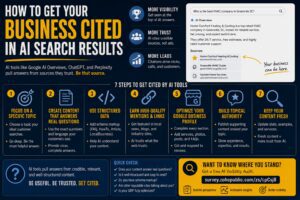
- Focus on clear, factual, well-structured content that AI can easily reference.
- Answer the core question of your topic in the first paragraph.
- Use headers, lists, and subtopics that make your post scannable.
- Include data, quotes, and experience-based insights that signal credibility.
AI models pull from high-trust content. The more proof of experience and authority your site shows, the more likely it is to be cited.
2. Keywords Still Matter, But Topics Matter More
The days of chasing one keyword at a time are over. AI evaluates the full context of a page, not just its target phrase.
Instead of focusing on a list of keywords, shift to topics and clusters.
Pick one core subject, then create multiple posts that explore related angles.
For example, if your pillar post is “How AI is Reshaping SEO,” your supporting content could include:
- Keyword research in the age of AI
- How AI tools impact content creation
- The truth about AI-written blogs and ranking
- How to optimize for Search Generative Experience
Interlink them. Each blog supports the others, helping Google understand that your site owns the topic.
When your site builds topical authority, you’ll start ranking for hundreds of variations around that theme.
3. E-E-A-T Is Non-Negotiable
E-E-A-T stands for Experience, Expertise, Authority, and Trust.
Google has made it clear that content must be written by real people with real knowledge. AI can assist, but your human perspective and proof of experience matter more than ever.
To improve your site’s E-E-A-T signals:
- Add an author bio that highlights your experience.
- Link to real data sources and references.
- Use original examples, stories, or screenshots.
- Keep your site updated and your information current.
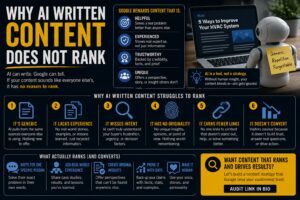
When AI evaluates which sites to trust, these signals set you apart from generic content mills or fully AI-generated blogs.
4. Human Creativity Is the Competitive Edge
AI can create content, but it can’t create trust.
Readers and search engines are both drawn to authenticity. Your insights, experience, and point of view will always stand out.
Use AI to handle the busy work, not the voice of your brand.
- Let AI help outline, summarize, or analyze.
- Write the insights and examples yourself.
- Edit everything for tone, accuracy, and brand alignment.
SEO in 2025 is about using AI to scale without losing personality. The blend of automation and authenticity is where your authority grows.
5. SEO Is Now a Continuous Conversation
You can’t publish once and move on anymore. Search engines and AI models constantly learn from new content, engagement, and context.
Treat your blog like an ongoing conversation with your audience.
- Update high-performing posts every 60–90 days.
- Add new data or examples when trends change.
- Repurpose key sections into LinkedIn posts, short videos, or podcast segments.
This activity keeps your site fresh, signals relevance, and helps your content show up in evolving AI search results.
6. AI Tools Are Your Advantage, Not the Enemy
AI doesn’t replace SEO. It makes SEO faster and smarter.
Use it to research, outline, and refine, not to replace your expertise. Some examples:
- Use ChatGPT, Gemini, or Perplexity for topic discovery.
- Use Surfer, Clearscope, or Frase to identify semantic terms.
- Use RankMath, Yoast, or WebSite Auditor to improve technical SEO.
The key is balance. Let AI guide your workflow, but don’t let it replace your insight.
7. The Future Belongs to Those Who Adapt
AI isn’t killing SEO. It’s forcing it to evolve.
Search engines will always need trusted, high-quality content to reference. Your job is to make sure your site is the one they trust.
If you’re consistent, strategic, and authentic, you’ll outrank the noise.
This next phase of SEO isn’t about chasing algorithms. It’s about becoming the reliable source that both humans and AI look to for answers.
AI FAQs
1. Is SEO still relevant in the age of AI?
Yes. AI has changed how SEO works, but it hasn’t replaced it. SEO now focuses more on authority, trust, and topic coverage than just keywords.
2. How do I optimize for AI Overviews?
Create detailed, trustworthy content with structured formatting. Use clear subheadings, answer-based paragraphs, and include expert insights to help AI models cite your work.
3. Should I use AI to write my content?
You can use AI tools for research and structure, but your insights and experience should lead. AI-generated content alone won’t build trust or rank consistently.
4. What metrics should I watch now that clicks are down?
Focus on engagement time, scroll depth, and conversion actions rather than only clicks. These show how valuable your content is, even if AI answers reduce page visits.
5. What’s the most important SEO skill in 2025?
Adaptability. The ability to combine human creativity with AI-driven insights will define who stays visible long-term.
AI has rewritten the SEO rulebook, but the fundamentals are the same — quality content wins. Focus on depth, trust, and expertise, and your site will continue to rank even as search evolves.
Search has changed, most businesses haven’t.
If you’re ready to stop guessing and start ranking, let’s build your AI-proof SEO plan today.