
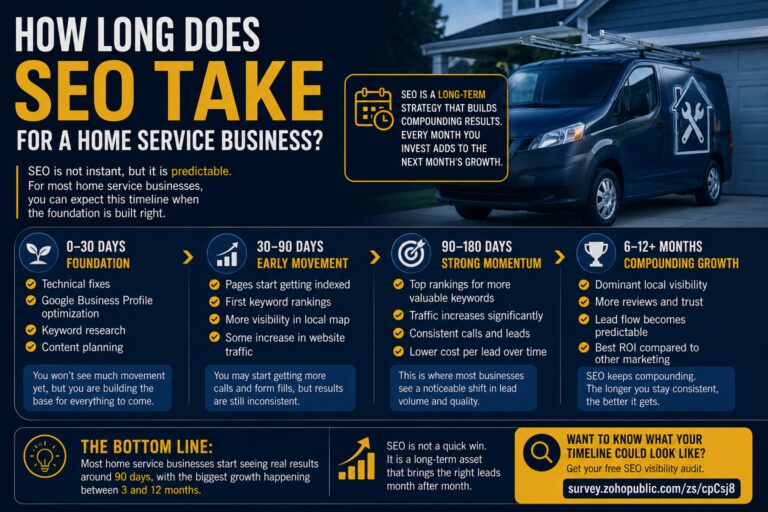
Why does everyone say SEO takes six months?
Because it is a safe answer, and because it is true in the context it came from.
The six month figure comes from competitive commercial search. National ecommerce, insurance, legal, finance. Markets where thousands of well funded companies fight over the same terms and every one of them has already done the fundamentals. In that environment you are not fixing neglect. You are trying to out-earn established authority, and that genuinely takes a long time.
Local home services is a different market with different physics.
You are competing inside a service radius, not a country. Your competitor set is measured in dozens, not thousands. And a large share of those competitors have profiles that have not been touched in two years and websites written by whoever built the site in 2018.
When the bar is that low, clearing it does not take six months.
The other reason the number persists is less flattering. Six months buys an agency two quarters of retainer before anyone is entitled to ask hard questions. That is not always cynical. Sometimes it is just how the industry learned to set expectations. But it means the number gets quoted to businesses it does not apply to.
What actually determines your SEO timeline?
Four things, in order of impact.
1. How much of the foundation has never been done
This is the biggest variable and nobody asks about it. A business with a correct Google Business Profile, decent service pages, and a clean site structure is trying to improve something that works. A business with none of that is trying to start something that does not exist.
Counterintuitively, the second one moves faster. There is more available upside in fixing a wrong primary category than in optimizing a right one.
2. How dense your local competition is
Ranking for HVAC repair in a metro with forty aggressive competitors and three national brands buying local presence is harder than ranking in a market with eight local companies. Both are achievable. The timelines are not the same.
Check this yourself before anyone quotes you a timeline. Search your primary service plus your city in an incognito window and count how many of the results are real local businesses with active profiles versus directory listings and dead pages.
3. Whether your domain has any history
A domain that has existed for ten years with steady, modest activity earns trust faster than a domain registered last month. If you rebuilt your site and changed your URL structure without redirects, you may have thrown away years of that history, which is one of the more expensive unforced errors in this work.
4. How fast the work actually gets done
This is the one nobody wants to talk about because it is usually not the algorithm’s fault.
A ninety day plan takes ninety days if the work happens in the first thirty. It takes eight months if approvals sit for three weeks, photos never get sent, and the review process never gets implemented on the crew side. Search does not punish you for being slow. It just does not start counting until the work exists.
What moves in the first 30 days?
More than most owners expect, because the fastest wins are the ones that do not depend on ranking at all.
- Google Business Profile visibility. Category corrections, service entries, and service area fixes can change map pack placement within days. This is the single fastest lever in local search and it is free.
- Profile engagement metrics. Direction requests, calls from the listing, and website clicks respond quickly once photos, posts, and complete service listings are in place.
- Conversion rate on traffic you already have. Fixing a slow page or a twelve field form does not require Google to do anything. It makes every existing visitor worth more starting the day it ships.
- Indexing of new or rewritten pages. A new service page typically gets crawled and indexed within days. Where it lands initially is not where it ends up, but it is in the game.
What does not move in thirty days is competitive organic position on your highest value term. If someone promises that, they are either doing something risky or telling you what you want to hear.
What moves in 60 to 90 days?
This is the window where the work compounds and the numbers start looking like a trend instead of a fluctuation.
Rewritten service pages settle into real positions. Google needs time to evaluate a changed page against the queries it now matches, and that evaluation is not instant. Around the sixty day mark you usually stop seeing a page bounce between position four and position eleven and start seeing it hold.
Review velocity starts registering. Reviews earned in the last ninety days signal differently than reviews earned five years ago. A process that produces four or five reviews a month shows up as prominence, which is one of the three factors driving local rankings.
Internal linking and site structure improvements get crawled and understood. A page that was buried three clicks deep and is now linked from your main service page inherits relevance it did not have before.
And the traffic starts converting differently, because by this point the pages are matched to intent rather than just attracting volume. This is where owners often notice that call quality changed before call quantity did.
What actually takes six months or longer?
Being honest about this matters, because the fast wins are real but they are not everything.
- Ranking for your highest volume, highest competition term in a dense metro. If four established competitors have been building authority for a decade, you are not passing them in a quarter.
- Building topical authority across a full service line. Ranking for one service is a page problem. Ranking for all of them is a site problem, and site level authority accrues slowly.
- Recovering from a botched migration or a manual penalty. Damage takes longer to undo than to cause.
- Any market where your competitors are also executing well. Most of the time they are not, which is the whole opportunity. When they are, plan for a longer runway.
What a real timeline looked like for one HVAC company
An HVAC company came to us after two years with an agency that told them to be patient. Organic traffic went up 53.7 percent in one month.
Nothing clever happened. The previous agency had never done the fundamentals.
The service pages described the company instead of the customer’s problem. Someone with a failing compressor was landing on a page about the company’s commitment to quality and leaving. The Google Business Profile listed one broad category and crammed every service into a single description block. The pages that mattered were buried three clicks from the homepage.
We rewrote the service pages around the terms homeowners actually type. Rebuilt the profile so categories and service entries matched those same terms. Flattened the site structure. Added answer blocks near the top of each page so a skimming buyer and an AI engine could both find the answer immediately.
That is the entire list. It moved in weeks because the starting point was that low.
A separate HVAC client saw inbound calls climb 242 percent from a Google Business Profile rebuild alone, with website clicks up 80.8 percent and profile interactions up 44.3 percent. No additional ad spend. Same principle. The demand was already there and the profile was blocking it.
What should you ask an agency that tells you to be patient?
Patience is reasonable. Vagueness is not. Three questions separate them.
What specifically will be different in thirty days? A real answer names deliverables. Profile rebuilt, three service pages rewritten, tracking installed. If the answer is about building momentum, there is no plan.
What are we measuring, and what is the baseline? If nobody wrote down where you started, nobody can prove you moved. Calls from organic search, form fills by page, and map pack position for your top five terms are the minimum.
What has been completed so far? Not worked on. Completed and live. Six months of patience with three months of actual work is not a timeline problem.
If your foundation has never been built and you are four months in with nothing shipped, the issue is not the algorithm.
Frequently asked questions
How long before SEO produces actual phone calls?
Google Business Profile fixes can produce additional calls within two to four weeks because map pack placement responds quickly. Organic service page traffic converting to calls typically follows at 60 to 90 days, once rewritten pages settle into stable positions for buyer intent searches.
Is SEO faster than Google Ads for a home service business?
No. Ads produce calls the day they launch. SEO produces calls you do not pay for again. Ads are faster, SEO is cheaper over time, and the strongest local businesses run both, with ads amplifying pages that already convert.