The assumption that costs MSPs deals
Most MSPs treat local SEO as something for plumbers and HVAC companies. Their buyers are businesses, the thinking goes, and businesses do not search “near me.” So the Google Business Profile sits half finished, the website never plainly names the service area, and the local channel gets zero attention while the marketing budget chases LinkedIn ads and cold email.
The behavior of actual buyers says otherwise. IT decision-makers search “managed IT services near me,” “IT support Greenville SC,” and “cybersecurity company near me” every day. They do it for the same reason anyone does: when the stakes are high, they want someone who can show up. And because most MSPs have opted out of this channel entirely, the ones who compete in it face the thinnest competitive field in the industry.
Why B2B buyers still want local
On-site response. When a server room floods, a switch dies, or the network goes down during payroll week, remote support has limits. Buyers who have lived through a bad outage carry that memory into every vendor evaluation afterward. The ability to put a tech in the building within the hour is not a nice-to-have to them. It is the whole point.
Trust and accountability. A local company has a reputation inside the same business community the buyer operates in. Shared connections, chamber memberships, referrals that can actually be checked over lunch. A national provider is a logo and an SLA document. A local one is a known quantity, and known quantities win ties.
The meeting factor. Larger contracts still get signed after face-to-face meetings. A buyer evaluating a serious monthly spend wants to look someone in the eye before committing. Local makes that easy, and the vendor who can be in the conference room Thursday has an edge over the one offering a video call.
The referral loop. Local visibility and local referrals feed each other. When a peer recommends you, the buyer’s first move is to Google you. A strong local presence, complete profile, recent reviews, clear service area, confirms the referral. A ghost presence undermines it. Local SEO is not separate from your referral engine. It is the verification layer of it.
What local SEO looks like for an MSP
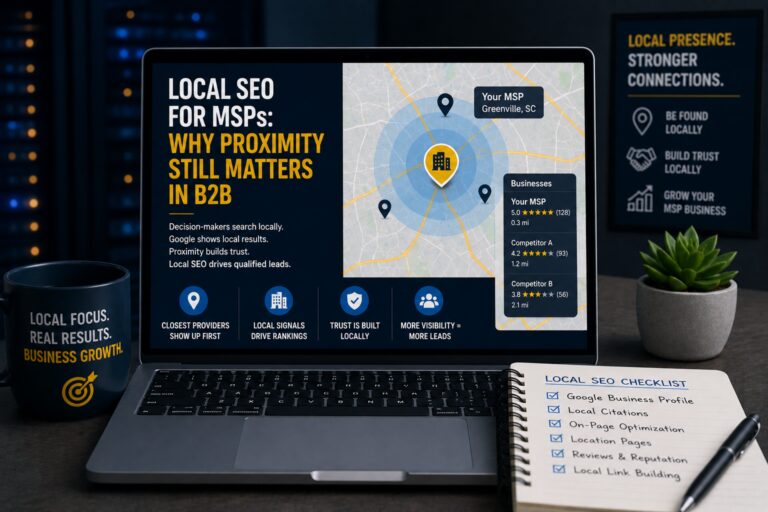
The foundation is the same as any local business, executed with B2B intent. Start with the Google Business Profile: correct primary category, secondary categories covering security and support services, and every service listed with a plain-language description. Reviews from business clients, ideally naming the service and the area, because “migrated our Simpsonville office to Microsoft 365” is both a ranking signal and a sales asset. A website that names your city and service area in real sentences on real pages, not buried in a footer. And citations consistent across the directories Google trusts, because conflicting name, address, and phone data erodes the trust you are trying to build.
Then add the layer most local businesses never need: service pages targeting compliance and vertical searches with regional modifiers. “CMMC consultant South Carolina” has almost no competition in most states. “HIPAA IT support” plus your metro is the same story. These are real searches from real buyers with real deadlines, and the intersection of compliance intent and local intent is close to empty in most markets. Whoever builds those pages first owns them for years.
The map pack is a B2B channel
Picture how vendor lists actually get built. An operations manager gets told to find three IT companies to evaluate. The search starts on Google, and the map pack is the first useful thing on the screen: three businesses with ratings, reviews, and a call button. Those three have a real chance of becoming the list. Everyone else is a scroll away from invisible.
That is a lead source most MSPs have never seriously competed for, which means the bar to enter it is lower than any other channel you could fund this quarter.
The objection: “our clients come from referrals”
Every MSP says this, and it is true right up until it is the ceiling. Referrals are excellent and they are not scalable on demand. They also do not protect you: as covered above, every referral gets Googled, so a weak local presence quietly kills a percentage of the referrals you never hear about. Local SEO does not replace the referral engine. It catches the referrals that would have leaked and adds a channel that produces on its own.
The 30-day starting plan
Week one: complete the profile. Categories, services, hours, description, photos of the actual office and team. Week two: fix the website’s local signals. City and service area named plainly on the homepage and contact page, embedded map, consistent phone number. Week three: start the review engine using project completions and QBRs as the ask moments. Week four: pick one compliance-plus-location keyword and build the page for it. Thirty days of unglamorous work, and you are ahead of most of the MSPs in your metro, because they are not doing any of it.
FAQ
Does local SEO work for MSPs and IT companies?
Yes. IT decision-makers regularly search locally for managed services, IT support, and cybersecurity providers, especially when they want on-site response capability. MSPs with complete Google Business Profiles, business client reviews, and location-clear websites capture map pack visibility most competitors never contest.
What local keywords should MSPs target?
Combine services with your location: “managed IT services” plus your city, “IT support near me,” and compliance terms with regional modifiers like “CMMC consultant South Carolina.” Compliance plus location searches often have almost no competition while carrying strong buyer intent and urgency.
Want to know where you rank in your own market? Book a free audit and find out.