
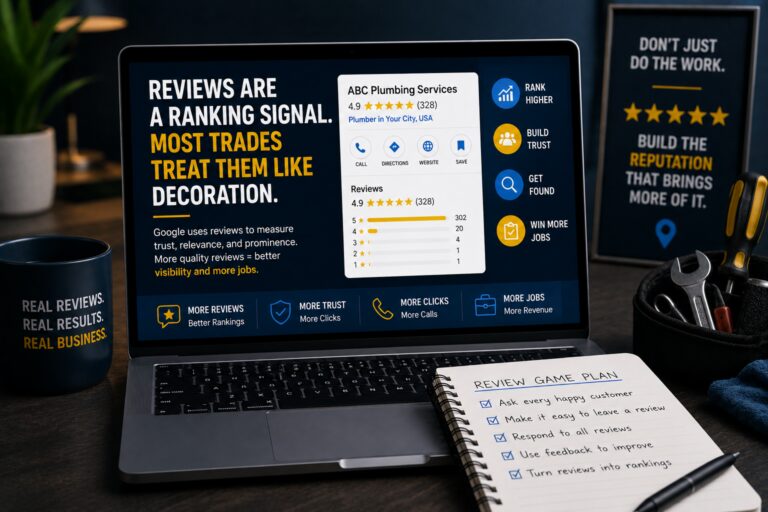
Reviews do two jobs at once
Every review your business earns does double duty. It is a ranking signal Google feeds into the decision of who appears in the map pack, and it is the first thing a buyer reads before deciding whether to call. One asset, working both sides of the funnel: visibility and conversion.
Most contractors think of reviews as a scoreboard, something to feel good about when a nice one comes in. That framing is the mistake. Reviews are infrastructure. They should be built, maintained, and operated like any other system in the business, because the businesses that treat them that way are quietly taking the map pack positions and the calls that come with them.
What Google reads in your reviews
Velocity. A steady flow of reviews signals an active, trusted business. Thirty reviews spread evenly across a year beats thirty reviews from one burst two years ago, because the pattern itself carries information. Steady velocity says the business is consistently completing jobs and consistently satisfying customers, month after month.
Recency. Buyers filter by newest, and Google’s trust calculation weighs freshness too. A profile whose most recent review is eight months old looks dormant to both audiences, no matter how strong the historical average is. Recency is also the factor that decays automatically, which is exactly why reviews need a system rather than luck.
Content. The words inside reviews are ranking signals. When customers mention “furnace replacement,” “drain cleaning,” or your city by name, those phrases help connect your profile to those exact searches. This is why two profiles with identical star ratings can perform completely differently: one is full of “great job, thanks,” and the other reads like a catalog of services and neighborhoods.
Responses. Replying to every review, positive and negative, signals an engaged business to Google and shows the next 500 readers how you treat customers after the invoice is paid. Your reply is also a legitimate place to naturally name the service: “Glad the water heater install went smoothly” reinforces the exact phrase a future searcher will type.
Building the pipeline into work you already do
The businesses with strong review velocity are not lucky and they are not begging. They attached the ask to a moment that already happens on every job: completion.
The system has three parts. First, the tech mentions it in person as the job wraps, when satisfaction is at its peak and the relationship is face to face. A simple “if you were happy with the work, a Google review really helps us” is enough. Second, the office sends the direct review link within the hour, while the job is still fresh. Not “find us on Google,” which is homework. A link. One tap. Third, someone owns the process, checks weekly that requests are going out, and replies to what comes in. Without an owner, the system decays in a month.
Then add the detail multiplier. When a customer is happy about something specific, ask them to mention it: “It would help us if you mentioned the water heater install and that you are in Simpsonville.” Most happy customers will. Those specifics become the ranking fuel described above, and no policy against review gating is violated by asking a customer to describe their own real experience.
What not to do
Three practices to avoid completely. Do not gate reviews, meaning do not screen customers first and only send the link to the happy ones; Google’s policies prohibit it and the filtering patterns are detectable. Do not incentivize reviews with discounts or gifts, which violates the same policies and puts every review at risk if discovered. And do not buy reviews, ever. Purchased reviews are the fastest route to a suspended profile, and a suspended profile takes every ranking you have with it. The honest system above outperforms all three shortcuts anyway, without the risk.
The 30-day sprint to restart a stale profile
If your review flow has been dead for a year, restart it deliberately rather than all at once. Week one: build the direct link, brief the techs, assign the owner. Weeks two through four: work the completion process on every job, and reach back to your five or ten happiest recent customers personally, one call or text each, spread across the month. The goal is steady flow, not a suspicious spike. By the end of the month, the system is running on its own and the profile reads as alive again.
The compounding effect
Reviews compound like nothing else in local search. Every review makes the next ranking easier, and every ranking makes the next call more likely, which produces the next review. A competitor can copy your website in a weekend. They cannot copy 400 reviews earned over years. It is the most durable competitive moat a local business can build, and it costs nothing but consistency.
[Internal link: GBP page on “map pack” / Local SEO page on “local search”]
FAQ
Do Google reviews affect local search rankings?
Yes. Review count, rating, recency, velocity, and the words within reviews all feed Google’s prominence calculation for map pack rankings. Reviews mentioning specific services and locations help you rank for those searches. Consistent review flow signals an active, trusted business.
How do contractors get more Google reviews?
Build the request into job completion, when satisfaction is highest. Have the tech mention it in person and send a direct review link within the hour. Make it one tap. Businesses with steady review velocity systematized the ask. It is process, not luck.
Slow review flow and a quiet phone usually go together. Book a free audit and fix both.