Everyone targets it, almost nobody wins it
Type “managed IT services” into Google right now and look at who actually ranks. National directories. Review platforms. Franchise MSPs with hundreds of locations and fifteen years of accumulated domain authority. Aggregator sites whose entire business is ranking for exactly this phrase.
That is the competition. Not the MSP across town. Companies with content budgets larger than most MSP marketing budgets, playing a game they have already won. Chasing that phrase as your primary target is how MSPs spend a year and real money on SEO and have nothing to show for it except a report that says “impressions are up.”
This is not an argument against SEO. It is an argument against bad targeting. The search demand in this industry is real and winnable. It just does not live where everyone is looking.
The intent problem nobody talks about
Set aside the competition for a moment and look at the search itself. Even if you ranked number one for “managed IT services” tomorrow, who is typing it?
A student researching the industry. A job seeker. A vendor building a prospect list. A journalist. And yes, somewhere in there, an actual buyer, probably at the very beginning of a journey that will take months. The phrase is vague because the intent behind it is vague.
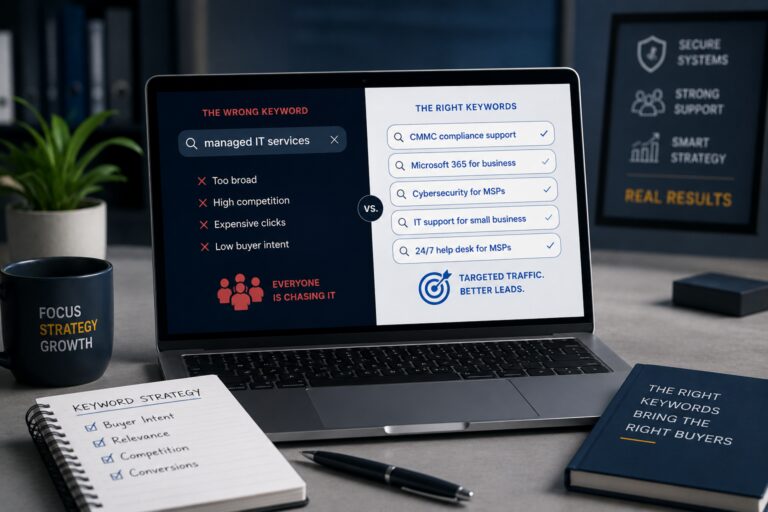
Now compare: “CMMC compliant MSP.” “Co-managed IT for manufacturing.” “Microsoft 365 migration support.” The person typing those has a specific problem, usually a timeline, and often a budget. The search volume is a fraction of the generic term. The buyer percentage is many times higher. In lead generation, a hundred visits from buyers beats ten thousand visits from browsers, every single time. Traffic is not the goal. Revenue is.
Where the winnable traffic lives
The pattern is simple: take the service and add a qualifier that only a real buyer would use. Four qualifiers do most of the work.
Service plus vertical. “IT support for law firms.” “Managed IT for medical practices.” “IT services for manufacturers.” Buyers search their own industry because they want a provider who already understands their software, their compliance exposure, and their workflow. A page written for their industry converts at a rate a generic page never will, because the buyer sees themselves in it.
Service plus compliance. “NIST 800-171 IT provider.” “HIPAA IT support.” “CMMC assessment preparation.” Compliance qualifiers are the strongest in the industry because compliance creates deadlines and deadlines create budgets. These searches also filter for company quality automatically. Nobody researches CMMC for fun.
Service plus location. “Managed IT services Greenville SC.” Local modifiers cut the competitive field from national to regional instantly. The directories still show up, but a well-built local MSP site with a strong Google Business Profile can absolutely compete here, and the map pack adds a second placement the national players cannot fully control.
Service plus problem. “Microsoft 365 migration support.” “24/7 network monitoring.” “Server virtualization services.” Specific services attract buyers who already know what they need, which means shorter sales cycles and fewer education calls.
How to audit your current targeting
Before writing anything new, find out what you are actually targeting today. Open your site and read your page titles. If they say some version of “Managed IT Services | Your Company Name” on every page, you are targeting the generic term and your brand, nothing else.
Then open Search Console and look at the queries you appear for. Two things usually jump out. First, you are getting impressions for modified searches you never intentionally targeted, which proves the demand exists in your market. Second, you rank on page two or three for some of them, which means a focused content improvement can move you into clicking range far faster than any new page could rank from scratch.
List every service you actually sell, every vertical you actually serve, and every compliance framework you actually support. Cross-reference against your existing pages. The gaps in that grid are your content plan, already prioritized by what you can genuinely deliver.
The structure that wins modified keywords
Each modified keyword deserves its own page, built for that search alone. A vertical page speaks the industry’s language and names its specific risks. A compliance page demonstrates real command of the framework, with honest answers about scope and timelines. A problem page walks through the fix and is honest about when it needs a professional.
Every page ends the same way: one clear next step. Not five options. One. In our case, and in what we build for clients, that step is a booked audit call.
The strategy in one paragraph
Keep “managed IT services” in your page titles and headers. It belongs there for relevance. But build your content plan and your expectations around the modified searches you can actually win in six months, not the generic one you might never win. Rankings that bring buyers beat rankings that bring bragging rights. That is the entire strategy, and almost nobody in this industry follows it.
[Internal link: MSP SEO page on “content plan” / Cybersecurity page on “compliance”]
FAQ
Should MSPs target the keyword “managed IT services”?
Include it in your page titles and headers, but do not build your strategy around it. National directories and franchise MSPs dominate that result. Modified keywords combining your service with a vertical, compliance framework, or location deliver higher intent traffic you can actually win.
What are the best low-competition keywords for MSPs?
Combine services with qualifiers: industry verticals like “IT support for law firms,” compliance frameworks like “CMMC compliant MSP,” locations like “managed IT Greenville SC,” and specific services like “Microsoft 365 migration support.” These carry stronger buying intent and far less competition than generic terms.
Want a keyword map built around searches you can win? Book a free audit.