
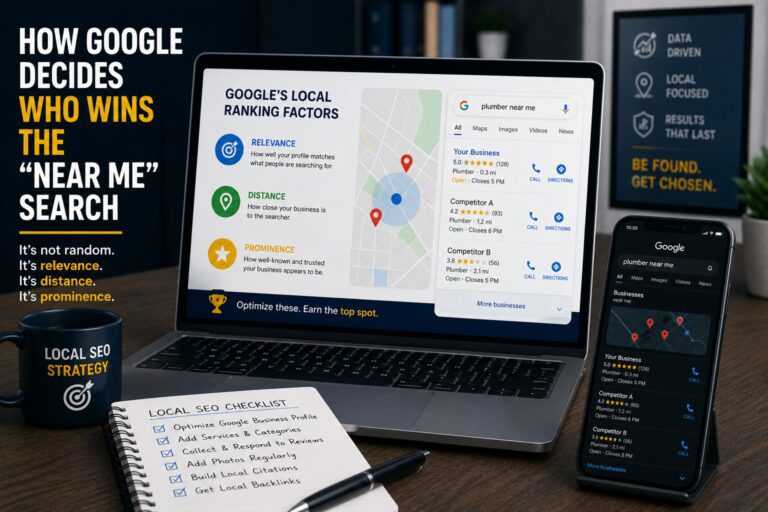
Three factors. That is the whole system.
Google has publicly stated how local ranking works, which makes local SEO unusual: the rules are not a secret. Relevance, distance, and prominence. Every map pack result is those three factors weighed against each other for that specific search, from that specific location, at that specific moment.
Most businesses lose near me searches not because the system is mysterious but because they never organized their effort around it. Understanding what you control, what you influence, and what you cannot touch is the entire game. Let us take the three factors in order of how much control you have, starting with the one you have none over.
Distance: the factor you cannot control
Where the searcher is standing matters. A plumber two miles from the searcher has an edge over one ten miles away, all else being equal. You cannot move your shop every time someone searches, and service-area businesses cannot game this by claiming a fake address, because Google suspends profiles for that and the penalty far outweighs any temporary gain.
Here is the reframe that matters: distance only decides ties. When two businesses look equally relevant and equally trusted, the closer one wins. Your job is to make sure it is never a tie. Every improvement in the other two factors extends the radius in which you beat closer competitors. Businesses with dominant relevance and prominence routinely appear in map packs across their whole metro, well past nearer rivals. That is the goal.
Relevance: does Google understand what you do?
Relevance is how well your profile and website match the specific search. This is fully in your control, and most businesses handle it badly through simple neglect.
Start with categories. Your primary category should match your core revenue service, and your secondary categories should cover the rest of what you do. Then services: every service you offer should be listed on the profile with a plain description. When someone searches “water heater replacement near me,” Google scans for profiles that clearly signal water heater replacement. A profile that only says “Plumber” is relevant to the generic search and invisible to the specific one, and the specific searches are where the buying intent lives.
Your website carries relevance too. It should say what you do and where you do it in plain language on real pages, not buried in a footer. Service pages for your major offerings give Google, and the buyer, something specific to match. Vague profiles and vague websites lose to specific ones. That is the entire relevance game.
Prominence: does Google trust you?
Prominence is your reputation in Google’s eyes, assembled from signals across the web. You cannot set it directly, but you build it steadily, and it is where the compounding happens.
Reviews drive it more than anything else: count, rating, recency, velocity, and the words inside them. A steady flow of reviews mentioning your services and your city is prominence fuel of the highest grade. Citations support it: your name, address, and phone number consistent across the directories that matter. Inconsistent citations do not just fail to help, they actively erode trust, because conflicting information makes Google less certain about your business. And your website’s overall authority feeds in: links from local organizations, suppliers, industry associations, and local press all count.
Prominence is why a business slightly farther away with 300 strong recent reviews beats the closer one with 12 old ones. Trust travels farther than distance.
The 20-minute self-audit
You can grade yourself on all three factors in one sitting. For relevance: open your profile and check whether the primary category matches your biggest revenue service, whether every service is listed with a description, and whether your website names your services and city plainly. For prominence: check your review count and rating against the three businesses currently in the map pack for your main search, check the date of your most recent review, and search your business name plus phone number to spot citation inconsistencies. For distance: search your main keyword from your shop, then from the far edge of your service area, and note where you fall out of the pack.
That last exercise shows you your effective radius, and the gap between it and your actual service area is the opportunity.
Two myths worth killing
First myth: putting “near me” in your content helps you rank for near me searches. It does not. Google translates “near me” into the searcher’s coordinates. Write for the service and the city, not the phrase.
Second myth: local rankings are fixed and the businesses at the top are untouchable. Map packs are more volatile than organic results precisely because they recalculate by location and freshness. A neglected leader can be overtaken in a season by a business that works all the controllable signals consistently.
The takeaway
You control relevance completely and you build prominence over time. Businesses that lose near me searches almost always lose on those two, then blame their location. Fix the profile, build the review engine, keep the signals consistent, and the map pack follows.
[Internal link: Local SEO page on “signals” / GBP page on “profile”]
FAQ
How does Google rank near me searches?
Google weighs three factors: relevance, distance, and prominence. Relevance measures how well your profile matches the search. Distance measures proximity to the searcher. Prominence measures your reputation through reviews, citations, and website authority. You fully control relevance and build prominence over time.
Can a business rank in the map pack from farther away?
Yes. Distance is only one of three factors. A business with a complete profile, strong review velocity, and consistent local signals regularly outranks closer competitors with neglected profiles. Distance decides ties. Strong relevance and prominence keep it from ever being a tie.
Losing near me searches to competitors down the street? Book a free audit and we will show you why.