How To Use SEO For Lead Generation

How To Utilize SEO For Lead Generation

The primary objective of an SEO campaign is to increase traffic to your website and get more leads. It is your company’s aim to acquire more customers and prospects in order to increase future revenues, which is what lead generation is all about. SEO and lead generation go hand in hand in efforts by driving organic traffic to the site via search engine results pages and generating awareness for your company. 

As one of the most trusted brands in the world, Google is one of the reasons SEO is so effective at generating leads. Since Google’s business model has been invisible to the public, where the data collected from customers feeds an online ad program that most people are accustomed to, there is a perception that this is a free service similar to Wikipedia, or at least that’s what we are conditioned to believe.

It is also a fact that Google’s product is superb, which is another reason people trust the company. When you search for almost anything, you will receive a satisfying response. Hence SEO totally helps your lead generation strategy.

For marketers, the best chance at reaching the top of Google search results is to actively participate in the results, and earn Google’s favor such that searchers see Google recommend your website over and over again because you’re ranking highly.

So let’s see how we can use SEO for lead generation.

Intent Optimization

When it comes to optimizing content for intent, there are two main types: informational (what) and transactional (how). Transactional content is typically found on pages with forms like contact us, while informational content is usually found on articles and blog posts. So you need to research keywords and craft a content strategy as per your target audience.

Informational Content

Informational content should be optimized around keywords that describe the topic of the page. This means that when someone searches for something they want to learn more about, they’ll find information about that topic on your website.

Transactional Content

Transactional content is typically used on landing pages and forms. In this case, the goal is to convert visitors into buyers. You might have a form on your homepage asking for their name and email address. That would be considered transactional content. If you were selling a product, then the landing page could contain more details about the product and offer a link to purchase.

Use Keyword That Converts

There are many ways to research keywords. One way is to look at the competition. What keywords are already getting lots of traffic? What keywords do people use to find your competitors’ websites? These are some of the questions you need answered before starting any keyword research.

Another method is to create a list of potential keywords based on the type of content on your website. For example, if you sell products, you may consider using keywords like “best,” “cheapest,” and “fastest.” If you provide services, you may choose words like “professional” or “accountant.” And if you run a non-profit organization, you may target terms like “donate” or “support.”

Once you’ve decided on your keywords, make sure they’re relevant to your audience. Using too broad of a keyword will result in irrelevant traffic. Also, focus on SEO content creation.

Content Marketing

Content marketing is one of the important parts of SEO strategies and lead generation. Once you know what keywords to focus on, you’ll need to write a piece of content around those topics. There are many different methods for creating content. Some companies hire writers to produce high-quality content, but others prefer to outsource the work to freelance writers.

Regardless of whether you decide to produce your own content or buy it, make sure it focuses on keywords related to your industry. Your content needs to be useful to readers. They don’t care about your brand; they just want to read an article that answers their question.

Focus on Page Load Speed & Web Vitals

If your website doesn’t load quickly, users will leave. Not only does slow loading time hurt user experience, but it also hurts search engine rankings. According to Google, webpages that take longer than three seconds to load receive a lower rating.

Google also says that mobile users have less patience than desktop users. As such, if your website isn’t optimized for mobile devices, you risk losing business.

To ensure fast load times, make sure images aren’t taking up too much space. Use CSS sprites instead of separate files. Minify JavaScript and CSS code. Optimize images with GIMP or Photoshop.

Mobile friendliness is another important factor. Make sure your web pages look good on both desktops and smartphones. You can test how well your site works on various devices by visiting Google’s Mobile-Friendly Test Tool.

Perform A Competitor Analysis

After you’ve created content for your website, it’s time to analyze your competitors. This step helps you determine where you stand against your rivals.

You should start by looking at your top competitors. How did they rank in the search engines? Did they perform better than you? Why were they able to achieve higher rankings?

You can then compare yourself to your second-tier competitors. Are you doing as well as them? Why not? Do you need to improve your marketing strategy?

The third step is analyzing your bottom competitors. How are they ranking? Are they even ranked? Is there anything you can learn from their strategies?

The final step is analyzing your niche competitors. How are they performing? Are they making money? Why aren’t you? What do you need to change?

To perform an in-depth competitor analysis so you can plan an SEO roadmap that is focused on lead generation.

Conversion Rate Optimization For Increased Leads

Leads are one thing, but conversions are quite another. Conversion rate optimization (CRO) is the process of improving the conversion rates of your potential customers through your landing pages.

Landing pages are the pages visitors land on after clicking on a link. These pages usually contain a form that allows visitors to submit contact information.

There are two types of landing pages:

  1. Lead capture pages – these are designed to generate interest in a product or service.
  2. Sales pages – these are used to collect contact information and add your customer to a sales funnel.

While most websites focus on increasing the number of leads generated, CRO aims to convert those leads into sales.

This means optimizing your landing page copy, design, layout, and calls to action.

Here are some tips to help you optimize your landing pages:

  • Use clear language. Visitors want to know exactly what they’re signing up for. Avoid using jargon and technical terms. Instead use simple words like “free” or “guaranteed.”
  • Use an appealing headline. Headlines are the first things people see when they visit a webpage. They play a huge role in whether visitors stay on a page or bounce away. So make sure your headlines are compelling enough to draw attention.
  • Make sure your call-to-actions are obvious. If a visitor lands on your page but doesn’t understand what needs to be done next, he may leave without filling out a form. Make sure your forms have clearly labeled buttons. And don’t forget to include a subscribe button!
  • Make sure your forms are easy to fill out. Forms with too many fields will discourage visitors from completing them. Keep your forms short and concise. Also, avoid asking for sensitive information such as Social Security numbers.
  • Add value. Don’t just ask for contact info; offer something valuable in return. You could give visitors free access to a whitepaper or exclusive deals.
  • Don’t overuse images. Images take up a lot of space and distract readers. Try to keep image usage to less than 10% of your content.
  • Include videos. Videos add credibility to your business and are great ways to engage potential buyers.
  • Test different layouts. While it may seem counterintuitive to test multiple versions of your landing page, this is actually a good idea.
  • You should always try to improve the conversion rates of your pages. This way you’ll attract more qualified leads and ultimately increase your revenue.

If you want lead generation through SEO then you need to optimize CRO techniques so it becomes easy for your customer to convert or fill the leads gap.

SEO For Better Customer Service

Customer service has never been more important than it is today.

The internet has made customer service easier than ever before. But if you aren’t taking advantage of it, then you might lose out on new customers.

If you’re looking for ways to improve your customer service, here are five tips to consider:

  1. Provide quick responses. Customers expect immediate answers to their questions. If they need to wait hours or days for a response, they’ll likely go elsewhere.
  2. Use live chat. Live chat allows customers to instantly reach someone who can answer their questions.
  3. Offer 24/7 support. Some companies only provide phone support during normal business hours. This makes sense because there’s no guarantee that someone will pick up the phone at any given time. However, offering 24/7 support gives customers the assurance that they can reach you whenever they need to.
  4. Have a FAQ section. A well-written FAQ section provides answers to frequently asked questions. This helps prevent customers from having to email you repeatedly.
  5. Be transparent. Transparency goes a long way toward establishing trust between you and your customers. In fact, according to research conducted by The Art of Manliness, transparency increases customer satisfaction by nearly 20%.

Conclusion

As you can see, SEO for lead generation is much more than simply optimizing keywords. Instead, it’s a whole process that involves creating quality content and using various tools to drive targeted traffic to your site.

Lost or seems this all a little too much to handle? You can always leave it to the professionals to take the reins. Apply to work with us 

Maybe you want to implement the strategies and use the tools yourself. We have a program for those who simply want a guide to your SEO problems: SEO Lifeline – https://1x1impression.com/seo-lifeline/

In the meantime, you can always join our free Facebook group: https://www.facebook.com/groups/seoforbusiness1x1

How To Increase Website Conversion Rate

Looking To Increase Website Conversion Rate?

First, a conversion rate is a function of a website’s usability. It increases the brand’s trust, the relevance of incoming traffic, and various other factors. Do you want to increase website conversion to get more business? You’ve arrived at the ideal location.

Working to increase website conversion rate becomes necessary if you want to be sure of the most acceptable quality content and know that your marketing expenses yield the desired results. You must constantly optimize your website to boost conversion rates.

Let’s dive into this blog post to learn about some practical tactics for increasing reasonable conversion rates.

Why Is It Necessary to Improve Your Website Conversion Rate?

Before you start making improvements or working on the process, it is critical to understand why this is necessary in the first place.

To improve website conversion rate, you would be working towards improvising the marketing ROI. In other words, it is all about aiming for a more significant number of visitors, which would ultimately lead to a higher impact on the drive.

Being on top of things and boosting existing traffic will allow you to get the most out of your marketing spending. As a result, it is critical to devote significant time and effort to the conversion factor.

Statistically Proven Methods to Increase Your Website Conversion Rate

If you’re looking for some great ideas to boost your website’s conversion rate, all you have to do is take a step-by-step approach.

Here are the statistically proven methods to improve your conversion rates:

  1. Defining the objectives

 Before embarking on the conversion rate optimization journey, you must clearly define your objectives and plan. This strategy should outline what needs to be done and what you expect from your visitors due to their actions on your website.

Defining the website’s goals is critical to understanding conversions and what to optimize for. You must also ensure the value for which your users come to your website. The end goal is to achieve a reasonable conversion rate.

After you have defined your objectives, you must measure your performance against your established standards. This can be accomplished by evaluating the visitor’s behavior against the defined goals.

  •     Goals to Consider

Form submissions, CTA buttons, link clicks, element clicks, landing pages, and custom conversions are some of the main conversion goals you can establish to increase your conversion rates.

Hiring some external help with a solid professional foundation and a wealth of expertise can offer you a leg up on the competition in various ways.

You would be able to define targets based on your specific needs and track your visitors’ behavior. This will direct potential customers to your website so that website optimization will be at the top of your list of company chores.

  1. Developing a Strong Value Proposition

When running a business, you must ensure that you can create a lot of traffic. This is achievable through developing a credible value proposition. Another key metric that can predict the possibility of a higher conversion rate is the value proposition.

To increase your website conversion rate, you can always rely on the most crucial conversion component, which is none other than value creation.

Strengthening the goal and values and developing a USP will assist you in attracting more customers, making the most of your marketing investments, and aiming for higher ROIs.

  •     How Can You Achieve a Good Value Proposition?

If you want to have an excellent value proposition and work hard to get one, you must recognize that it must be sufficiently separated from your competition.

You must also excel at one point or one part of the value. Suppose we continue to discuss what a VP is. In that case, it must be all about developing or reflecting your product or service in an entirely distinct way and offering value for the customers.

Once you have created a value proposition, you must convey it correctly and effectively to achieve the best results. The most excellent way to accomplish this is through social media.

  1. Eliminating technical jargon

This could be a significant reason or a beneficial factor in turning the tables for your website overnight. You should make sure that you are posting content on your website so that it is easily understood even by a layman.

To entice your audience, utilize customer-friendly language and avoid using fancy terms. Technical jargon can sometimes impede increasing your conversion rate because it pushes users away from your website.

It should be all about people because they will decide the fate of your company and the website you create for it. Don’t continue to use vital phrases to persuade.

You must write as you speak. This means you should post relevant material that emphasizes your products and services. If necessary, rephrase to remove technicalities.

You can anticipate anyone to visit your website, whether it is a company, a customer, a human unfamiliar with the nuances of the language, or someone with cultural differences. As a result, you must ensure that your material is written in plain language.

  1. Including live chat

Many customers who visit your website are potential customers ready to buy your goods or service right away. However, their lingering thoughts and coming questions hold them back and make them abandon their carts.

Even if you go to great lengths to outfit your website with everything head to toe, customers may demand more. To meet those extras, you should have a live chat option to learn everything they need to know about your products.

This powerful method, like a pop-up, will make your website more user-friendly.

  1. Examining the competition

If you want to excel in your domain and stand out from the competition, you need to know your competitors. It would help to examine your competitors’ moves, strengths, and weaknesses.

The facts and social proofs gathered from your competitors will assist you in framing your UPS and working tirelessly to improve the site conversion rate.

When consumers decide to buy something, they conduct research and find the best things, whether on a website or not. Keeping this in mind, you must put yourself in your customers’ shoes and compare yourself to the competition to figure out how to differentiate your offers.

  1. Build trust

If they are unsure about your services, your customer will never fall for a deal, no matter how good it is. You are expected to present your products and content on your website so that your customers can thoroughly assess the correctness and thus be convinced.

You must take some steps to accomplish this. You must make the information easily accessible on the internet to be easily measured for accuracy.

In addition, you must lay a solid foundation for your website. Along with the material and services you offer, you should highlight your organization’s expertise.

  1. Provide lucrative bargains and money-back guarantees.

Another strategy to increase website conversion rate is to attract your customers with appealing promotions and offers. At times, your customer may expect more from you regarding guarantees and warranties.

At times, you may need to provide incentives and offers to your customers, such as a money-back guarantee, for them to exhibit interest in at least testing your goods and closing the deal for future occasions.

Consumers today want to avoid risks at all costs and want to be competitively priced and confident in what they are paying for. A money-back guarantee would assist you in assuaging concerns and moving past obstacles.

  1. Use best techniques for sales copywriting.

It would help make your website sales copy more persuasive to improve the site conversion rate. Case studies have often demonstrated that even minor initiatives or changes to your copy and improvements can result in a significant increase in conversion rate.

Numerous parts of the sales text can be tested. The headline is the most crucial. So, start by testing your headline and determining whether or not it can affect your conversion rate.

  1. Effective Communication

Because you are not physically present on the website, you must ensure that it can communicate effectively on your behalf. It should provide all of the specifics in as much depth as feasible.

After-sales communication or encouraging your consumers not to abandon their carts is what can keep your business running. You can ask customers to register with their email addresses so that you can contact them later to remind them of your products.

All of this is feasible if you improve your communication channels and website. Your website should tell volumes about your company’s genuineness.

  1. Make site navigation as seamless as possible.

Visitors arrive at your website intending to become thoroughly acquainted with your offerings. The path to this destination should be straightforward. You should keep the landing page route basic and easy to follow.

Ensure that your website’s navigation is simple and that you can effectively increase your website conversion rate. It would help make the website more user-friendly to improve usability and encourage visitors to convert.

Include a search function on your website. An internal search trend can dramatically alter the dynamics of your conversion rates. As a result, ensure that you can ultimately maximize the resources and provide the ability for visitors to convert at high speed.

  1. Shortening the time it takes for a page to load

Customers frequently wish to quit a website because it takes too long to load. Longer loading times in calls to action or other techniques can irritate your potential customers. This could be a significant impediment to your transactions.

This can harm your conversion rates. Page load times of no more than four seconds are ideal. The shorter the duration, the greater the likelihood of better conversion rates. Impatient visitors will not return as a result of this.

You can reduce load time by avoiding using huge graphics and utilizing AMPs.

Statistics on Average Conversion Rates

Let’s look at some average conversion rate statistics that can help you measure your website to let you know and give you a good picture of where you are right now.

  1. The average conversion rate for a website is 2.35 percent.

This statistic fluctuates depending on the webpage. However, on average, it displays the same platform across all industries with the same conversion rate. If your conversion rate is around 2-3%, this is acceptable and normal and indicates that you are not performing poorly.

  1. The best websites have an average conversion rate of around 11%.

According to statistics, websites with a conversion rate of 11% or higher are recognized to perform exceptionally well. It moves the website from the bottom to the top. A good website has such a good average.

  1. Facebook ads have an excellent conversion rate of around 9%.

Facebook is much more than just a platform for social conversations. Across all industries, the average Facebook ad conversion rate is 9.2 percent. This could help your website get off to a good start.

  1. The average conversion rate for mobile devices is around 1.6 percent.

According to recent statistical surveys, consumers do not want to convert while using mobile phones. This could be because people find it difficult to text on smaller screens, which could be a significant disadvantage in processing payments.

The Right Way to Aim for Higher Conversions

With the right approach, aiming for better conversions is no longer significant. You can also hire some professionals and use digital marketing to make the most of the money you’ve spent on marketing.

A company and its website can only be successful if people use them and visit them. The higher the number of potential customers, the higher the conversion rate. As a result, use statistically proven strategies to increase conversion rates.

 We know busy business owners don’t always have the time to research the newest, most effective strategies and implement them, so let our SEO experts take that off your plate. Click here to apply to work with us.

Importance Of Search Intent Optimization

Importance of Search Intent Optimization

In today’s competitive business world, better strategies are required to distinguish them. This is feasible if you can make the content placed on your website more successful in terms of visibility and answering your consumers’ questions. 

Customers are the ultimate kings of the market in this day and age; thus, paying attention to the most minor aspects of what they desire is critical. If we talk about what the customers need, it is the exact piece of information they need when they go to search for something on the internet.

This is referred to as search intent optimization. Customers today want precise information and to-the-point specifics about whatever they seek on the internet.

Search intent optimization is offering the exact same information or answers based on the question of your target customer. It is all about satisfying your clients’ immediate demands and hence prioritizing and keeping their wants at the forefront.

What is Search Intent?

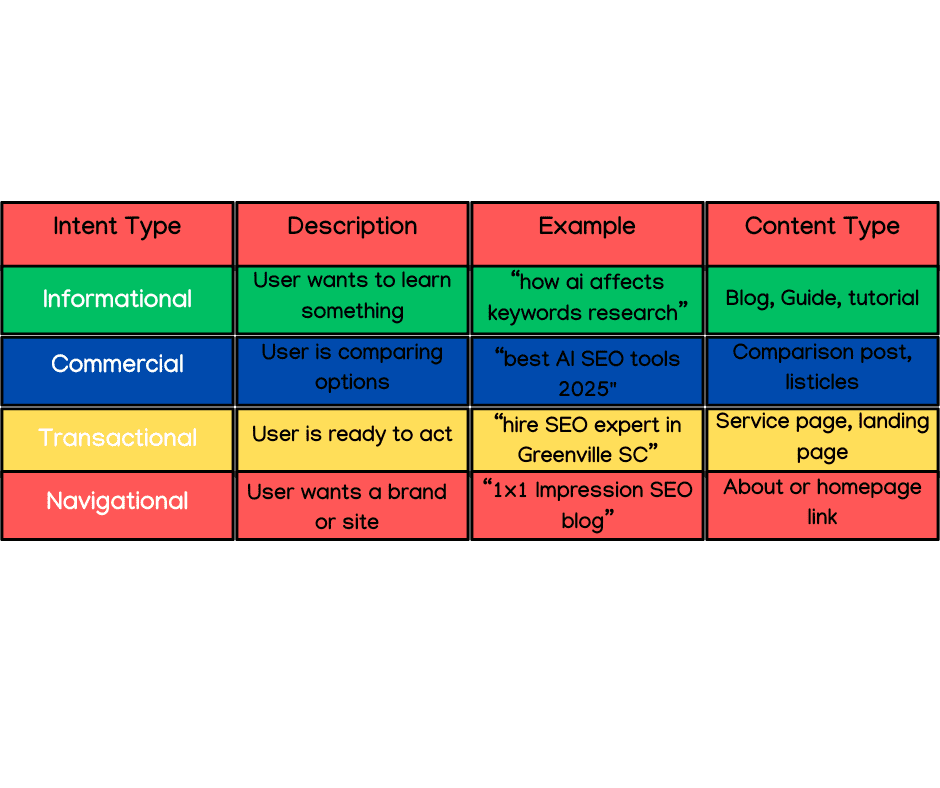
Search intent is one of the most important parts of digital marketing nowadays. There are various types of search intent that we will examine here. Intent-based search optimization is what you should aim for to make your marketing strategies effective. So, let’s look at the many types of search intent.

Types of Search Intent 

Informational

The searcher here is looking for information. The answer might be as basic as possible. For some good rankings, you must supply the customer with more than adequate information for them to acquire a clear view. The goal of informational intent is to provide exact responses.

Examples of informational aims include: 

  1. “How to write SEO-optimized content?”
  2. “What is the name of the 5th President of the United States?”

Commercial

The searcher has arrived and is eager to complete a transaction. The search engine must provide appropriate responses to the searcher in order to solve the queries in a matter of seconds. Customers are in the shopping mood and have pre-planned what they want to buy. To optimize for search intent properly, you must be astute enough to allow your customers to navigate the process effortlessly and fast.

Customers in this category are seeking a place to buy. The suitable marketing and steps would satisfy the client’s needs in the most appropriate way.

Transactional intent examples include

  1. “Purchase iPhone 13 Pro Max.” 
  2. “spa voucher.”
  3. “Samsung Galaxy A52 cheap.”

Navigational

This searcher is looking for a specific website. They already know where they need to go. It is faster and easier for them to Google it immediately rather than putting the entire URL into the address box.

One cause for this could be that they are unfamiliar with the precise URL due to its length and complexity.

The following are examples of navigational searches:

  1. “Instagram” 
  2. “Beginner’s Guide to Cryptocurrency.” 
  3. “Facebook Login.”

Commercial

The searcher over here is in the market looking for a specific product or service but is unsure about the financial selection. They are undecided on whether or not to purchase the product. They are looking for reviews and comparisons in order to make a more informed selection.

Search Intent optimization must be on point in order to make proper use of the content marketing and encourage the buyer to proceed with the purchase. They are deliberating their alternatives.

Examples of this search include: 

  1. “Best immunity booster.” 
  2. “Python vs. Ruby.” 
  3. “Top restaurant in Connaught Place.” 
  4. “Best cardiologists reviews.”

Why Shouldn’t You Ignore Search Intent Optimization?

To optimize for search intent, you must be on point and focused on putting your customers’ requirements first. Today’s market is entirely focused on the consumer, and nothing goes beyond that. It all comes down to making the proper decisions and hiring digital marketing services to handle everything for you.

Search intent is addressed in the context of e-commerce, where you must match the landing page to the expectations of the target customer.

Content marketing strategy can help you have a better experience as a result of it. Therefore, it should not be avoided at all costs.

When you use the services of SEO experts, you can make the most of your money while getting unrivaled results. Today, speed is the most crucial factor to work on, and if you succeed in maintaining it fast and optimally, it may considerably catch your customers’ attention.

The faster you can answer your customers’ questions, the better your marketing outcomes will be. The search query must direct your customer to the desired website in a matter of seconds.

The search purpose explains why the user is conducting the search.

How to Optimize for User Search Intent: What Should You Do?

If you are seeking answers to the questions of what needs to be done to optimize for search intent appropriately, then there aren’t one but several things to accomplish. Check out these helpful hints for making optimization a success.

Data extraction from SERPs: 

Take a look at your content’s SERPs if you want to improve its match to search intentions. You can see the results Google generates when you run keywords through its search engine. Keyword placement challenges can be obstacles for you.

To get unbiased results, you must go incognito and clear caches. SERPs can provide you with good insight and analysis of the keywords. You’d be able to see which pages are at the top of the rankings. An active intent is all about directing your clients to sites that will provide them with the correct answers to their concerns.

Taking these steps ahead of time will allow you to concentrate on the type of material that should be included in the text. Make sure that your material is as relevant as possible.

Identify the search intent: 

To get started with search engine optimization, you must first map it out. All you have to do is begin mapping out the keywords and creating a more strategic list. This will provide you with an idea of the target keywords.

You must incorporate those keywords into your marketing approach. You’ll need to make a chart for it. This chart must include the keyword categories, search volume, intent type, and keyword value.

Charting will give you an overview of the keywords and their intent. You can now begin your keyword research. Fill in the information on the chart as you discover the likely keyword. It becomes simple to concentrate on the search intent.

Content evaluation: 

If you have already completed the creation of your content, you will be needed to review it. It is now necessary to match the existing material to the user’s goal.

Spend some time analyzing the content to determine how well you extracted the information.

Actual intent-based search optimization should be your goal. You must concentrate on keyword usage and placement for this. Examine the search results to see what kinds of rankings they contain.

Match your content to the top of the rankings list. If your content isn’t aligning with the keywords you’ve picked, you should evaluate them and go with the ones that show in more relevant searches.

The Importance of SEO Search Intent

One of the reasons why users perform searches is for query purposes. Everyone who comes to look for anything has a question in mind. The correct keyword list should be geared toward meeting your customers’ needs.

The content and landing pages must be tailored to the target demographic. Here are some legitimate reasons why search intent is important for SEO.

Better satisfying consumer needs: 

When you can match the search intent, you may better address the demands of your customers. You make it simple for your customers to find the information they require.

It would help if you continually were on the lookout for opportunities to solve problems or provide appropriate answers to your customers’ questions. Such marketing strategies might propel your company to new heights.

In specific ways, the appropriate search intent optimization allows you to question your customers’ searches better. You can bring more traffic to your website if you are able to meet the needs of your clients. More leads would result in improved SEO rankings.

Raising brand awareness: 

Digital marketing is one of the most powerful marketing tactics available today for search intent optimization. It correctly forms search intent. Your website’s content improves its ranking in search results and drives relevant leads to the site.

If you want your page to appear at the top of the search results, both traffic and keywords must be optimized. The correct search intent strategy leads to increased brand exposure.

Targeted keywords must be sufficient to cover the name of your brand and the information provided on your brand. The more time your audience spends on your website, the more interested they will be.

Leads should only come from one source: 

Search intent is an excellent source of leads for your page. When you are able to provide information that accurately answers your consumers’ questions, they will not be led to other sites to obtain information. This would restrict your customers’ actions to a few websites.

Your clients would be able to rely on your website and would visit it more frequently if they saw it as a one-stop shop for information. The right strategy to search algorithms is the best technique to get all of the leads and gain the trust of your customers. Customers would spend more time on your website.

Gaining a monopoly: 

Matching the user search intent assists your business in establishing itself as an authority and gaining a monopoly in your field. Providing relevant information based on your client’s needs will show your audience that you are aware of your information and know-how to answer their inquiries about your business, industry, and product.

Building a monopoly and raising awareness about your company will result in an increasing number of individuals visiting your website. Because of how knowledgeable you are in your industry, they will have more trust in you. This trust-building would result in an increase in leads and visitors to your website. This would improve the rankings as well.

Is Your Content Search Intent Optimized?

Now that you’ve completed everything from content placement to keyword research, it’s time to see if your content is optimized for search intent. There is always an opportunity to upgrade and enhance your existing pages and set them to match the relevant search intent.

Make use of the most up-to-date analytics and tactics to ensure the effectiveness of search intent optimization. This can be accomplished by enlisting the assistance of SEO experts who understand how to use digital marketing more effectively. While creating new content, you would be able to combine search intent with keyword research.

Our SEO experts are always ready to assist with optimizing your search intent; whether you hire us or join our SEO Lifeline program.

What is SEO Maintenance & Why You Need It?

If we define SEO maintenance, then we can say that it is the process of making continuous improvements in the ongoing process of making modifications to the website. This is done in order to attain satisfactory rankings in search engine optimization. 

 The major goal of this technique is to ensure that the website’s content accurately represents the site. This is done in competition with others who, from time to time, make significant efforts to keep their enterprises on top. 

 SEO maintenance services assist businesses in maintaining their current top search positions. Such services are supplied to businesses that have higher ranks for the main keyword

 Even if you stay at the top of the webpage, things will not always be as they are. To create better links and stay on top, you must always stay on top of the ongoing processes and properly maintain your SEO for never-ending success. 

 To be at the top of the search results, you must put forth significant effort. Today, the right companies are putting up their best efforts in the area of SEO maintenance. To get the best results, all you need is consistent keyword placement and regular SEO maintenance. 

According to analytics, SEO is one of the most important aspects impacting the success of a piece of content. 

Importance of Ongoing SEO Maintenance 

If you are concerned about the analytics and success of your website, as well as its upkeep, the appropriate tactics will make this a much easier chore. Most businesses are using smarter methods than ever before to make their content and marketing successful. 

So, let’s concentrate on the significance of ongoing SEO maintenance. 

Ongoing process 

 you can make the most of your efforts if you pay close attention to Google Analytics and measure your success against the defined standards. 

SEO maintenance is a continuous procedure that brings to mind one of the most effective tactics for improving your website’s metrics. This continual process assists you in maintaining your position at the top of the search results. It’s not going to be like this forever until you’ve made it to the top. To be at the top of the search results, you’d have to work hard all the time in maintaining the SEO.  

It should always be about the straight landing of your business from the link

SEO is not a one-time show 

Another important point to remember is that after you reach the top, things will not always be as they are. It’s all about constant improvement and being open to new ideas in SEO. 

Businesses that are succeeding nowadays are doing so because they are investing in SEO and paying attention to every detail in order to properly monitor the performance of their website. They were able to effectively arrange their plans

As a result, SEO offers a variety of benefits and is not a one-time event. It’s all about sprucing up your content on a frequent basis in order to maintain your top ranking. 

SEO is dynamic and ever-changing

Every day, technology has brought about a massive surge of inventions. When it comes to evaluating the website and its success on a regular basis, SEO is a must. You have to come up with something new every day to stay innovative in your domain of website maintenance. 

This is how businesses can achieve success. 

Being at the top of the search results is only achievable if you adapt your business to the ever-changing dynamics and maintain your website’s SEO on a regular basis. It’s all about double-checking keyword placement and tracking visitors’ experiences.  

If you follow current trends and make full use of technology to come up with something unique, SEO can be a breeze. 

A trend can be changed 

It will never be the same again. If you want to improve the visitor’s experience on your page, you’ll have to put in some significant effort. It may be easier to reach the top of the search engines if you adapt your performance to changing trends. 

Your website’s material and content must speak for themselves in terms of how up-to-date or current it is in terms of trends. This is how SEO works to help you achieve your goals. To keep up with the current trends, all of the factors that directly or indirectly affect the performance of your website must be considered. 

The website’s contextual content and the article should be put in such a way that they can be modified at any time to reflect current trends. 

Competitors aren’t going to back out. 

Another significant benefit of SEO maintenance is that it provides you with information about your competitors, who are continually striving to remain at the top of search engines. In those circumstances, keeping up with the competition can be challenging. 

The smartest method to succeed in the competition is to hire SEO companies that can help you navigate your way to SEO success. 

You must also avoid disadvantages such as broken links, monotonous content, and so on in order to keep up with the competition. Prepare for the unexpected since your opponents will devise more robust strategies

Rankings won’t be stable 

Ongoing SEO maintenance can also help you stay ahead of the competition in terms of search engine rankings. However, you must accept the reality that rankings are not always consistent. They could shift from one day to the next. 

It’s all about getting to the top with the right bounce rate and a good post. Additionally, a report and analysis of your performance might provide you with some insight into what has to be done in order to consistently obtain first place. 

Your company should always be able to rank at the top of organic search results and achieve organic success. In the event of fluctuations, search engine algorithms are the greatest strategy to attain higher rankings. 

What Does Monthly SEO Maintenance Includes? 

Checking keyword rankings 

It’s vital to test the content’s success and usability after you’ve finished creating it and placed it on the website. This is achievable if you maintain a close check on the website and know how effective it is at keyword placement. 

Ongoing SEO maintenance puts you ahead of the game in terms of monitoring your keyword rankings in major search engines and ensuring that you are constantly at the top. 

You may always aim for a success-driven strategy that speaks for itself in terms of efficiency while being at the top of the search engine results. 

Monitoring the website’s performance 

Ongoing SEO maintenance allows your company to make great use of tools like keyword tracking tools and others to track the success of your website. 

You have a dedicated time frame to devote to measuring the performance of your website. The quantity of visitors to your website determines your success. This, of course, is dependent on the material you provide on your website. 

There would be increased visitor engagement if the content was more interesting. You can accurately assess the performance of your website and conduct keyword analysis with continuing SEO for long-term success. This has the potential to significantly increase the ranking factor. To get to the top, you must crack the code. 

Fixing technical SEO issues 

Only 30% of small businesses use SEO to make their websites successful nowadays. With continued SEO maintenance, this tiny number can be transformed into a larger one. This might be remedied with regular SEO upkeep.

It can help you get a handle on your technical SEO challenges and develop a more solid strategy for making your website SEO-friendly. We also keep your Google search console clean and error-free.

The correct marketing strategy is sufficient to attract potential customers, and this may be accomplished by engaging in continuing SEO maintenance to address technical SEO difficulties. 

Updating content 

Ongoing SEO maintenance can also give you a leg up on the competition by allowing you to spruce up your content on a regular basis and in accordance with current standards. It is critical to use resources and refresh your content to keep your consumers engaged in order to achieve the best organic search position. 

This is how this method performed admirably in terms of ranking high in major search engines. Ongoing SEO maintenance allows you to keep your material current with current trends and problems. 

Continuous content creation and updating content strategies are essential to maintain the effectiveness of an SEO campaign.

Competitor Analysis 

When you’re working hard and often on improving your search engine rankings, you’re bound to notice what your competitors are up to. In this manner, you can undertake competitor analysis as part of your continuous SEO procedures and develop a more strategic plan to rank at the top of the major search engines. 

This strategy can propel you to the top of the search engines, and you can focus solely on making the best use of your resources and attaining success as a result. Weekly or quarterly reporting is sufficient to keep up with the competition and leave your competitors in the dust. 

Link building 

There are numerous advantages to SEO. It is also sufficient that it aims for solid link building and the overall success of the website. With continuous SEO, it’s all about keeping track of the appropriate numbers and making better use of resources for successful link creation. 

You can find important search engines and assess which pages should be ranked higher in the SERPs. 

In this manner, you may obtain optimal results with the correct techniques, making it easier for you to reach the summit of the success ladder. This course of action has a better chance of succeeding in the long run. 

Why you Need SEO Maintenance Services 

The keys to staying on top of greater search rankings are SEO maintenance services. It’s all about improving online experiences and getting the most out of the least amount of content you’ve been placing on your website. 

If you’ve been fighting to reach the top of the major search engines for a long time, SEO monthly retainer services are the best way to go. It can do everything for you, from sprucing up the material to assessing performance against predetermined benchmarks. 

It considerably aids the business’s growth, regardless of the obstacles that may arise in the shape of cost, competition, or any other issue. Hire our SEO services to get ahead in the game. 

Professionals can use the majority of their brainpower, as well as some technology, to reach the top of search engines and make SEO a success. There is a rival for each and every business out there.

 With the correct SEO strategy, this major competitive obstacle can be overcome.

Maintain SEO checklists and rankings by hiring reputable SEO services, and make a difference in the old ways of running your company’s website. It’s vital to delegate this process to professionals if you want your content to be validated properly.

This is how you can get the most out of your marketing budget and steer your strategies in the right direction.

So, get your business an in-house strategy to combat all of the technical challenges and roadblocks posed by an SEO plan, and use the correct SEO maintenance to make your business more successful than ever before.

SEO Maintenance Cost

You can consider SEO monthly maintenance as a monthly investment for compound interest. SEO is a long-term investment where you can reap benefits with organic traffic for years.

You need SEO website maintenance to ensure that your rankings and traffic are not disturbed due to changes in the factors like search intent, trend, competition, and so on.

Our clients range from start-ups to established enterprises. We work with them to develop custom SEO plans that suit their specific requirements.

Our SEO experts will ensure that your site stays at the top of Google’s search engine results page (SERP). They will also help you to build backlinks and optimize your social media profiles.

Our pricing models are tailored to your needs. You don’t need to worry about getting ripped off because we are completely transparent when it comes to pricing.

Contact us now to learn more about our professional SEO services company or Apply to work with us!

How To Boost SEO Using Schema

Have you ever considered the potential that your company is overlooking? Schema Markup could be one of those potential options. It is one of the most recent advancements in SEO, and it is a new type of optimization that is frequently overlooked or underutilized. 

Have you ever noticed how search snippets on search result pages display extra characteristics to make them stand out even more? These are referred to as rich snippets, and they are the outcome of schema markup. 

One of the most crucial potentials for a business is Schema Markup, which is currently underutilized. Let’s go over the Schema markup and how to boost SEO using Schema. 

What is Schema & Why is it important for SEO? 

Schema is also known as Schema markup or structured data, and it is the necessary coding that can be contributed to the website’s back end. It enables crawling, organizing, and displaying content to end-users as possible and easy for search engines. 

The standard HTML scripting techniques make it difficult for search engine crawlers to extract the data’s significance. They can only determine the information. That’s where the Schema Markup enters the picture. 

Schema Markup aids in the transmission of what the content means and how important it is to search engines. 

What are the schema benefits? 

To progress in the path of knowing your end goals, you must first comprehend the benefits of Schema markup. 

1. Assists in a better comprehension of your site’s content. 

It’s all about making sure your content is comprehended by the people you’re trying to reach. The main goal is to inform the search engine about everything your site offers, which is why the schema markup was designed in the first place. 

A clear understanding of your website’s content can be expressed via schema markup. This will aid the search engine in surfacing content relevant to the content on other websites. 

2. Get your website at the top of the search engine results. 

Another advantage of using schema markup is that you will be able to reach the top of the Google results. This is because organized data aids you in making the most of the content on your website. 

Google uses white hat tactics to inform people about your content and website, and a schema is merely a tool in the toolbox. According to statistics, Google places a high priority on Schema markup sites. 

3. Enhances your brand’s web presence 

With Schema markup, you can give your brand a boost and increase its online presence. The Google knowledge graph, the big box on the right-hand side of Google desktop searches, is one of the most valuable tools to make it all possible and desired. 

This search includes all relevant business information that clients need to know, such as social media profiles, phone numbers, and reviews. Google only shows information from firms that it considers legitimate, accurate, and valuable. 

Customers will be able to access information on your website and related content that may be of interest to them. 

4. Controls how your brand appears in search results. 

The process of SERPs is where your opportunity to make a positive first impression in front of potential clients begins. It would be a fantastic opportunity to control the consumer experience. The use of structured data gives you an advantage in having more and more control over how your brand is represented. 

Control over this means you can go about establishing how your brand is represented and its content is interpreted and readily testing multiple techniques and the distribution of structured data to websites. 

5. It improves the content approach. 

Thanks to schema markup, you may see your website and the content on it on the other side. Consider your content from the standpoint of rich results, and you’ll see how the schema markup works and allows you to have the most precise solution in hand. 

It also aids in generating fresh content ideas or the revision of old content. The Schema could also serve as a foundation for how you build your website, taking into account a variety of elements. 

With smarter and more precise tools and methodologies, a schema markup implementation keeps you ahead of the game. 

Ways to Create Schemas  

Do you want to learn how to boost your SEO by using schema markup to improve your SEO? Then all you have to do is understand the various ways. There are several methods for incorporating schema markup into web content. 

Let’s get down to business and learn about the various methods for adding Schema. 

1. Google’s Structured Data Markup Helper 

If you lack some web development skills and seek a way to gain access to a developer’s skills, adding schema markup to your web content may be the finest option. It would take care of all the coding. 

The Google structured Data markup aid answers your questions and worries about generating schema markup for articles, movies, restaurants, movies, and job postings, among other things. This web-based utility provides you with everything you require. 

  2. Technical SEO Schema Markup Generator 

This is one of the most widely used systems that Google Search supports. This schema markup format is JSON-LD, Google’s recommended format for structured data. Another way to ensure that your website has relevant information and structured data is to use this strategy. 

It assists in instilling all of the needed item attributes, as well as others. It produces a lot of information. 

3.  WordPress Plugins Like Yoast/Rankmath 

Plugins for WordPress Plugins such as Yoast/Rankmath assist you in optimizing your pages so that you can attain the highest possible rankings. Some SEO plugins go above and above to optimize content for search engines. Yoast SEO is one such plugin that helps with the entire process. 

It aids with the elimination of keyword overuse and provides some suggestions for improving the readability of the article. 

RankMath may also be used as a Swiss army knife of SEO tools on your WordPress website. It includes everything you’ll need to take complete control of your on-page SEO. This tool integrates the functionality of several plugins. 

Implementing the Schema  

Do you want to learn more about Schema and how to boost SEO using Schema? Now that you’ve learned about the different types and how to use them, it’s time to put your strategy into action. 

The primary purpose of using Schema is to improve your ranking, display your website in a better light, and obtain higher results in the SERPs while also looking good in front of users. 

  1. Concentrate your efforts at first on tools like Google’s structured data markup helper. 
  2. Decide on the data type. There isn’t just one option, but several. There is no exhaustion on the list. 
  3. Copy and paste the URL you want to markup. If you only have HTML as a choice, you can do so. 

Then you are free to begin “tagging.” The page will be loaded into the markup tool, providing you with a workspace for the next stage of markup-tagging objects. You’ll see your web page in the left page pane, and in the right pane, you’ll see the data items. 

  1. Decide which items you want to markup. 
  2. Using the data list as a guide, highlight the remaining elements in the article and add them to the markup list. 
  3. Produce HTML. You’d be able to examine your page’s HTML and the required microdata. 
  4. Make the site schema compliant. 
  5. Put your Schema to the test. Make use of techniques such as structured data testing. 

What To Check After Implementing 

1. Errors 

Are there any issues with the schema markup implementation or working? This questioning mechanism will allow you to work rationally to improve your website. 

It’s critical to keep an eye on the schema markup to ensure that your website’s efforts aren’t vain. While the Google search console displays the results, several tools may be used to check for issues or warnings caused by markup. 

Schema Markup Validator, Rich Results Testing Tool, Structured Data Testing Tool, Schema App’s Analyzer, Schema App’s Structured Data Tester, and Google Search Console are some available tools. 

2. Warnings 

Once you’ve completed your testing, you’ll need to pay attention to aspects of warnings that will signal you so that you can take corrective action right away. If any disparities occur, you can take action to correct them if you see any of the warnings. 

This will allow you to get the most out of your efforts and technical resources, resulting in a final product that is reliable, valuable, and accurate. As a result, act logically to eliminate inconsistencies and check for warnings to organize the content. 

3. Accurate information 

When you use structured data, your material becomes suitable for rich results. It also gives the search engine more detailed and accurate content information. When you incorporate it into your SEO plan, you’ll notice an improvement or boost in digital marketing objectives like links, click-through rates, and conversions, among other things. 

Another criterion to keep an eye on as you work on the Schema implementation is accuracy. Accuracy is what your end customers or users will expect; therefore, aim for it immediately away after you’ve finished with the Schema markup implementation. 

Final Words  

When it comes to increasing brand visibility, Schema Markup is one of the most effective approaches. A few businesses and websites have only used it, and it should be used on a broader scale because it is the quickest and easiest approach to make a website and its content successful. 

This strategy would usher in and stay for a longer period. Now that you’ve learned about the different aspects of Schema, it’s time to start using relevant microdata to improve your search results. Get it done now to put yourself ahead of the game by applying to work with our SEO experts and joining our free Facebook group for help with your SEO strategies: https://www.facebook.com/groups/seoforbusiness1x1

How Do Your Measure SEO Success

SEO is one of the most significant factors when it comes to a website’s success. One of the most significant methods to adopt to attain the efficacy and operations of a good website is search engine optimization. It’s essentially a plan that determines where we are and where we want our website to appear in a shorter period of time.   

Through the realms of digital marketing, SEO enhancements are made to work on the website in various ways, such as obtaining good rankings on the major search engines.  

Whether you’re in e-commerce or any other type of business, you’ll need to pay close attention to SEO. Once you’ve implemented SEO, you’ll want to know how well it’s working and how it may continue to grow in the future. The effectiveness of SEO can be measured in a variety of ways. Let’s look at some of the factors that determine SEO success and the know-how do you measure SEO success.  

SEO is a robust digital marketing approach that brings in the most results for a website for the appropriate Google analytics. How you measure SEO performance depends entirely on the type of business you’re in.  

How to Measure SEO: What Should You Do?  

 Knowing the correct Google Analytics measurements and how to go about adopting wiser approaches to make your website a success is all about running and maintaining your business.  

It takes care of everything, from keyword placement to acceptable content. In its algorithms, Google uses over 200 ranking variables. Are you interested in learning more about how you measure SEO? We’ve got you covered, don’t worry.  

Knowing the correct KPIs, targeting the right potential clients, and using and placing the right content and keywords are all crucial.  

The Three Key Performance Indicators  

Three key performance indicators, or KPIs, should always be considered when evaluating SEO success. Rankings, conversions, and traffic are among the KPIs.  

The data acquired from these KPIs is sufficient to determine the efficacy of any website for which you wish to develop and work on SEO.  

These KPIs also provide you with an idea of actionable data that can help you enhance your website’s rankings and bring in more potential clients by generating more leads.  

Rankings  

One of the most essential aspects of the KPI section is keyword rankings. According to various surveys, the top 92 percent of traffic goes to websites at the top of the page. Tracking keyword rankings is a wonderful way to ensure that your website succeeds. It also helps to understand the best keywords, how to use them correctly, and which ones are helpful to the website.  

To attain good rankings, you must build the proper links and insert the keywords in the right places. To achieve SEO success, you’ll need to put in more effort. According to research, specific keywords are highly competitive, while others provide little or no value to the website.  

If you’re unsure about how to measure SEO effectiveness, keyword ranking data is the place to start. You’d be able to make some critical business decisions as a result of it. Good traffic production is also aided by proper keyword placement and utilisation.  

It all starts with relevant content on the website, followed by higher-ranking keywords, and finally, SEO success. It’s all about maximising your SEO efforts to achieve maximum results in the shortest amount of time.  

Traffic Generation  

Another crucial issue to work on is traffic generation and understanding how it may be generated for SEO success that never ends. The number of searches on your website should be as high as possible, while the bounce rate should be as low as possible. This is how you’ll be able to get the most people to visit your website.  

One of the most lucrative and crucial endeavours is determining the quality and volume of traffic delivered by first-page rankings. All you need is the correct kind of visitors, and achieving SEO success in the shortest amount of time would be preferable.  

The number of visitors to an organic website should calculate website traffic volume.  

You will notice a significant shift in the functioning of your website if you use the proper measurements in the direction of SEO success. The organic search traffic you can expect is determined by the prospective audience you want to reach.  

Another critical area to work on in traffic production is traffic quality measurement. This is a more complex process, but it is also highly beneficial in aiming for the ideal audience who can propel you to success.  

Average visit lengths, bounce rate, and pages per visit are some metrics that may be used to assess traffic quality. You need to ensure that the number of visits and time spent on the site is high and the bounce rate is low.  

Conversions  

What are conversions these days? Let’s start by defining them. The website’s specific aims determine conversions. If the goal is to increase the number of leads, conversion tracking should concentrate on quote requests, contact requests, appointment requests, and phone calls.  

Many visitors to your website’s website abandon the idea of completing a purchase at times. These are the activities that must be considered with utmost care and intelligence. Neglecting this line of action could result in you missing out on a valuable chance.  

Newsletters, subscriptions, and whitepaper downloads are examples of conversions. The use of these would provide you with information on potential customers.  

Creating Economic Traffic  

Everything isn’t cheap, and some traffic is costly, which could cost you money on your quest to figure out how you measure SEO success. Instead of Google Ads or organic traffic, the economic value of traffic is sometimes determined by a few clicks and links.  

If you’ve targeted organic clicks with Google Ads, the economic value of the traffic will give you an indication of how much you’ll have to spend for them.  

It’s critical to study the facts and ask yourself questions about which traffic provides you the best rankings, whether landing pages can be improved, and the conversion rate once visitors get on your pages.  

When it comes to gaining success with SEO, a lot of effort and work is required upfront. Compared to PPC, it is a considerably less expensive strategy that also pays off in the long run. It’s all about having the correct content on your website and using well-ranked keywords to get the best Google analytics ranks. It can help you achieve maximum results with the least amount of time and money.  

Learn More About Other SEO Success Metrics

Click-Through Rate  

The click-through rate is calculated by looking at the percentage of individuals who visited or clicked on your page from the search results. A high click-through rate will reveal whether your page and meta description are properly optimised and tempting potential buyers.  

The higher the click-through rate, the better the possibilities of getting engaged and achieving some conversions for the visitors to the landing page. It is one of the most efficient methods for maximising SEO success.  

Bounce rate  

The bounce rate of a website is a SEO metric informs the owner of the number of people who have visited the site, how many of them have browsed or purchased something, and how many have departed the site without taking any action.  

If your clients have viewed your website but haven’t connected with it in any way, you may have made a mistake if you ignored this element. A higher bounce rate is not good for a website’s health. It’s better if your bounce rate is as low as possible.  

Bounce rate is one of the smartest and most entrenched strategies for understanding consumer behaviour since it provides a holistic approach to measuring the effectiveness of your website.  

 A greater bounce rate could also indicate that your website visitors haven’t found any useful content and have therefore decided to leave without taking any action. This will offer you an idea of how to create an executable plan to attain achievement.  

Traffic from Referrals  

Beyond simply boosting organic traffic, planning and implementing a solid SEO campaign can help your company become more structured. It has the potential to propel your company to new heights. If you maintain links at the forefront of your plan, you’ll be able to get the greatest traffic in the quickest amount of time. It’s always a good idea to drive and show the added value. This will also provide you with an idea about a variety of marketing benefits and create strong referral traffic that converts at a higher rate than any other sort of traffic.  

Calculate the return on investment  

Knowing the numbers in terms of monetary value will help you understand the most significant aspects of your website. To analyse the success of SEO on your website, you can calculate the ROI of your initiatives.  

The lifetime value could be a starting point for determining ROI and SEO effectiveness. You can also pay attention to aspects such as a new customer’s first purchase, but failing to include recurrent transactions could lead to inaccurate data forecasts. This could have a negative impact on the finances you’re investing in your company.  

Strategic Understanding to SEO   

Managing and operating a company is a difficult task. Every website owner wants their consumers to be loyal and stay with them for a long time. All you have to do is provide great outputs to your clients and explain to them what makes your products unique and where you shine.  

When you have everything in place, from the correct content and keywords to SEO, it’s time to assess the effectiveness and gain SEO results, which may be done in a variety of ways—creating a clear plan for business goals and KPIs should be done in such a way that customers can understand it. Furthermore, reporting has strategic importance, and proper reporting leads to strategic corporate decision-making.  

Final Thoughts  

You can always tweak your website and aim your SEO efforts in the proper direction by tracking KPIs and using other SEO effectiveness metrics. SEO has a plethora of advantages, ranging from financial to non-financial. Furthermore, SEO is a low-cost, all-encompassing approach to a website’s success. It covers everything from potential customer management to website cost-effectiveness and ROIs.  

Tracking KPIs can offer you an indication of the campaign’s current performance and provide actionable insights and statistics to help you make the best business decisions for long-term success.  

As your business grows and changes, it’s likely that your SEO methods will evolve as well. SEO puts your company and its website on the right track to grow and make the most of your marketing funds. It’s one of the smartest ways to run your website and generate ever-increasing leads for eternal riches and success. So, get started with SEO and maintain track of your results to ensure that you’re getting the most out of it. 

Never touched SEO before and know this is exactly what your business needs but you don’t know where to start, the 30 Days to Unlock Your SEO Potential is just the program you need. Click the link to unlock your SEO potential: https://1x1impression.com/30-days-to-unlock-your-seo/

If you’ve optimized everything and need assistance with maintenance or simply don’t know how to push your SEO further, apply to work with us today

How To Dominate Local SEO?

How to Maximize Your Local SEO to Boost Online Presence?

The online business world lets you target billions of people with a quick click. But unfortunately, if you’re not on the Google first page, your business isn’t on the radar of search engines. Maybe you are present somewhere on hidden pages, but presence doesn’t mean anything if the audience cannot search for you.

If you want to boost traffic, then mark your presence on Google’s top page. But is it possible a small fish can make a presence in between the ocean full of sharks? Trust me, it’s unbelievably tough to get the #1 rank on Google. However, it’s not as tough as you think.

What makes you stand on top is dominating the local SEO. Why So?

#1. You only need to outrank your local competitors.

#2. Boost local SEO to improve searching and ranking

Now, isn’t it looking easier than you think? Local SEO helps dominate your industry and boost your presence on search engines. But, “how to dominate local SEO” to mark a strong presence on Google”?

We will provide you with the answer here. This article will provide you with a stepwise guide that helps to dominate local SEO and crush your competitors under the foot.

Let’s get started!

Google is Spying on You

Do you know “Google has a lens with which it constantly spies on the websites? If you fail to generate the trust signals, you’re not going to stand anywhere on Google. Eventually, your business value gets down. That’s why you need to impress Google and follow Local SEO.

Before we go deep into the trick to boost local SEO, it’s worth staying here for a moment and understanding how local SEO works.

To make it clear, let’s take an example.

Suppose you search on Google “Best accountant near me .”But the question is, “Did Google know who the best accountant is?”

Google does not know the best accountant near you. However, Google is a master in figuring out who solves the audience question and sends positive signals.

So, how does Google Work? The simple answer is trust and answers. If your service answers the user’s search, Google is likely to rank business on top of the search engine. It is easy to do so when you dominate the local SEO.

Why Dominate Local SEO?

Local SEO has the power to give everything a business needs to crush down competitors and get conversions. In addition, it improves discoverability, maximizes the flow of traffic, and helps to rank on search engines.

Let’s face the fact figures now.

  • Nearly 46% of the Google searches daily made are local
  • 97% of the people search for local online stores near to them
  • Nearly 88% of the searches for local businesses are made from mobile devices
  • 61% of searches are for a local business every day on Google
  • Best services near me become the prime keywords which usually searched by the people online

The reasons are enough to explain why companies need to dominate local SEO these days. However, the question is “How to dominate the local SEO .”Let us take you deep-dive into the tips and tricks that help boost your local SEO and rank better on search engines.

How to Dominate Local SEO

How to dominate local search? If you’re thinking about this, then here is the answer. I will explain here the best strategies that give a quick boost to your rank and improve your website traffic. Let’s read below and focus on the strategies.

1.      Invest in Quality Content

Invest your quality time to write unique, readable and Google-friendly content. Everything you write is an index page for Google. This is the page that targets your services and geographical search phrase. It allows you to improve your presence on search engines and easily show you on the Google search engine result page.

If you don’t know how to write a quality blog or article with CTA, take the writer’s help. You can also add success stories of the customers and case studies about how your business helps solve their problems.

Remember that Google loves solutions, and if you’re solving your clients’ problems, Google ranks you on the search engine page. To top of this, content should be optimized and Google-friendly.

2.      Follow On-Page SEO Elements

When optimizing your website and articles, focus on the on-page SEO elements. It helps to rank your website and improve discoverability.

  • Use keywords in the website or content page URL
  • Optimize the page header with relevant keywords. For instance, if you ask how to dominate local SEO, then do ensure to mention it in the header and URL.
  • Internal linking is a must. This gives weight to your statistics and proves that the information return is true. Moreover, internal linking helps boost traffic.
  •  Optimize the website content with keywords. Always use long-tail keywords, which the audience usually uses to do searches on Google.

On-page SEO is helpful to optimize your content, website, and pages. This helps to boost your website quickly and improve your rank on search engines.

3.      Target Long-Tail Keywords Phrases

When you are optimizing your website, always target long-tail keyword phrases. This helps to target your locality and helps to improve your discoverability.

Let’s take an example:

Suppose you’re selling the best designer costumes. The keyword will be the best designer costume. But it may not be able to pull traffic. Why so? This is because you target the best designer costume across the globe and are in millions. How are you supposed to take a stand with a random keyword?

Now, let’s target with a long-tail keyword. Best designer costume in Southeastern DelhiBest designer costume in Calgary.

Likewise, you can cover all the cities and target the same keywords. You can also capitalize the long tail keywords with different cities and locations to make your website search engine friendly.

You have to target the way people search so that the audience can easily find you on Google. This is how you can dominate local search.

If you don’t know what kind of keywords can create the traffic pull, take help from Google Keyword planner and other search engine tools.

4.      Target Complimentary Local Services

Don’t forget to target complementary local services. This also helps to boost your presence on the search engine result page. For example, suppose you’re selling the Best designer costumes. Similarly, you can talk about someone in a specific location selling the same services.

You must be thinking, why do I highlight my competitor?

Well, sometimes highlighting your competitor can give you an extra advantage. How? It helps to write relevant content that quickly targets your locality. But do not overstuff the keyword to reach the word count. Google algorithm strictly punishes you.

Keep it organic with a search intention. When you write organically about complementary services, it helps to boost your presence and give a strong traffic pull. Your customers can easily find you on Google. This helps further in inbound linking.

5.      Make Location Pages

Now, next is to make location or geo-targeted pages. This is one of the crucial steps when you’re dominating local SEO. Suppose you have a franchise at a particular location or multiple locations. Do tell your users through content that you’re active in different locations.

In addition, make location pages that target the particular geographical location. If possible, then make different pages for all locations. 

This helps to target multiple locations at one time. Moreover, you’ll be able to show your presence to the people in all locations.

This gives you a quick boost and dominates the local SEO. Besides that, add the particular address, business name, and phone number. If you have any landmark and contact information, then specify the address.

This helps users to find you easily and reach you. You can also make a separate contact page and an about us page for the address. When you tell people where you are, they will find you easily and connect with you.

6.      Make Website Mobile Friendly

Today, most of the searches made on Google are through mobile devices. But unfortunately, mobile devices and local searches go vice-e-versa. Therefore, you cannot boost local searches unless you make your website mobile-friendly.

Keep in mind; people leave your page within 2 seconds if your page doesn’t download within 2 seconds. They don’t have the patience right now. So, make sure your website is mobile-friendly and optimized correctly. This helps to make your website mobile-friendly.

7.      Write About Current News of Industries

The best way to impress Google is to stay up-to-date. So write current news and blog fodder because this helps make the big win and impress Google. Google freshness updates timely rewards, updates websites, and offers current information.

If anything relates to your industry, make the news and publish it on the website. You can also focus on the local events and other industrial-related news trending these days. This helps to improve your rank on the search engine result page.

How to Optimize Website to Dominate Local Search

How to dominate local search? If you have a question in mind, I’ve got the answer.

1. Register on Google My Business

Registering your business on Google My Business is crucial for dominating local searches. This is essential to boost the local search result. On the Google My Business page, you can add your services and other details such as:

  •  Type of business
  • Business address
  • Opening and closing hours
  • Website URL

Apart from this, optimize the Google My Business page with specific keywords. This further helps to improve your website’s rank on search engines.

2.      Get Links

Start guest blogging to earn maximum links. When you get quality backlinks, automatically your rank will boost on the search engine platform. Also, be an active participant in your industrial niche. This gives you a buzz around improving your rank and building links.

3.      Get Positive Reviews

Today online shoppers decide to purchase anything by reading the reviews. Maybe it’s difficult to ask for reviews because customers are always in a hurry, but you still have chances to get them. So whenever your customer purchases anything from you, ask for the reviews. This helps to build trust and boost your ranking also.

Wrapping Up

Local SEO has the power to boost your visibility and mark sales records. With Local SEO, you can improve your presence on the search engine result page. Congratulations, now you know the answer to How to dominate local SEO.

Now, you can follow the local SEO hacks mentioned above and boost your rank. But don’t forget to add a strong CTA at the end. This compels your audience to reach you and get your services. So save the hacks and thank us later.

Need support? Sign Up for Google Business Profile Optimization

Learn How To Rank For Featured Snippets

How to Get Your Site Listed in Google’s Featured Snippets 

The power of featured excerpts is undeniable, and no one can dispute it. Today’s SEO professionals strive to have all available snippets for their working content.  

The descriptive search results are provided in a customized box prominently displayed near or at the top of the search engine results. 

While figuring out how to rank for featured snippets, keep in mind that optimizing the featured snippets can help you rank higher because Google will be able to tell which page has the best answer to the associated query based on the search results. 

Let’s get down to business and learn the most in-depth analysis of featured snippet opportunities, whether it’s your first time. 

Before we go into the specifics, it’s vital to understand what featured snippets are. 

What are Featured Snippets, and how do they work? 

Featured snippets are extended snippets that appear on the first page of Google’s search results. The major goal or feature of the snippets is to answer the user’s inquiries based on their needs correctly. 

Featured snippets are unique boxes in which the normal search format is reversed, with the descriptive snippet appearing first. 

Users who want to read the complete article can do so by going to the URL of the featured snippet. 

If you’re looking for a way to get to the top of Google’s sites without spending money on the content or building backlinks, you can use Google’s highlighted snippets. 

Different Types of Featured Snippets 

Paragraphs, bulleted or numbered lists, videos, and tables are the four most popular types of featured snippets. 

Based on the search query, Google can select any bit of content from the top-ranking web pages and display it as a snippet in one of several formats. 

Let’s dive into the specifics of each sort of snippet. 

1. Paragraph Snippet 

These paragraph-style featured snippets are the most common. They can show up on the search engine results page (SERP). They include a small text piece that concisely answers questions like how, who, why, when, and what. 

The featured paragraph snippets have roughly 40-60 words on average. 

2. Bulleted or the numbered snippets 

The points or answers provided to users in a numbered or bulleted list are referred to as listicle featured snippets. These snippets are generally displayed in how or what query questions. These must be answered in a specific order or as a list of objects. 

These listicles featured snippets are presented in two formats: an ordered list and an unordered list. The ordered list shows a set of steps or a list of sorted objects. 

The unordered list does not need to be rated in any certain order. 

3. Video snippets 

In some cases, Google may provide a featured video sample, which it usually gets from YouTube. It includes a ready-to-play time stamp that begins at the specified point in the video. 

According to numerous studies and research, these snippets respond to how-to questions. In the instance where the video matched the typed query, this occurs or is used. As a repository of techniques and tools, Google is always releasing new sorts of snippets. This is mostly done to improve the user experience and alter users’ perceptions while exploring or searching for new information on the Google search engine. 

Why Are Featured Snippets Important? What Role Do Featured Snippets Play? 

If you’re trying to figure out how to rank in featured snippets and want to know why they’re significant, there are a lot of benefits to consider. 

1. They improve your website’s ranking. 

One of the most effective strategies for quickly outranking your competitors is using a featured snippet. It propels you to the top of the search engine results page (SERP). 

This is especially important for pages aiming for the top 10 rankings. It is a lot faster way to outperform and improve your rank and boost your performance for direct competition. 

2. Increases brand awareness 

On the quest to learn how to rank for featured snippets, one of the best ways to promote your brand and propel it to the top of the rankings is to use featured snippets. 

The featured snippet will display the website, which will be the first thing customers see when they go online to search for something. 

This is critical for client interaction, especially those who conduct searches on their mobile devices. 

Users will be more aware of your brand and recognize your authority in the area if the featured snippets are optimized to their full potential. 

3. Increases the number of visitors to the website 

The most obvious benefit of using featured snippets is that you will be able to increase the amount of traffic to your website. When agencies and businesses use featured snippets as a tool, they will significantly increase website traffic. 

You may keep track of the most popular pages, the inquiries that led to them, and the pages that didn’t receive the sample. The triggering inquiry would be pinpointed as well. 

Because you’ll be able to work on all of these technicalities, you’ll be able to use rectification to drive more and more visitors to your website. 

4. Improves your website’s authority 

Another advantage of using snippets is that they can assist you in increasing the authority of your website. 

The key ranking mechanism used by Google depends on a website’s authority and how much Google trusts that particular site. The authority of a website is determined by several elements, including link building, average time spent on the page, and total number of visits, among others. 

With more clients, a longer average time spent on the site, and link development through the featured snippet, the website’s total authority improves. 

5. Increases the CTR in some cases 

Compared to other pages, those containing featured snippets are more likely to be clicked. This isn’t always the case, though. Google’s SERP deduplication upgrade makes things a lot easier and more concise. The search query’s purpose determines the number of clicks and the page’s original position in the case of featured snippets. 

Featured snippets can attract some traffic that would otherwise be lost when it climbs to the top of the search results. 

The featured snippet has a 30% chance of stealing clicks from the top-ranking pages. This would generate more visitors than ever before for any page. 

How to Make Featured Snippets Work for You 

1. Keep an eye on your competitors. 

It’s not easy to steal your competitors’ featured snippet. All you have to do is keep an eye on their movements. Put the competitor’s URL in the search box and seek a set of keywords with featured snippets. 

Export the list, categorize it into separate featured snippets, rank it by increased search traffic, highlight the snippets with a low KD score, and collect it for early planning. 

To track why you’re optimizing the page, add the content subjects and the type of featured snippet. 

2. Recognize the search intent 

Understanding the goal behind each query being put or triggered is one of the most important components of moving forward with optimizing the highlighted snippet. 

There are several types of people who come to look for one thing or another. These individuals could be your potential consumers, competitors, third parties, or influencers who persuade your potential customers to purchase from you. 

Each group of people will have diverse goals, with the only thing in common being the informational part. Understanding the intent is essential, whether it be a particular answer, a comparison, a brief explanation, or a video. 

3. Optimize content for your keywords more effectively. 

Optimizing your keywords increases your chances of landing on the featured snippet and guiding you and allowing you to reach the overall SEO. Every company must concentrate on the proper use of keywords and their placement. The focus keywords are quite important in this case. 

This highlighted snippet strategy would tempt any business looking to acquire as much traffic as possible to work for them. It also assists in using third-party services that inform you of the usage and the intent of the focus keywords. 

To stay on top of the current trends in featured snippets, keep an eye on your competitors. 

4. Create and update digital content 

From the competitors’ snippets, you may have worked on the aspects of focus keywords, the type of material you want to work on, the type of featured snippet, the search intent, and the pool of SEO tools. 

If you want to get a jump start on the new content, you’ll need to work on the content plan first. If you’ve already started working on the material, you may need to revise or update the outline to reflect the new information. It provides you with a thorough grasp of what has to be done to attract more and more customers to your website and maintain your position at the top at all times. 

5. Validate and monitor your website’s content. 

Monitoring your performance against the established standards can assist you in making necessary corrections in the event of deviations. Once you have your material ready, go over it to see if it is molded to your consumers’ needs, whether it describes the search intent, and contains the target keywords or suggestions listed. 

This monitoring will tell you if you’re on the proper track with your activities to get a featured snippet. 

6. Put SEO into action. 

Now that you’ve finished writing the content and have it under control, you must assist Google in quickly determining what the website is about. 

You’ll need to perfect the URL, title the tag, add meta tags, heading tags, image alt attributes, external and internal linking, and schema markup elements, among other things, to feature the snippets. 

Following the newest trends will keep you ahead of the game and ensure that your material is ready to be featured in the snippets. 

Final Thoughts 

Like all other Google tools, Feature snippets are constantly evolving and bringing something new to the table. It’s one of the most profitable approaches to investigating and discovering SERP improvements. 

It aids you in a variety of ways in climbing to the top of the search engine and making the most of traffic attraction and lead-generating operations. With highlighted snippets, it’s easier than ever to get your business to the top of the search results. 

Fill out our application form today to hire our SEO services to help you get to the top of the search results.

Can I Do My Own SEO?

Taking Your Website to the Next Level: Doing Your Own SEO 

Today, SEO is a critical component for every organization, and it necessitates extreme caution and attention for any website’s performance. Many firms today either use external sources or try to do it themselves to improve the functionality of their websites. Now comes the question of “can I do my own SEO?” We’re here to answer that question in this post. 

To begin, in simple terms, it is incredibly possible to run your own SEO if you follow a set of steps and approach everything with expertise. All you need to do is conduct some research and practice, and you’ll be ready to complete the task with ease. 

If you are unfamiliar with the principles and wish to learn everything from head to toe, don’t worry; we are here to assist you. So, let’s start from the beginning. 

What is Search Engine Optimization (SEO), and what does it entail? 

The term SEO refers to the process of optimizing a website for search engines. It’s a smart and deliberate strategy for getting your company or page to the top of the search engines. While making SEO more effective and successful, a variety of measures or efforts may be explored. 

It would help if you worked on the following parameters in order for SEO to be effective: 

  1. Keyword research and integration 
  2. Domains of technical knowledge 
  3. Appropriate keyword placement 
  4. The credibility of the content 

Taking care of these aspects will offer you a leg up on the competition when it comes to getting your website to the top of the search results. SEO is a method for enhancing your website and building higher goodwill towards it. 

Build a Holistic Approach to DIY SEO  

You should construct a checklist to keep track of your performance in SEO, just like you would for any other activity you accomplish on your own. You no longer have to question whether can you do your SEO or not. It’s all about keeping track of everything, so you don’t forget anything.  

First, you should conduct an audit of your website to see whether you are making progress in the right direction. You can also come across certain deviations that need to be addressed.  

From on-page to off-page SEO, there are many different things to consider. Let’s talk about what can be done in terms of SEO strategies. 

Different Approaches to SEO: How to Do Your Own SEO 

When you have limited funds for your business and even less knowledge of SEO, doing your own SEO is considered an opportunity or an initiative. If you engage in activities such as employing a low-cost agency solely to perform SEO, you are putting yourself at risk. 

Let’s look at some methods for achieving SEO success on your own, as well as some stages for how to do your own SEO. 

  1. Identify your target audiences

Customers are the backbone of every business. Obtaining a large number of potential clients might be a game-changer for your website. The generation of leads is critical because it is the business’s profit-driving factor. If you have a good understanding of this factor, you should work on it. 

The most effective approach for building a large consumer base is SEO. Today, more than 60% of customers start their purchasing journey with a search engine. You will successfully reach your clients if you make your website accessible. 

Knowing your target audience requires understanding their demographics, including everything from age to consumer preferences. As a result, make sure your website and content are audience-centered. 

  1. Keyword research and planning

After you’ve completed your target audience study, you’ll need to descend to your clients’ pain areas. This will help you determine which keywords to target. Customers who come to your website via search engines use a variety of keywords. 

Don’t use a jargon-heavy approach to keyword research. Concentrate on keyword placement and create a list of well-phrased keywords. To get started, get a keyword ranking tool and make use of some free resources. 

This way, you can develop a holistic approach to your “can I do my own SEO” questioning mechanism. 

Creating a list of seed keywords 

The foundations of your keyword research are seed keywords, and more keyword planning can lead to more keyword ideas. Finding the seed term is a breeze when you’re putting together a strategy. Grab a pen and begin exploring the questioning technique for effective brainstorming. 

The topic to keep in mind for proper keyword mapping is what keywords your clients would search for when visiting your website or how they would describe your products or services. 

For example, if you want to make a shampoo keyword list, you may use terms like hair fall control shampoo, organic shampoo, self-control hair, hair fall relief, and so on. 


Make improvements to your website 

There are numerous technicalities that must be addressed in order for your SEO campaign to be successful. Everything on your website must be accessible and informative, from the page’s URL to the social media share buttons. 

To make it more improved and enhanced with tech-friendly tools and resources, start with the website’s URL, give your page an appropriate title, incorporate visuals on the page, optimize the photos, and add social media sharing buttons. 

Get some quality backlinks for your website to improve its overall SEO performance. Make it user-friendly to keep your consumers from fleeing. 

Extend your social media reach 

You can connect with people all over the world via social media. If you want to increase your company’s visibility in the worldwide market, nothing beats enhancing your brand and making it visible on multiple pages and websites. 

Furthermore, social media allows you to make more professional contacts with industry professionals, competitors, and the broader population. Whether you have a small or large business, all you need to do is be socially aware and create accounts on social media pages to attract the attention of consumers all over the world. 

It will also increase your backlinks. With SEO, create a substantial list of social media presence. 

Move with the trends  

Technological discoveries have ushered in a fresh wave of developments, resulting in a constantly evolving digital landscape. Adapting to the changing digital realm is a challenging task that may be accomplished after a thorough understanding of it. 

All you have to do is sign up for any free classes and stay up to speed on the latest SEO trends. The most effective strategies and techniques are constantly evolving, and every day, a new method of optimizing the search engine emerges. 

Make plans to broaden your expertise and improve your SEO success. Join any reputable courses that will provide you with an in-depth understanding of the newest SEO trends and technologies. 


Publish content that has been optimized. 

Once you’ve found the valuable keywords and determined their search volume, you’ll be able to proceed in the appropriate direction. Following that, you can begin creating high-quality content that will serve as the foundation for successful marketing and SEO. 

Keyword stuffing is not a good idea. Search engine algorithms will not reward such approaches. In the complementary mix, choose the primary and secondary keywords. Include some image-based rich material that is user-friendly. 

Put just optimized content that is authentic and in a way that the user can thoroughly relate to it. 

Pay attention to the results of your search

Using powerful analytical tools, keep track of your domains. Create a Google Analytics account for your website and pay attention to the statistics and analytical requirements. You will be able to proceed down the path to SEO success in this manner. 

You can drive yourself to the top of the search sites entirely by focusing on the search statistics. It’s one of the most natural ways to do SEO on your own. 

Make your website’s material simple to read and understand

Your website should not appear to your visitors as technical jargon. Because you may be striving for a global audience reach, you might expect anyone to visit your website. As a result, make sure your website has easy-to-understand and read sources and material. 

Users will press the back button faster than they will be able to experience anything on your website if your content is difficult to read. 

So, make sure you’re not placing anything on your website that will make it difficult to grasp. Make sure you aren’t taking SEO too technically. It’s simply a landing page. 

Digging Down Deep into the Technicalities  

There are plenty of things to consider if we talk about the technicalities that you may be required to climb down in order to answer the issue of “can you perform your own SEO?”

If you’re just getting started with SEO, it can be challenging to target your own SEO that is brutally honest. 

It all has to do with responsive web design, site security, duplicate content, internal links, and a slew of other difficulties. 

There is also the matter of the bounce rate to consider while optimizing the search engine. Let’s look at what a bounce rate is. The percentage of visitors who arrive at your website and leave after viewing only one page is known as the bounce rate. Bounce rate is a measure of how well a website resists customers. 

 If you want more people to visit your website but don’t want them to leave without looking around or buying anything, lowering the bounce rate is the goal. 

Final Thoughts 

If you’ve ever wondered whether you can do SEO or not, the answer is yes if you follow a sequence of technical steps. You don’t need to engage outside aid to improve your search every time. You’d be well-positioned in the game of doing your own SEO if you had a lot of resources. 

Your visitors will have an exceptional experience, and your website will be organically improved. You can do your own SEO by adding informative and concise content to your website and following a set of sequential steps to achieve a healthier and SEO-verified website. For effective SEO, make changes to your website. So, go ahead and improve your website ranking on your own.  

If you want to do even more on your own, we have plenty of resources for you. Our SEO Lifeline program provides the support you need as you implement your SEO strategies. Click here to join.

Of course, if you don’t want to do this alone, our SEO experts are there for you:

Fill out our application today to work with us. 

Basic SEO Concepts For Beginners

5 Most Important Concepts of SEO That You Should Know Today

SEO is a jungle – It is vast and scary. 

We know how difficult it is to understand SEO tools, what is SEO, and how it works.

We are here to answer all your questions related to basic SEO concepts.

So, here is everything you need to know about what is SEO (Search Engine Optimization) and how it works – the five highly effective tricks that guarantee success.

1. Basic SEO Concepts: Relevant Content

One of the first basic SEO concepts is having relevant content on your website.:

What is relevant content in SEO fundamentals and concepts?

If users find your content to be worth their time, you have what’s called relevant content.

Content relevance is the degree to which your content matches the search query. 

Content can be text, images, videos, PDFs, and so on. Search engines prefer websites that give the user what they’re looking for in the best way possible.

Why relevant content is an important part of basic SEO concepts?

Search engines like Google work for people. They want to give their users relevant information with as little effort on the user’s part as possible.

This is why search engines reward websites that feature relevant content.

Your reward comes in the form of better rankings in SERP (SERP meaning: Search Engine Results Page). 

A secret of SEO success and one of the major ranking factors is consistently generating the types of content that your audience wants. 

Ranking higher means you’ll get more organic traffic.

The more relevant organic traffic, the higher the conversions. 

Most businesses care most about the bottom line. And here’s a direct method to increase it.

How to write SEO-relevant content?

Producing high-quality, SEO-relevant content isn’t art. It’s formulaic.
Grab our 30- Day Content Blueprint

Identify your target audience –  If you want to write a blog post to answer the question: “What is HTML?”, begin with understanding the kind of people who might search for this (construct user personas). In this case, it could be students, IT newbies, and so on.

Understanding your target audience is the first step toward giving them what they need.

Find out what your target audience is looking for – You begin your article on “What is HTML” by defining computer systems. Their history. Their evolution.

While your content might be factually correct, it isn’t what your users are looking for.

Let’s say, your target audience is students. You give them correct, to-the-point, relevant content. This ensures that they return to your website. Maybe even subscribe to your newsletter, or buy your product or service.

Dig deep into the search/user intent – Find out the reasoning behind queries.

When a searcher asks Google about, say, pizzas, Google studies the semantics of the search query, along with the context, and at times, the user’s search history. Depending on that, the searcher sees either pizza recipes or the nearest pizza places.

Create content relevant not just to users but to search engines too – Do intensive keyword research. Include relevant keywords. You might’ve written the best, most relevant content. But if your target audience can’t find it, what’s the use?

Let the search engines know what your content is about. This will help them display it in front of the people who’re looking for exactly that.

Now that’s called relevant content.

Basic SEO Concepts: Analyzing User-Intent/ Understanding User Intent

The next step in understanding basic SEO concepts is looking at user intent. 

What is the meaning of user intent?

As previously stated, user intent is the ‘Why’ behind a search query. The reason behind/the intent of a particular search is called the user intent.

Why did someone enter ‘LED TV’ into Google? 

Do they want to find out what LED TV means? Are they looking to buy LED TVs?

Why user intent is important in SEO

User intent is a central part of basic SEO concepts. It plays a huge role in generating relevant content.

No matter what the types of search intent may be, every user wants to see relevant results – fast. Quality content that satisfies the search intent of that particular query, is shown front and center. That, in turn, drives massive amounts of traffic to certain websites.

How to find relevant keywords – There is a growing need to base keywords on the user intent. 

It is with the help of this carefully curated list of relevant keywords, that your website will rank for search queries.

If your website ranks high for a particular user query and is exactly what the user wants, the probability of scoring potential customers increases that much.

Knowing user intent in SEO is like water to fish – crucial for surviving.

3. Basic SEO Concepts: Improved User-Experience

What is user experience in SEO fundamentals and concepts?

As mentioned above, search engines work for people. 

If you give users a great experience on your website, search engines will give you good rankings.

Factors that improve the user experience:

Secure website: Having an HTTPS website is far better than an HTTP one. It ensures that your visitors enjoy a safe online experience.

Improve site navigation: Empathise with your user.

Make sure that navigating your website does not feel like a maze. That means having easy-to-understand buttons, simple instructions for unique functionalities, and other such factors that can get visitors to return.

Mobile-friendly: A vast majority of traffic and search volume to most websites comes from mobile devices, and not desktops. However, even today, most websites are designed with a desktop-first view. This causes some viewing troubles for mobile users.

Design your website with a mobile-first mindset.

Why? So that it will give the majority of users a better user experience.

Fast load speed: In today’s fast-paced world where there are always options and worthy competitors, if you don’t give users what they want and give it fast, they’ll go somewhere else

That isn’t the way you want to lose potential customers.

Follow standards and set practices, and increase your website’s page load speed for a great user experience.

Easily skimmable content structure: With today’s environment of over-stimulation, nobody spends more than a couple of minutes on a website.

And in the first few seconds, if users cannot find what they’re looking for, they’re going to leave.

As part of your on-page SEO, work on giving users what they want – a skimmable content structure.

Make sure they get to your Call To Action at the end of the page. That’s the way you will be able to make business.

Don’t miss out on opportunities to make money because your content was too long, too confusing, or too exhausting to navigate.
Get a Free Audit

4. Basic SEO Concepts: User-Engagement

What is user engagement?

A measure of all the ways visitors to your website are interacting with it.

Zero user engagement would be if a user exits immediately after clicking on your website link. Or if the user goes through the entire website/webpage without interacting with it in any way.

How to increase user engagement?

Increase CTRs (Click Through Rates) – Increase the number of people entering your website through its link on SERPs.

Displaying interesting information in your title tags and meta description helps. When your website shows up in SERPs, catchy titles and descriptions generate curiosity, causing a possible increase in CTRs.

Bounce Rate – Percentage of users who leave almost immediately, without taking action of any kind, after viewing only one webpage.

Page Load Time: Once the user is in, how long does it take for the information to be displayed? The faster, the better. This is one surefire way to decrease bounce rate.

Thinkwithgoogle states that as the page load time goes from 1 to 3 seconds, the probability of bounce rate increases up to 32%.

Dwell Time – The amount of time a user spends on your website.

It can be increased in many ways:

  • Have fresh content that is useful and interesting. These are the types of content that are widely shared on social media.
  • Keep navigation clean, and easy to use and understand.
  • Have interactive features like a chatbot.
  • Display content in a variety of different ways, including videos, GIFs, and images.

5. Basic SEO Concepts: Tracking Metrics & Analytics

A very important part of SEO fundamentals and concepts is the SEO tracking metrics.

Metrics are, simply put, numbers. They are the factors on which you determine whether or not your online activities are a success.

The analysis of your tracking metrics isn’t a one-time activity. You should monitor them routinely, and take action in accordance.

If asked, “What are the 3 components of SEO?”, tracking metrics and their analysis almost always come up.

Organic Conversions – Let’s get straight to the point: How many new subscriptions did you get? Or how many people ended up buying what you offer? Monitor the number of visitors to your website versus the ones that comply with your call to action.

Organic Search Traffic – The number of people who found and visited you from SERPs. If you attract more relevant, organic traffic, it proves that your SEO efforts are paying off. The higher you rank in organic search results, the better your chances are of getting more traffic.

Domain Authority – Moz created it as a way to measure “how likely a website is to rank in search engine result pages (SERPs)”. This is also a way to know how much search engines trust your website.

Increase your Domain Authority (DA) by:

  1. Having relevant, well-structured content.
  2. Getting other, trusted websites to link to you (backlinks).
  3. Paying attention to technical SEO. This means getting rid of broken links, having a sitemap in place, an HTTPS website as opposed to HTTP, a mobile-friendly site, and less page load time.

Bounce Rate – A metric to gauge how many visitors felt like what you offered wasn’t what they were looking for.

This could have many different reasons, including, not ranking for relevant keywords, needing content improvement, better page load time, and cleaner navigation.

There are several tools out there that can help you with tracking metrics. These include Google Search Console (GSC), Google Analytics, Ahrefs, SEMrush, and more.
Need Help Tracking? Grab The Ultimate Tracking System

And there you have it. Knowing the basic SEO concepts is a crucial step in successfully running your business online. We hope you got a brief idea of the most important SEO fundamentals and concepts. Let us know in the comments below if you have any suggestions.