Referrals are good.
They are also unpredictable.
Most MSPs love referrals because they come with built-in trust. A happy client recommends the company. A business owner asks another business owner who handles their IT. A warm introduction turns into a sales conversation.
That works until growth depends on it.
Referrals are hard to control. They do not always come from the right type of client. They do not always match revenue goals. They do not always create enough pipeline.
MSP lead generation needs a stronger foundation.
A managed IT company should show up when buyers search, compare, and ask questions before they ever request a referral.
What Is MSP Lead Generation?
MSP lead generation is the process of attracting qualified businesses that need managed IT services, cybersecurity support, cloud services, compliance help, or technical support.
A strong MSP lead generation strategy helps the right buyers find your company before they reach out.
That includes:
Search visibility
Website conversion
Google Ads
Local SEO
Service pages
Industry pages
LinkedIn visibility
Proof-based content
Case studies
Review strategy
AI search readiness
The goal is not more random leads.
The goal is a stronger pipeline with buyers who match your services, price point, and expertise.
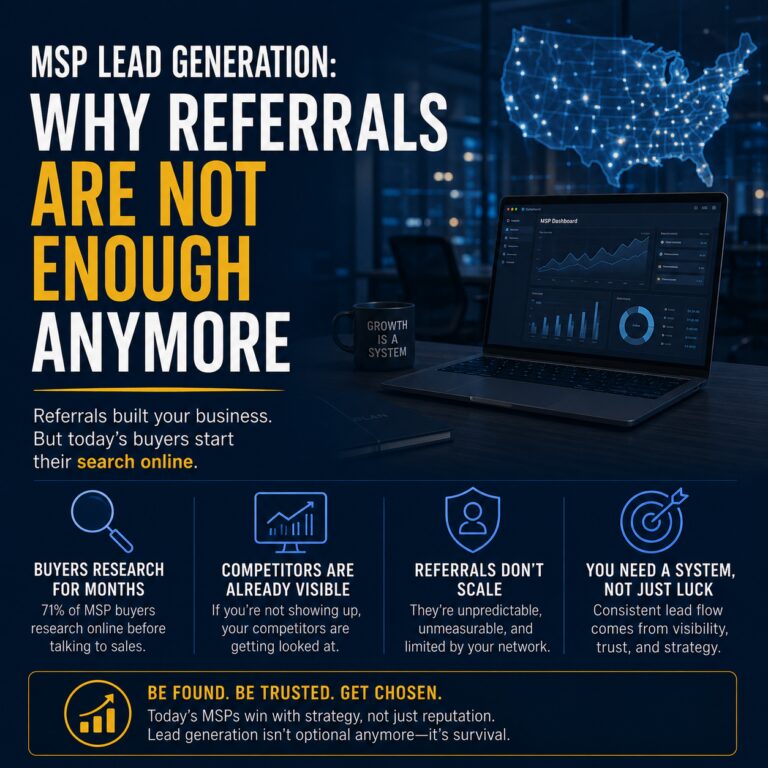
Why Referrals Alone Create Growth Problems
Referrals feel safe because they come from people who already trust you.
The problem is they limit control.
When referrals are the main source of leads, the MSP often has no clear answer to these questions:
How many leads will come next month?
What industries will they come from?
Will they need managed IT, cybersecurity, or one-off support?
Will they fit our pricing?
Will they value our expertise?
Will they close fast enough to support revenue goals?
A referral-based MSP often grows in uneven bursts.
One month looks strong. The next month feels quiet. Sales depends on timing, relationships, and luck.
That creates pressure when payroll, hiring, tools, vendors, and growth goals all need steady revenue.
A stronger lead generation system adds control.
The Buyer Has Changed
Business buyers research before they talk to sales.
They search Google. They read service pages. They compare competitors. They look at reviews. They ask AI tools for answers. They check LinkedIn. They look for proof.
By the time a buyer fills out a form, they already formed an opinion.
For MSPs, this matters.
A buyer might search:
managed IT services near me
best MSP for small business
co-managed IT provider
cybersecurity services for healthcare
Microsoft 365 support company
IT support for law firms
CMMC compliance support
managed security services provider
If your MSP does not show up during the research phase, another provider gets the opportunity.
That does not mean referrals lose value.
It means referrals should work alongside search visibility, content, ads, and website conversion.
The MSP Lead Generation Problem
Most MSPs do not have a service problem.
They have a visibility and conversion problem.
The company knows how to support clients. The team understands tickets, networks, security, cloud platforms, vendors, and user issues.
The website often fails to communicate that value clearly.
Common problems include:
Generic messaging
Weak service pages
No industry-specific content
No clear lead offer
Limited case studies
Poor local SEO
No Google Ads strategy
No AI search strategy
No clear follow-up path
No proof near conversion points
This creates a frustrating situation.
The MSP does good work, but buyers do not see enough online to choose them.
Good service alone does not create consistent lead flow.
Why SEO Matters for MSP Lead Generation
SEO helps MSPs get found by buyers already searching for help.
Strong SEO connects your website to searches tied to managed IT, cybersecurity, Microsoft 365, cloud services, compliance, backup, and support.
The strongest MSP SEO strategy focuses on buyer intent.
Examples of high-intent keywords:
managed IT services provider
IT support company
MSP for healthcare
co-managed IT services
cybersecurity services for small business
Microsoft 365 management
backup and disaster recovery services
managed security services provider
IT compliance support
cloud security services
These searches often come from buyers with a clear need.
SEO helps capture that demand without relying only on referrals.
MSP SEO should include:
Dedicated service pages
Industry pages
Location pages
Blog content tied to buyer questions
Internal linking
Review strategy
Technical site cleanup
Google Business Profile optimization
Conversion-focused page structure
Search visibility brings the buyer in.
The website must turn that visit into a lead.
Why Google Ads Helps MSPs Move Faster
SEO takes time.
Google Ads gives MSPs a faster way to test demand, capture high-intent searches, and send buyers to focused landing pages.
For MSPs, Google Ads works best when campaigns avoid broad traffic and focus on specific buyer intent.
Examples:
managed IT services for businesses
IT support company near me
cybersecurity services provider
co-managed IT services
Microsoft 365 support company
backup and disaster recovery provider
The landing page matters as much as the keyword.
Sending paid traffic to a vague homepage wastes money.
A strong MSP ad strategy sends each searcher to a page that matches the problem they searched.
Managed IT searches should land on a managed IT page.
Cybersecurity searches should land on a cybersecurity page.
Compliance searches should land on a compliance page.
Microsoft support searches should land on a Microsoft 365 page.
That improves relevance, trust, and conversion.
The Website Has to Support the Sale
Lead generation breaks when the website does not support the buyer journey.
An MSP website should answer the questions buyers ask before they contact a provider.
Those questions often include:
Do they work with companies like mine?
Do they understand my industry?
Do they handle cybersecurity?
What happens during onboarding?
How fast do they respond?
Do they support Microsoft 365?
Do they offer co-managed IT?
Do they understand compliance?
What proof do they have?
What should I do next?
If those answers are missing, the buyer leaves.
A strong MSP lead generation website includes:
Clear positioning
Service-specific pages
Industry-specific pages
Reviews
Case studies
Strong CTAs
Helpful FAQs
Proof above the fold
Simple contact paths
Clear next steps
The website should reduce doubt before the sales call.
Content Should Support Revenue
MSP blog content often misses the point.
Many companies publish basic articles that sound like they came from a generic IT content calendar.
Topics like:
5 Benefits of Managed IT
Why Cybersecurity Matters
What Is Cloud Computing?
How to Protect Your Business
These topics are not always wrong, but they need stronger intent, depth, and connection to revenue.
Better MSP content answers the questions buyers ask when they are closer to making a decision.
Examples:
How to Choose a Managed IT Provider
What to Ask Before Switching MSPs
MSP vs MSSP: What Is the Difference?
When Does a Business Need Co-Managed IT?
What Should Be Included in Managed IT Services?
How Much Do Managed IT Services Cost?
What Makes an MSP a Good Fit for Healthcare?
Why Slow IT Response Times Cost More Than You Think
This type of content supports sales conversations.
It also gives Google and AI search tools clearer signals about expertise.
AI Search Changes the Lead Generation Path
Buyers now ask AI tools for vendor research, comparisons, definitions, and strategy questions.
That changes how MSPs need to approach content.
AI search pulls from clear, structured, specific content. Thin service pages and generic blogs are easier to skip.
MSP content should include:
Question-based headings
Direct answers
Clear service definitions
Comparison sections
Industry examples
FAQ sections
Proof points
Internal links
Specific service language
For example, instead of writing a broad page about IT support, an MSP should answer:
What does managed IT support include?
How is co-managed IT different from fully managed IT?
What cybersecurity services should an MSP provide?
How does an MSP support Microsoft 365?
What should a business expect during MSP onboarding?
This structure helps buyers and AI tools understand what the MSP offers.
Why Proof Matters in MSP Lead Generation
MSP buyers are cautious.
Many have dealt with bad IT support, unclear billing, poor response times, unresolved tickets, weak cybersecurity, or vendors who disappeared after the sale.
Proof helps rebuild trust before the sales call.
Strong proof includes:
Client reviews
Case studies
Before and after results
Industry experience
Certifications
Partner status
Response process
Retention data
Client success stories
Security frameworks supported
Specific outcomes
Proof should appear throughout the website, not only on a testimonials page.
Place proof near service descriptions, CTAs, landing pages, and sales-focused content.
A buyer should not have to search for reasons to trust you.
What a Strong MSP Lead Generation Strategy Looks Like
A strong MSP lead generation strategy has several moving parts working together.
- Clear Positioning
The MSP should clearly define who it serves, what problems it solves, and why it stands apart.
Example:
Managed IT and cybersecurity support for growing businesses that need faster response, stronger security, and clearer technology leadership.
- SEO Built Around Buyer Intent
The website should target searches tied to services, industries, locations, and decision-stage questions.
- Google Ads for High-Intent Demand
Paid search should focus on buyers already looking for managed IT, cybersecurity, Microsoft support, or compliance help.
- Website Conversion Strategy
The website should turn traffic into calls, forms, assessments, or discovery calls.
- Proof-Based Content
Case studies, reviews, client examples, and process explanations should support trust.
- AI-Ready Content
Content should use clear questions, direct answers, FAQs, definitions, and internal links.
- Follow-Up Process
Lead generation does not end with the form fill. The MSP needs a clear process for responding, qualifying, nurturing, and tracking leads.
Common MSP Lead Generation Mistakes
MSPs lose leads when the strategy is too broad or too passive.
Common mistakes include:
Relying only on referrals
Sending all paid traffic to the homepage
Using the same message as every competitor
Ignoring Google Business Profile
Publishing generic blog content
Failing to build service pages
Having no lead tracking
Using weak CTAs
Not showing proof
Ignoring AI search behavior
Targeting traffic instead of qualified buyers
These mistakes are fixable.
The first step is seeing the website and search strategy through the buyer’s eyes.
How 1×1 Impression SEO Helps MSPs Build Better Lead Flow
1×1 Impression SEO helps MSPs, MSSPs, cybersecurity companies, and IT service providers build lead generation systems tied to search intent, website conversion, Google Ads, and AI visibility.
We look at the full path from search to sales conversation.
That includes:
What buyers search
Which pages should exist
Which keywords matter
Where the website loses trust
What proof is missing
How Google Ads should support SEO
How content should answer buyer questions
How service pages should convert
How AI search should shape content
The goal is not more traffic for the sake of traffic.
The goal is better visibility from the right buyers.
Final Takeaway
Referrals are valuable, but they should not carry the full weight of MSP growth.
A stronger MSP lead generation strategy gives your company more control over visibility, lead quality, and sales pipeline.
SEO helps buyers find you.
Google Ads helps capture demand faster.
Your website turns interest into action.
Content builds trust.
Proof reduces doubt.
AI-ready structure supports the way buyers search now.
If your MSP relies too heavily on referrals, 1×1 Impression SEO helps build a stronger path from search visibility to qualified leads.
FAQ Section
What is MSP lead generation?
MSP lead generation is the process of attracting qualified businesses that need managed IT, cybersecurity, cloud services, compliance support, or technical support. A strong strategy uses SEO, Google Ads, website conversion, content, reviews, and follow-up.
Why are referrals not enough for MSP growth?
Referrals are valuable, but they are unpredictable. They do not always bring the right clients, enough volume, or steady pipeline. MSPs need search visibility and website conversion to create more control over lead flow.
How does SEO help MSPs get leads?
SEO helps MSPs show up when buyers search for managed IT services, cybersecurity support, co-managed IT, Microsoft 365 help, cloud services, compliance support, and local IT providers. Strong SEO connects the MSP with buyers who already have intent.
Should MSPs use Google Ads?
Yes. Google Ads helps MSPs capture high-intent searches faster while SEO builds long-term visibility. Paid search works best when ads point to focused landing pages, not vague homepages.
What kind of content helps MSPs generate leads?
Content that answers buyer questions helps MSPs generate leads. Strong topics include how to choose an MSP, MSP vs MSSP, managed IT pricing, co-managed IT, cybersecurity services, Microsoft 365 support, and industry-specific IT needs.
How does AI search affect MSP lead generation?
AI search favors clear, structured, specific content. MSPs should use question-based headings, direct answers, FAQs, service definitions, comparison sections, proof points, and internal links to improve visibility in AI-generated answers.