he situation
An HVAC company came to us with a familiar story. The phones were slower than they should have been for the size of their market and the quality of their work. They were doing good jobs, keeping customers happy, and watching competitors with worse reputations get more calls.
They had a Google Business Profile. It had been set up years earlier, probably in an afternoon, and mostly left alone since. Some photos from whenever the account was created. A handful of reviews that trickled in on their own. Basic info that was partly outdated. Nobody was doing anything wrong, exactly. Nobody was doing anything at all.
That is the most common state we find profiles in. Not broken. Abandoned. And an abandoned profile does not just underperform. It actively loses ground every month, because Google’s local rankings are competitive, and the competitors are not standing still.
Why profiles decay
Before the rebuild, it is worth understanding why a profile that “worked fine” years ago stops working. Three forces are at play. Google keeps adding profile features, and profiles that ignore new fields look less complete relative to profiles that use them. Competitors keep accumulating reviews, so a review count that was respectable in 2022 is thin now. And Google’s systems reward activity, so a dormant profile gradually reads as a business that might not be fully operational.
None of this shows up as an alert. The profile just quietly slides down the map pack, and the owner experiences it as “the phones are slow.”
What we rebuilt, element by element
Categories. The primary category was too generic and secondary categories were missing entirely. The primary category is the strongest relevance signal on the profile, so we matched it to the core revenue service, then added secondary categories covering the rest of the business. This alone expands the range of searches the profile can appear for.
Services. Every service the company offers got listed with a description written for search intent. AC repair, furnace installation, duct work, maintenance plans, and the rest, each as its own entry with plain-language descriptions of what is included. Google matches services to searches. Every missing service is a set of searches the profile simply cannot win.
Photos. Real trucks, real techs, real completed jobs, uploaded on a schedule instead of dumped once. Photos do two jobs: they signal an active business to Google, and they answer the legitimacy question for every homeowner who checks the profile before calling.
Posts. Consistent publishing tied to seasonal demand: AC content in the spring, maintenance offers in shoulder seasons, heating content going into fall. Google rewards active profiles with visibility, and posts keep the profile fresh without touching the website at all.
Reviews. A request process built into the job completion workflow. Tech finishes the job, mentions the review in person, office sends the direct link within the hour. Reviews shifted from occasional and random to steady and predictable, which is exactly the pattern Google’s systems read as a trusted, active business.
Q&A. We seeded and answered the questions buyers actually ask before hiring an HVAC company: service areas, financing, emergency availability, brands serviced. The Q&A section is public real estate most businesses leave empty, and empty sections get filled by strangers or not at all.
The results
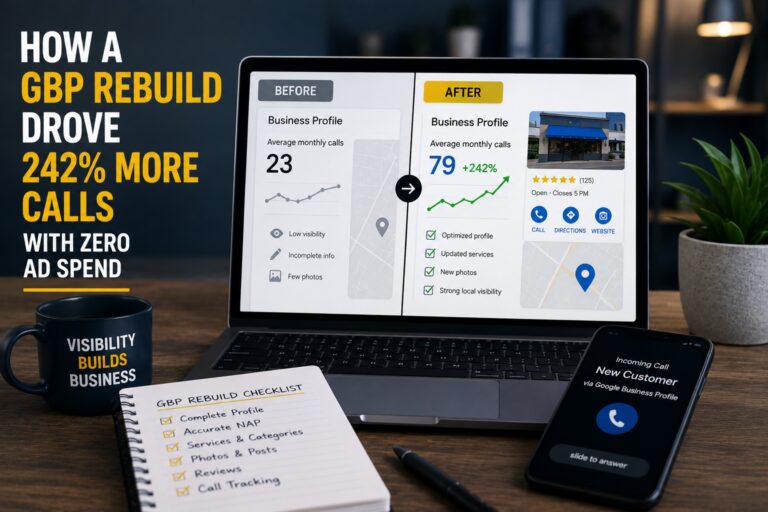
Inbound calls from the profile rose 242%. Website clicks rose 80.8%. Overall profile interactions rose 44.3%.
Ad spend during this period: zero. No new website. No paid campaigns. The same company, the same market, the same services, with the free asset finally doing its job.
How to audit your own profile this week
You can run a rough version of our audit in twenty minutes. Pull up your profile as a customer would see it and ask six questions. Is the primary category the service that makes you the most money? Is every service you sell listed with a description? Are your photos real, recent, and being added regularly? When was your last post? When was your last review, and was the one before that within the same month? Is the Q&A section answered by you, or by nobody?
Every “no” on that list is performance being left on the table. Most profiles we audit have four or more.
What this means for your business
Most local businesses are sitting on the same untapped asset. The profile exists, so it feels handled. It is not handled. A complete, active, optimized profile is the difference between being on the map and being in the map pack, and only one of those gets calls.
The other lesson from this case: the fix did not require more budget. It required the existing asset to be taken seriously. Before spending another dollar on ads, make the free channel work. Everything paid performs better on top of it.
[Internal link: GBP page on “optimized profile” / Case studies hub on “results”]
FAQ
How much can GBP optimization increase calls?
Results vary by market and starting condition, but the upside is real. One HVAC client saw inbound calls rise 242% after a full profile rebuild, with website clicks up 80.8%, all without ad spend. Neglected profiles leave that kind of performance on the table.
How long does GBP optimization take to work?
Most businesses see meaningful map pack movement within 60 to 90 days of a full rebuild. Profiles with consistent review velocity and active posting move fastest. GBP results typically arrive faster than organic website SEO because the profile competes in a smaller local field.
Your profile is probably leaving calls on the table. Book a free GBP audit and find out how many.