Cybersecurity companies have a visibility problem.
The service is valuable. The need is real. The buyer pain points are serious. Yet many cybersecurity websites fail to show up when decision makers search for managed security, compliance support, cloud security, threat detection, Microsoft security, or government cloud help.
SEO for cybersecurity companies is different from standard business SEO. The buyer is more cautious. The services are more complex. The sales cycle is longer. Trust matters before a lead ever fills out a form.
A strong cybersecurity SEO strategy helps your company show up in the exact moments when buyers are already looking for help.
What Is SEO for Cybersecurity Companies?
SEO for cybersecurity companies is the process of improving website visibility for searches tied to cybersecurity services, managed security, compliance, cloud security, threat detection, risk management, and IT protection.
The goal is not random traffic.
The goal is qualified visibility.
A cybersecurity company should rank for searches tied to buyer intent, such as:
managed security services provider
MSSP for healthcare
CMMC compliance support
GCC High migration partner
Microsoft security consulting
cloud security services
endpoint detection and response
security operations center services
HIPAA cybersecurity support
zero trust security services
These searches signal a buyer with a problem, a timeline, and a need for a trusted provider.
Why Cybersecurity SEO Is Different
Cybersecurity buyers do not behave like casual shoppers.
They research. They compare. They check proof. They look for signs of industry knowledge. They need to know whether your company understands their risk, compliance requirements, internal pressure, and technical environment.
This is why generic marketing content falls flat for IT and cyber companies.
A page saying “we protect your business from cyber threats” is not enough. Every provider says some version of it.
Strong cybersecurity SEO speaks to the actual search behind the service.
A healthcare organization searching for HIPAA cybersecurity support has a different concern than a defense contractor searching for CMMC and GCC High support. A CFO comparing MSSPs has different questions than an IT director looking for endpoint detection and response.
The best cybersecurity SEO strategy builds content around those differences.
The Biggest Mistake Cybersecurity Companies Make With SEO
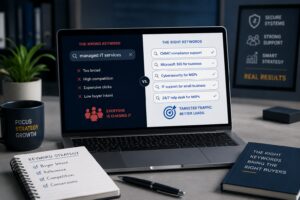
Many cybersecurity companies organize their websites around what they sell, not how buyers search.
That creates a gap.
A company might offer managed security, compliance consulting, Microsoft cloud security, endpoint protection, and incident response. Yet the website might only have broad pages like:
Cybersecurity Services
Managed IT
Cloud Services
Compliance
Consulting
Those pages are too broad to compete in search. They also fail to answer the detailed questions buyers ask before taking action.
A better structure breaks services into search-focused pages tied to specific intent.
Examples:
Managed Security Services for Healthcare Organizations
CMMC Compliance Support for Defense Contractors
Microsoft 365 Security Consulting
GCC High Migration and Support
Cloud Security Services for Regulated Companies
Endpoint Detection and Response Services
Security Operations Center Services
Zero Trust Security Planning
Each page should answer one clear buyer need.
That gives Google, AI search tools, and human buyers a stronger reason to trust the page.
Why Buyer Intent Matters More Than Traffic
Cybersecurity companies do not need thousands of low-quality visits.
They need search visibility from the right people.
High-intent searches often come from buyers who already know they need help. They might be comparing providers, preparing for compliance requirements, reacting to a security concern, or trying to find a partner with specific expertise.
A strong SEO strategy separates traffic into three levels.
- Informational intent:
The buyer is researching a topic.
Example: What is CMMC compliance? - Commercial intent:
The buyer is comparing options.
Example: Best CMMC consultant for government contractors - Service intent:
The buyer is ready to find help.
Example: CMMC compliance support provider
Cybersecurity companies need all three, but the strategy should give priority to commercial and service intent. These terms bring fewer visitors than broad educational keywords, but they bring stronger leads.
This is where many SEO campaigns go wrong. They chase traffic volume instead of revenue opportunity.
How Compliance Keywords Create Better Leads
Compliance-related keywords are some of the strongest SEO opportunities for cybersecurity companies.
Why?
Compliance searches often come with a business deadline, internal pressure, board concern, contract requirement, audit concern, or sales opportunity attached.
Examples include:
CMMC
NIST 800-171
DFARS
SPRS
GCC High
FedRAMP
HIPAA
SOC 2
PCI DSS
Azure Government
Microsoft 365 GCC High
These keywords do more than attract traffic. They signal urgency and need.
For example, a defense contractor searching for GCC High support likely has a contract requirement, customer pressure, or compliance obligation. A healthcare organization searching for HIPAA cybersecurity help likely needs a provider who understands risk, data protection, access controls, and audit concerns.
Compliance SEO works best when content explains:
Who the service is for
What problem it solves
What risk the buyer is trying to reduce
What happens if the issue gets ignored
What steps the provider takes
What proof supports the provider’s experience
What action the buyer should take next
This structure helps both search engines and buyers understand the page.
Why Service Pages Matter More Than Blog Posts Alone
Blog posts help build authority, but service pages drive action.
A cybersecurity company should not rely only on blog content to bring in leads. Blogs answer questions and support topical authority. Service pages convert visitors into calls, forms, and sales conversations.
A strong cybersecurity website needs both.
Service pages should target high-intent keywords. Blog posts should support those service pages with related questions, definitions, comparisons, and buyer education.
Example content cluster:
Main service page:
CMMC Compliance Support
Supporting blogs:
What Is CMMC Level 2?
CMMC vs NIST 800-171
What Defense Contractors Need to Know About SPRS Scores
How GCC High Supports CMMC Readiness
Why CMMC Compliance Is an Ongoing Operating Requirement
This gives Google a clearer picture of expertise. It also gives buyers a stronger path from research to inquiry.
How AI Search Changes Cybersecurity SEO
AI search is changing how buyers find and compare companies.
Search results are no longer limited to blue links. AI Overviews, AI Mode, answer engines, and citation-based summaries are pulling content from pages with clear answers, strong structure, proof, and topical depth.
This matters for cybersecurity companies because buyers often ask detailed, problem-based questions.
Examples:
What type of MSSP does a healthcare company need?
Who helps defense contractors with GCC High?
What is the difference between managed IT and managed security?
How do I reduce CMMC scope?
What should a cybersecurity service page include?
What is the best way to protect Microsoft 365 from phishing?
To earn visibility in AI-generated answers, cybersecurity content should be easy to parse.
That means:
Clear question-based headings
Direct answers near the top of each section
Specific terms tied to the buyer’s industry
Definitions where needed
Comparison sections
Proof points
FAQ sections
Service-specific pages
Internal links between related topics
AI search rewards content that answers real questions without hiding the point.
Cybersecurity companies need content written for both human decision makers and machine-generated summaries.
What a Strong Cybersecurity SEO Strategy Should Include
A strong SEO strategy for cybersecurity companies should include six core pieces.
- Service Pages Built Around Search Intent
Each core service needs its own page. The page should target one clear search theme.
Examples:
Managed Security Services
Security Operations Center Services
CMMC Compliance Support
GCC High Consulting
Microsoft 365 Security
Cloud Security Services
Incident Response
Endpoint Detection and Response
HIPAA Cybersecurity Services
One page should not try to rank for every service.
- Industry Pages for High-Value Buyers
Cybersecurity buyers often search by industry.
Examples:
Cybersecurity for Healthcare
Cybersecurity for Defense Contractors
Cybersecurity for Financial Services
Cybersecurity for Government Contractors
Cybersecurity for Manufacturing
Cybersecurity for Professional Services
Industry pages help buyers see relevance faster. They also support stronger SEO for vertical-specific searches.
- Compliance Content
Compliance content builds authority and attracts high-intent traffic.
This works especially well for cybersecurity firms serving regulated industries, defense contractors, healthcare organizations, finance, government, and enterprise companies.
- Blog Content With a Sales Purpose
Every blog should support a larger business goal.
A blog should connect to a service, industry, compliance need, sales objection, or buyer question.
Content with no connection to lead generation becomes noise.
- Proof and Case Studies
Cybersecurity buyers need confidence.
Case studies, results, certifications, partner status, client examples, process breakdowns, and sales outcomes help reduce doubt.
For example, at 1×1 Impression SEO, our IT and cybersecurity work has helped support major growth stories, including an IT company with a $600K annual sales goal that produced over $3M after SEO, ads, and LinkedIn improvements. That company later sold, and the marketing strategy remained valuable through the transition.
Proof matters because cyber buyers do not want generic promises. They want evidence.
- Google Ads and SEO Working Together
SEO builds long-term visibility. Google Ads captures high-intent demand faster.
For cybersecurity companies, this matters because keywords like MSSP, CMMC, cloud security, and managed security services often have strong commercial intent.
The smartest strategy uses SEO and paid search together.
SEO builds authority over time.
Google Ads tests keyword demand.
Landing pages improve conversion.
Search data helps guide content.
Content improves trust before the sales call.
This creates a stronger buyer path from search to lead.
What Cybersecurity Companies Should Avoid
Cybersecurity SEO fails when it becomes too vague.
Avoid pages filled with broad phrases like:
protect your business
secure your future
modern security solutions
advanced technology
end-to-end support
trusted partner
peace of mind
Those phrases do not create differentiation. They also fail to match the way buyers search.
Instead, use clear language tied to real services, industries, risk, compliance, and buyer needs.
Better examples:
CMMC compliance support for defense contractors
Managed security services for healthcare organizations
Microsoft 365 security consulting for regulated businesses
GCC High migration support
SOC monitoring for growing IT teams
Endpoint detection and response for mid-market companies
Specificity wins.
How Cybersecurity Companies Turn SEO Into Leads
SEO only matters when it supports business growth.
For cybersecurity companies, the path from search to lead should feel clear.
The visitor should understand:
What you do
Who you help
What problem you solve
Why your experience matters
What makes your process credible
What action to take next
A page should not make the buyer work to figure this out.
Every service page needs a strong opening, clear sections, proof, FAQs, internal links, and a direct call to action.
A strong CTA for cybersecurity SEO might sound like:
Need stronger visibility for your cybersecurity company? 1×1 Impression SEO helps MSPs, MSSPs, cybersecurity firms, and IT companies turn search visibility into qualified leads. Schedule a free discovery call and let’s look at where your buyers are searching.
Why 1×1 Impression SEO Works With Cybersecurity Companies
Cybersecurity marketing requires more than standard SEO.
It requires understanding the buyer, the technical language, the compliance pressure, the sales cycle, and the difference between traffic and qualified demand.
At 1×1 Impression SEO, we help IT, MSP, MSSP, and cybersecurity companies build search strategies tied to real buyer intent.
Our work focuses on:
SEO strategy
Service page optimization
AI search visibility
Google Ads
Landing pages
LinkedIn authority
Case study development
High-intent keyword strategy
Compliance content
Lead generation
We understand the difference between ranking for generic IT terms and showing up when a serious buyer searches for help.
That difference matters.
Final Takeaway
Cybersecurity companies do not need more content for the sake of content.
They need SEO built around buyer intent, trust, proof, compliance language, service clarity, and AI-ready structure.
The right strategy helps your company show up when buyers search for the exact services you offer. It also helps buyers understand why your company deserves the conversation.
If your cybersecurity company, MSP, or MSSP wants better visibility from buyers already searching, 1×1 Impression SEO helps turn that visibility into qualified leads.
FAQ Section
What is SEO for cybersecurity companies?
SEO for cybersecurity companies improves search visibility for services like managed security, compliance support, threat detection, cloud security, endpoint protection, Microsoft security, and IT risk management. The goal is to attract qualified buyers who are already searching for help.
Why is cybersecurity SEO different from regular SEO?
Cybersecurity SEO is different because the buyer journey is more technical, trust-driven, and risk-focused. Buyers need proof, clear service information, compliance knowledge, and signs of industry expertise before they contact a provider.
What keywords should cybersecurity companies target?
Cybersecurity companies should target high-intent keywords tied to services, industries, and compliance needs. Examples include managed security services, MSSP, CMMC compliance support, GCC High consulting, cloud security services, endpoint detection and response, HIPAA cybersecurity, and Microsoft 365 security.
Do MSPs and MSSPs need SEO?
Yes. MSPs and MSSPs need SEO because buyers often search before they contact a provider. Strong SEO helps IT and security companies show up for service-based, industry-based, and compliance-based searches.
How does AI search affect cybersecurity SEO?
AI search favors content with clear answers, strong structure, helpful definitions, proof, and specific expertise. Cybersecurity companies need question-based content, service pages, comparison sections, and FAQs to improve visibility in AI-generated search answers.
Should cybersecurity companies use Google Ads with SEO?
Yes. Google Ads helps capture high-intent searches while SEO builds long-term authority. For cybersecurity companies, paid search and SEO work well together because keyword data, landing pages, and content strategy all support better lead quality.